By Deepti Yenireddy, CEO, Boon AI
Ask any estimator how confident they are in a conceptual budget, and you’ll get a pause. Then a diplomatic answer about “ranges” and “contingencies” and “the level of design information available.”
Translation: they’re guessing. Educated guessing, informed by years of experience, but guessing nonetheless.
This isn’t a criticism of estimators. It’s a criticism of the systems we’ve given them to work with. The gap between what’s possible with early-stage estimation and what actually happens in most firms is enormous. Closing it could be the single biggest competitive advantage in preconstruction today.
The Scale of the Problem
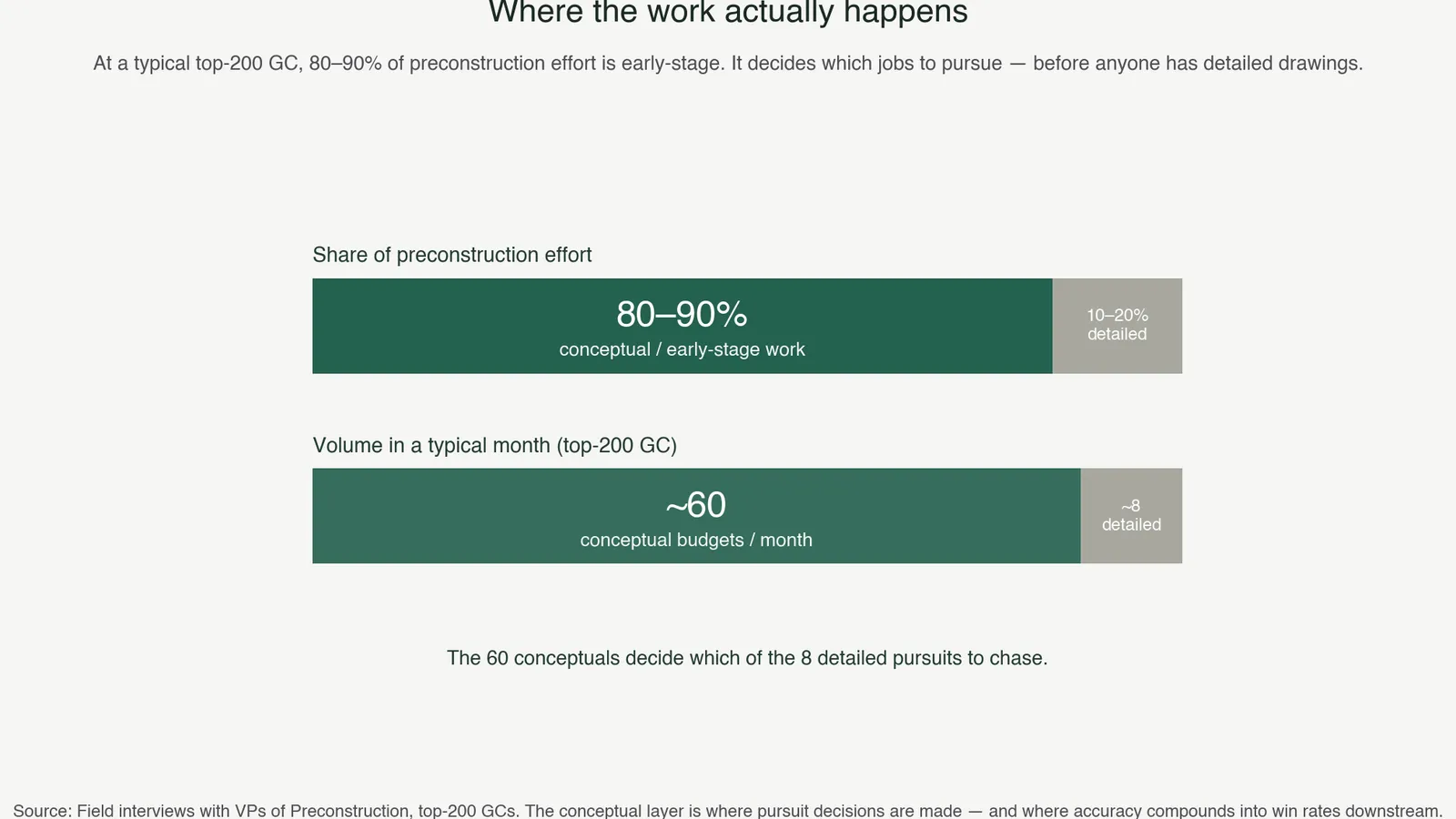
Here’s a number that surprised me when I first heard it: at some general contractors and subcontractors, 80-90% of their preconstruction work is conceptual or early-stage. Not detailed takeoffs from complete drawings. Not final pricing on a full set of CDs. Rough budgets. Feasibility numbers. “Can we build this for $X?” answers.
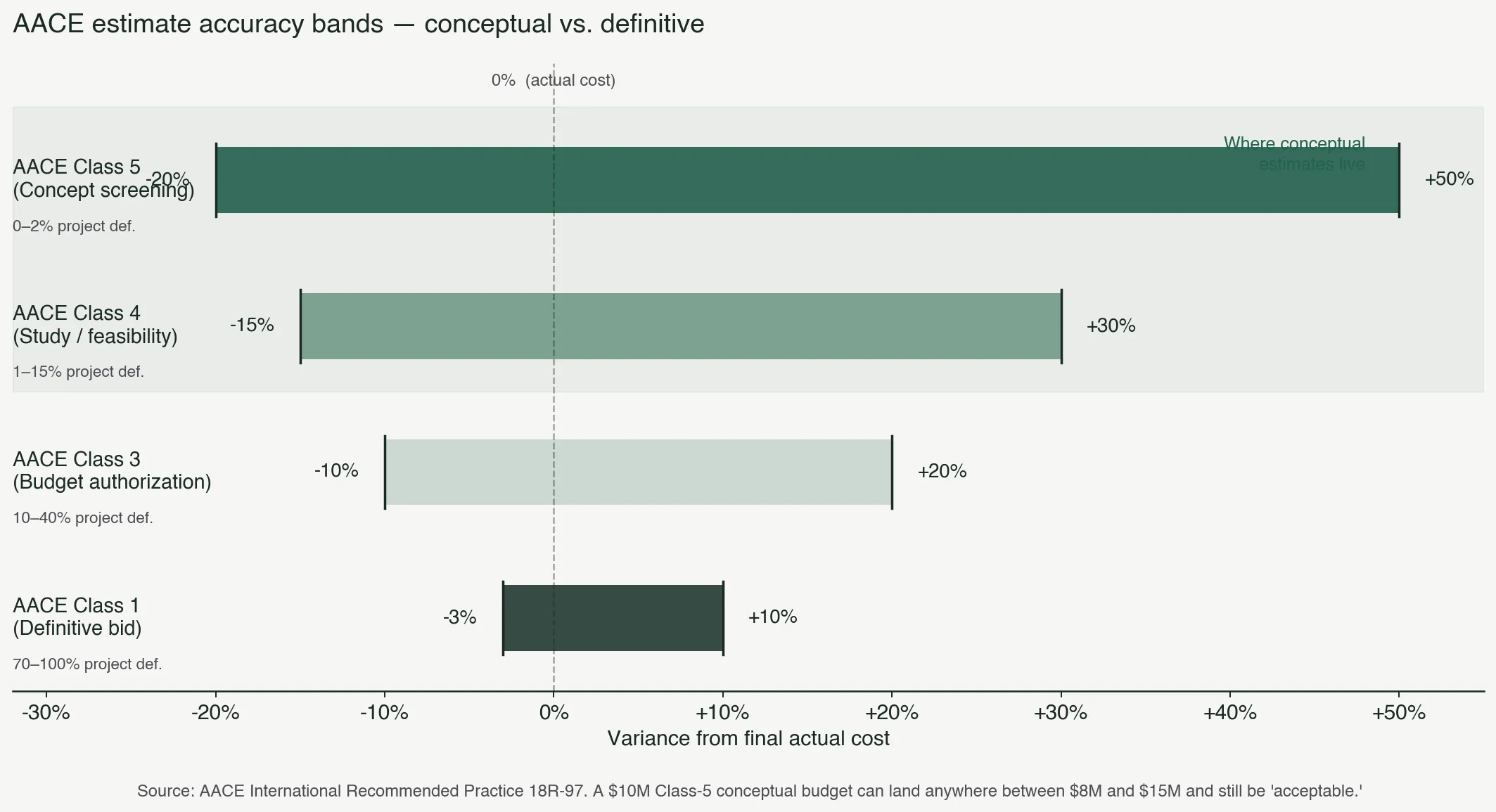
According to AACE International’s recommended practices , conceptual estimates (Class 5 and Class 4) carry accuracy ranges of -20% to +50% on the low end and -15% to +30% at best. That’s the industry standard. A $10M conceptual budget could land anywhere between $5M and $15M and still be within “acceptable” range.
For an owner making a go/no-go decision, that range is the difference between a viable project and a disaster. For a GC trying to win work, it’s the difference between a competitive number and losing the bid entirely.
“We give conceptual budgets on maybe 60 projects a month. Full detailed estimates on maybe 8 of those. The 60 determine which 8 we pursue. If our conceptual numbers are wrong, we’re chasing the wrong work.”, VP of Preconstruction, Top 200 GC
Why Conceptual Estimates Are Unreliable
The core problem is straightforward: conceptual estimates require information that doesn’t exist yet, so estimators fill in the blanks from experience.
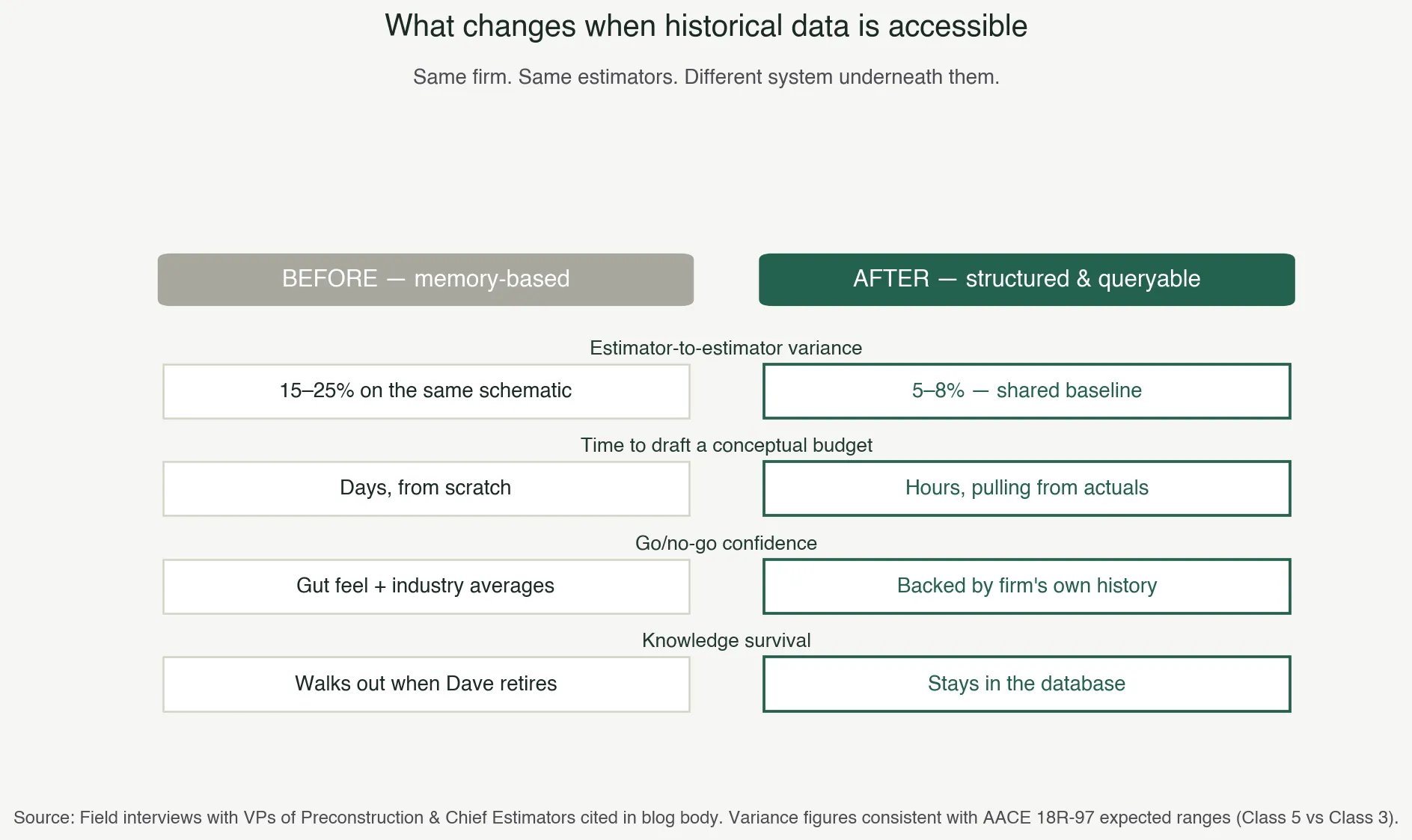
Experience is valuable. A senior estimator who has priced fifty healthcare projects can look at a schematic floor plan and produce a reasonable budget. But “reasonable” varies person to person. Two equally skilled estimators given the same schematic design will produce numbers that differ by 15-25%. Not because one is wrong. Because each is drawing on a different mental database of past projects, adjusted by their own assumptions about current conditions.
The RSMeans Cost Data guides that most firms reference provide national averages, but local conditions can swing costs 20-40% from those averages depending on labor markets, material availability, and regional building codes. Adjusting for those factors is where the art comes in, and where the variance lives.
“I have two senior estimators who’ve both been here fifteen years. Give them the same schematic, they’ll come back with numbers 20% apart. Both will be right in their own way. Neither will be right in the end.”, Chief Estimator, mechanical contractor
The inconsistency isn’t the estimator’s fault. It’s the system’s fault. Or more precisely, the lack of a system.
The Historical Data Trap
Every construction firm I talk to has historical project data. Years of it. Completed projects with final costs, quantities, labor hours, material prices. Five, seven, sometimes ten years of completed work sitting in project files.
Almost none of them can access it in a useful way.
The data is trapped. In spreadsheets on someone’s hard drive. In archived project folders on a shared server nobody searches. In an old estimating system that the new team doesn’t use. In the head of a senior estimator who retired last year.
A Procore-commissioned study found that the primary challenge with conceptual estimation is the absence of comprehensive documentation at the early stage, making historical comparison the most reliable method available, yet most firms lack organized access to their own past project data.
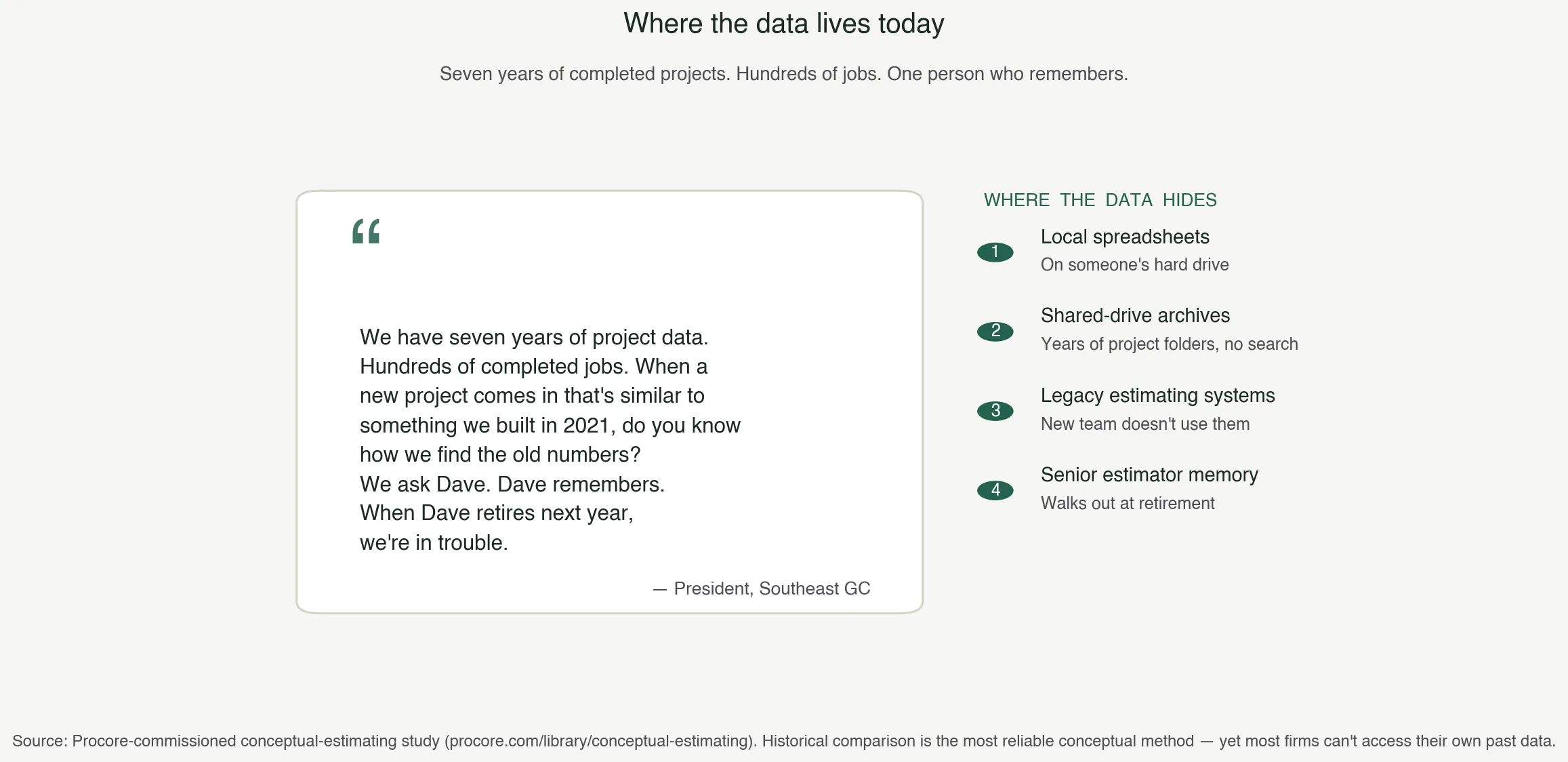
“We have seven years of project data. Hundreds of completed jobs. When a new project comes in that’s similar to something we built in 2021, do you know how we find the old numbers? We ask Dave. Dave remembers. When Dave retires next year, we’re in trouble.”, President, Southeast GC
What Accessible Historical Data Would Change
Imagine you’re estimating a 50,000 SF medical office building. Your firm has built four similar projects in the past five years. If you could instantly pull up the actual costs per square foot for each one, adjusted for inflation and location, you’d have a conceptual budget in minutes that’s based on your own real data, not national averages.
That’s not a fantasy. It’s what happens when historical project data is structured, searchable, and comparable.
Here’s what changes:
1. Consistency across estimators. When everyone draws from the same historical database rather than their own memory, conceptual budgets converge. The 20% variance between estimators shrinks to 5-8% because the baseline is shared.
2. Speed on early-stage work. Conceptual budgets that take days when built from scratch take hours when you can reference actuals from similar past projects. For firms processing 40-60 conceptual requests per month, that time savings frees up capacity for more detailed pursuits.
3. Confidence in go/no-go decisions. When your conceptual number is backed by your own historical data rather than industry averages and gut feel, you can pursue work with more confidence. You can also walk away from bad fits faster, saving the detailed bid effort for projects where you have a real shot.
4. Knowledge that survives turnover. The average tenure of a construction estimator at a single firm is roughly 4-6 years . When an estimator leaves, their institutional knowledge walks out the door. Structured historical data stays.
The Competitive Advantage Hiding in Your File Server
Your historical project data is your competitive advantage. If you can access it.
That qualifier matters. The data exists. The advantage doesn’t materialize until the data is structured, normalized, and queryable. Until a project manager can ask “what did MEP cost us per square foot on our last three healthcare projects in this market?” and get an answer in seconds rather than days.
The firms that figure this out gain something money can’t buy: institutional memory that doesn’t depend on any individual person. Every project they complete makes the next estimate better. Their accuracy compounds over time while competitors start from scratch with each new bid.
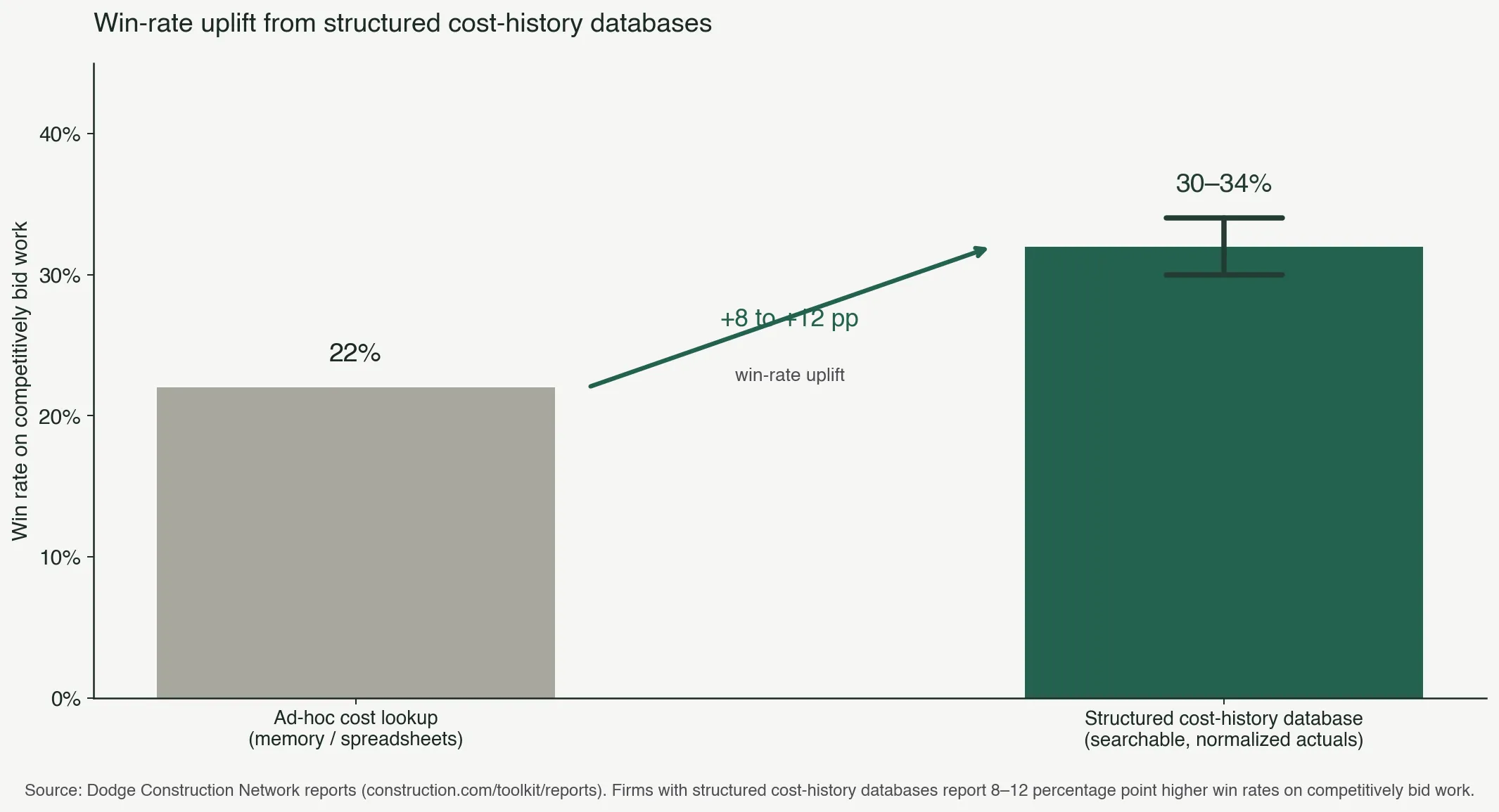
A Dodge Construction Network analysis noted that firms with structured cost history databases report win rates 8-12 percentage points higher on competitively bid work than firms relying on ad-hoc methods. The reason is simple: better data produces tighter numbers, and tighter numbers win bids without leaving money on the table.
What’s Actually Required
Closing the conceptual estimation gap isn’t a massive IT project. It requires three things:
First, a decision to treat historical data as an asset. Most firms treat completed project data as an archive, something to store and forget. The shift is treating it as a living resource that directly impacts future revenue.
Second, a structured way to capture and normalize cost data. This doesn’t mean rebuilding your entire tech stack. It means having a system that can ingest project actuals, tag them by building type, size, location, and trade, and make them searchable.
Third, tools that can bridge the gap between schematic designs and historical comps. AI construction takeoff software is making this possible in ways it wasn’t five years ago. Computer vision can analyze early-stage drawings and match them against similar past projects, pulling relevant cost data automatically.
None of this replaces the estimator’s judgment. All of it gives them a better starting point than a blank spreadsheet and a memory.
The Clock Is Ticking
Every month you operate without accessible historical data, you’re making conceptual decisions on incomplete information. You’re pricing work based on what one person remembers rather than what your firm actually knows. And you’re watching competitors who’ve figured this out win the work you should be winning.
The data is already yours. You’ve already paid for it, one completed project at a time, over years of hard work. The only question is whether you’ll unlock it before the next bid deadline, or keep asking Dave.
Sources
- AACE International Recommended Practices
- RSMeans Cost Data
- Conceptual Estimating. Procore
- BLS Occupational Outlook. Cost Estimators
- Dodge Construction Network Reports
Deepti Yenireddy is the CEO of Boon AI. She works with preconstruction teams to transform historical project data into a competitive advantage for conceptual estimation and early-stage budgeting.