Every month, HJD Capital’s leadership team met and asked the same question.
Where are we on the AI?
For four months, Mark Coshal, HJD’s senior electrical estimator, had the same answer. Not using it yet. The CEO had signed off on a significant AI investment. Four monthly meetings had come and gone. Four times Mark sat through the same conversation, listening to leadership grow more frustrated that the platform they were paying for hadn’t shipped a single hour back to the firm.
In the fifth meeting, the answer changed.
“He came in and asked. He was glad I finally got some use out of it, and that it was definitely picking up time.”
Mark Coshal, Electrical Estimator, HJD Capital
That meeting was the breakthrough the case study is built around. Not because the time savings were unprecedented. Because they were the first time the time savings landed inside HJD’s actual workflow, on an actual bid, in a form leadership could see.
This is the story of how an AI investment that was four months from being cancelled became a senior estimator’s worth of annual capacity, on the same headcount.
Why It Took Four Months
HJD doesn’t have a tooling problem. Mark works in AccuBid alongside LiveCount. Receptacle counts, fixture counts, circuit-by-circuit lighting. A workflow he’s sharpened over years.
What HJD has is a tooling-cost problem. Mark’s hours are the firm’s scarcest input. Every hour he spends clicking receptacles is an hour not spent on the calls that decide whether a bid wins or loses money. At HJD’s bid cadence, those clicks add up to a senior estimator’s entire week, every month.
The reason most AI bets in preconstruction stall isn’t that the AI can’t count. AI counting receptacles faster than a human has been true for a while. The reason they stall is that the AI runs in its own world. The estimator still has to translate the output into AccuBid by hand. The translation tax eats the gain. Four months in, the firm is paying for a tool the estimator doesn’t actually use.
That was HJD at the four-month mark.
What Changed in the Fifth Meeting
Two things landed at once.
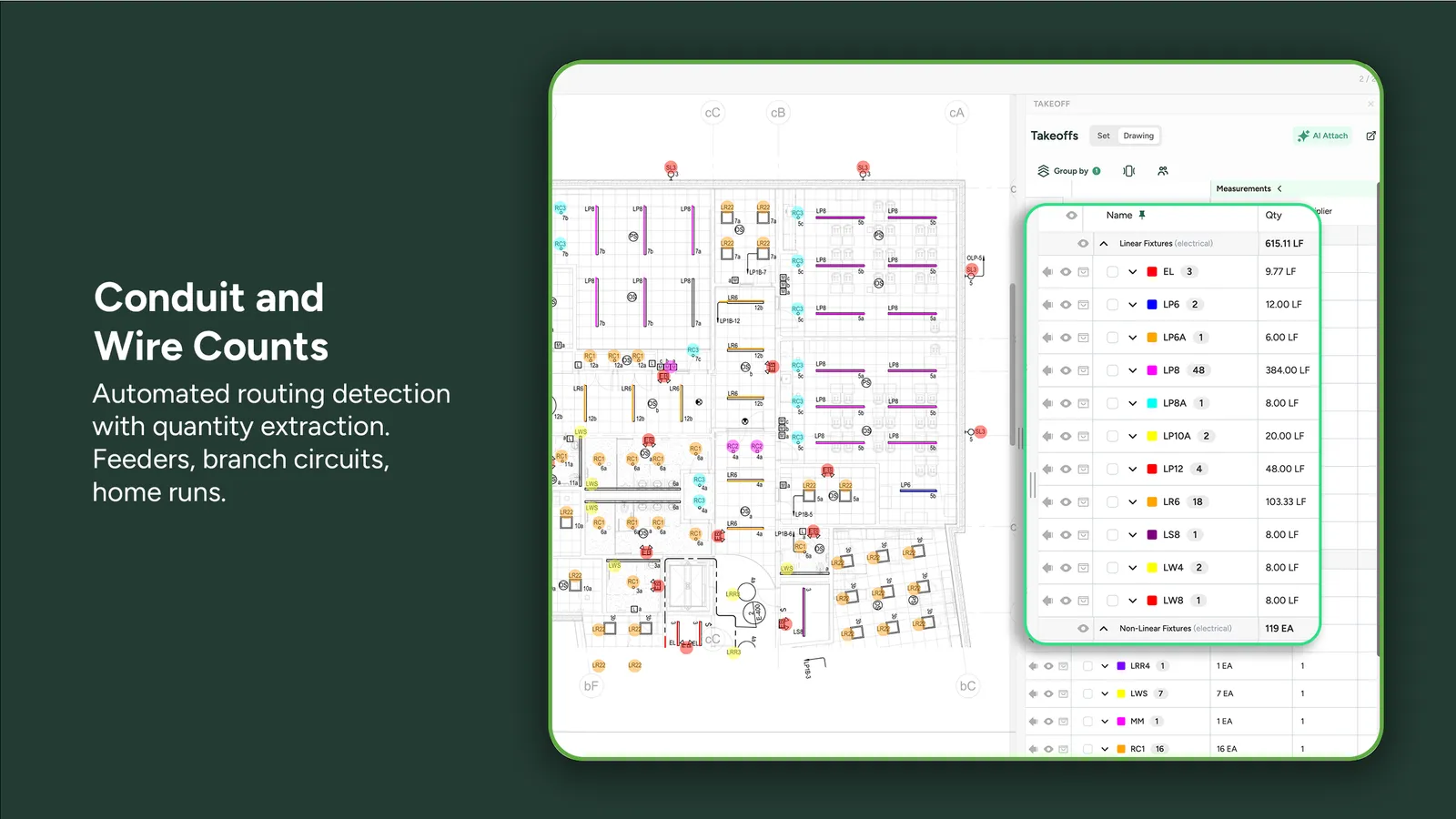
The first was home-run branching and switch detection running clean inside HJD’s drawings. That unlocked the second, which is the one that actually shipped the value: Excel export, structured the way an AccuBid user expects to see it.
That handoff is the moment the workflow clicked. Numbers come out of Boon already shaped for AccuBid import. No reformatting. No manual mapping. No second pass to translate the output. Mark runs the takeoff in Boon, pushes the file into AccuBid, and picks up where the takeoff ended.
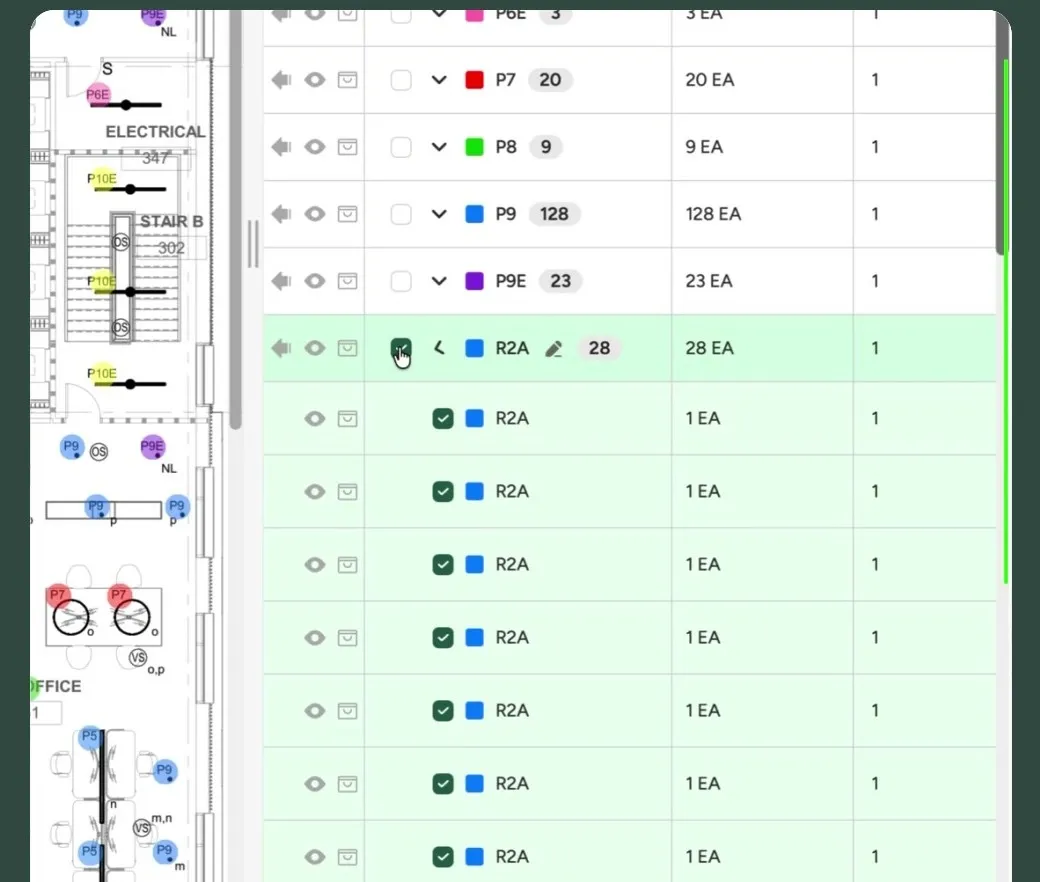
This is the part of vertical AI that gets undersold. Model accuracy matters, but workflow fit determines whether the investment pays off. HJD’s first four months were a model-without-workflow problem. The fifth meeting was the workflow finally being in place.
More Accurate Than the Tool It Replaced
The second surprise from the fifth meeting was about accuracy, and it came from Mark unprompted.
“Boon is more accurate than AccuBid’s visual takeoffs. You spend more time double-checking the live count than with the way Boon takes it off.”
Mark Coshal, Electrical Estimator, HJD Capital
This is not Boon vs nothing. This is Boon vs the visual-count tool a senior estimator has trusted for years. The verdict from inside that workflow is that the AI output needs less verification than the human-driven count it’s replacing.
Not because the human is sloppy. Because counting hundreds of small symbols on a dense power plan is the kind of work where human attention drifts and ours doesn’t. The AI doesn’t get tired on page 47.
For a CEO weighing whether to keep paying for AI, this is the claim that flips the conversation. The tool isn’t a faster way to do a worse job. It’s a faster way to do a better one.
The Math the CEO Asked About
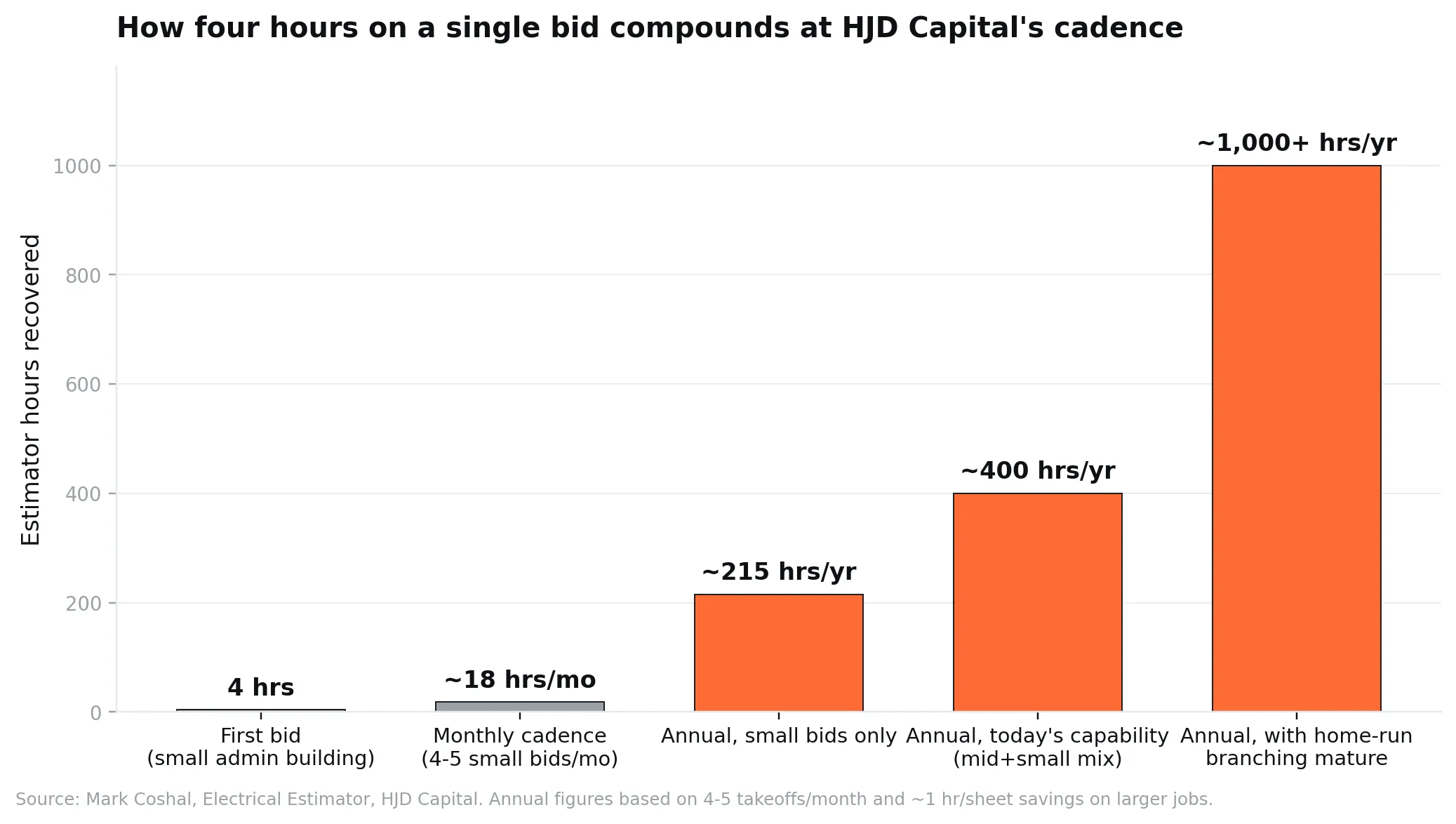
The first production project was an administrative building. Real takeoff, real bid, no sandbox. Mark estimated four hours saved on that single bid.
Four hours sounds small until you run the arithmetic against HJD’s cadence.
HJD runs four to five small-commercial bids a month. At four hours each, that’s sixteen to twenty hours every month, or roughly two hundred fifteen hours a year on the smallest projects alone. Before home-run branching is fully shipped. Before larger jobs.
Mark’s working baseline on larger jobs is roughly one hour saved per sheet, with another hour per sheet unlocking as home-run branching matures. His next bid is a two-story building with sixteen sheets of takeoff. Sixteen to twenty-four hours back on a single project.
Annualized across HJD’s actual mix of small and mid-size commercial work:
- ~400 estimator hours back per year at today’s capability
- ~1,000 estimator hours back per year once home-run branching ships at scale
A thousand hours is the better part of a full senior estimator FTE, recovered without adding a single hire. That’s the number the CEO asked about. That’s the number the four-month investment now produces.
What Did Not Happen
It would be easy to read the numbers and conclude that AI replaced a senior estimator. That isn’t what happened.
HJD didn’t lay anyone off. Mark is still running the bid, making the judgment calls, signing off on the number that goes to the client. What changed is the shape of his day. The hours that used to go to counting receptacles now go to pricing strategy, scope clarification, and the bid-level decisions that compound across a year of work.
Same estimator. Different day.
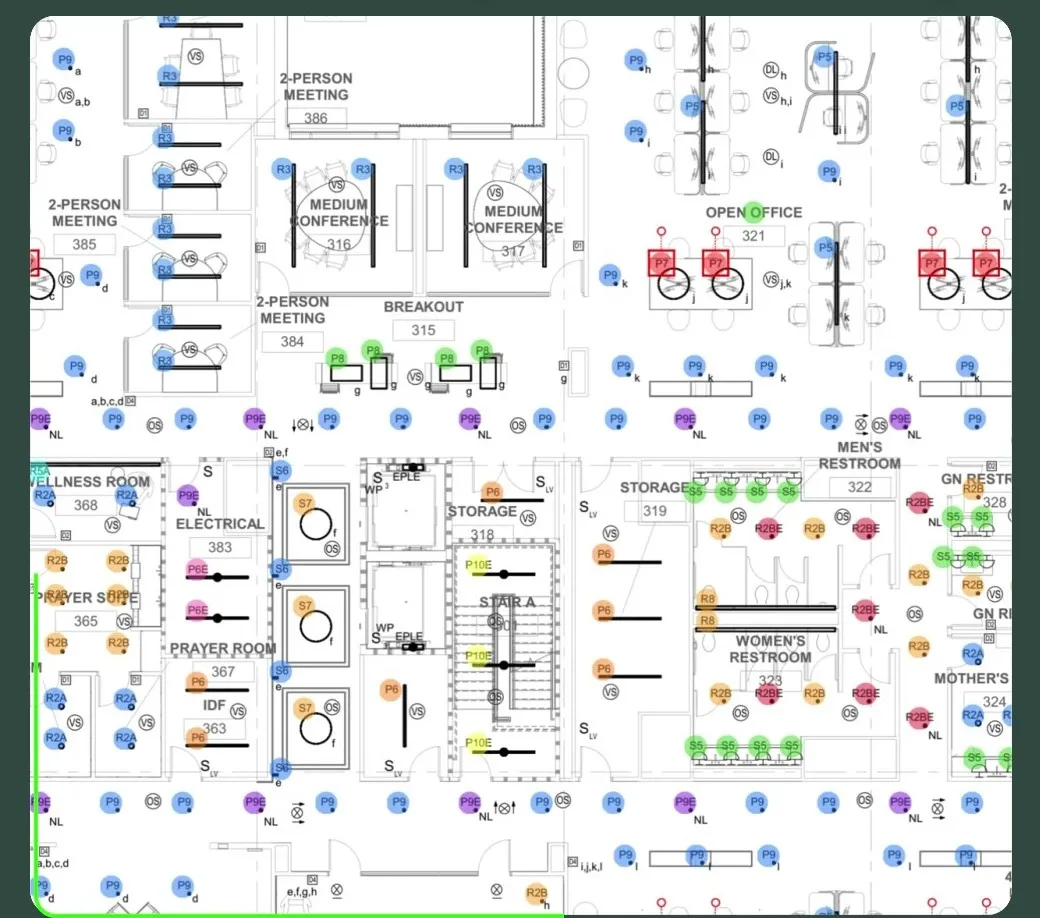
The interesting effect inside a preconstruction team isn’t headcount substitution. It’s capability expansion without headcount expansion. The same firm taking on more bids, or going deeper on each one, without hiring against the growth.
For HJD, that’s the bet. More bids, more competitive bids, same team. A thousand hours a year is the difference between a senior estimator running ten bids and the same estimator running fifteen, on the same calendar, at higher quality on every one.
What Is Running Today
The production stack at HJD, all running inside their existing AccuBid plus LiveCount workflow:
- Receptacle counting across power drawings
- Lighting fixture detection with multi-page schedule extraction
- Home-run detection and panel-circuit naming
- Excel export from Boon takeoff results into AccuBid
- Auto-count by symbol across fire alarm devices, security cameras, AV, and data and tech rough-ins
Every feature on that list is one Mark uses on live bids, not one we showed him in a demo.
What Is Next
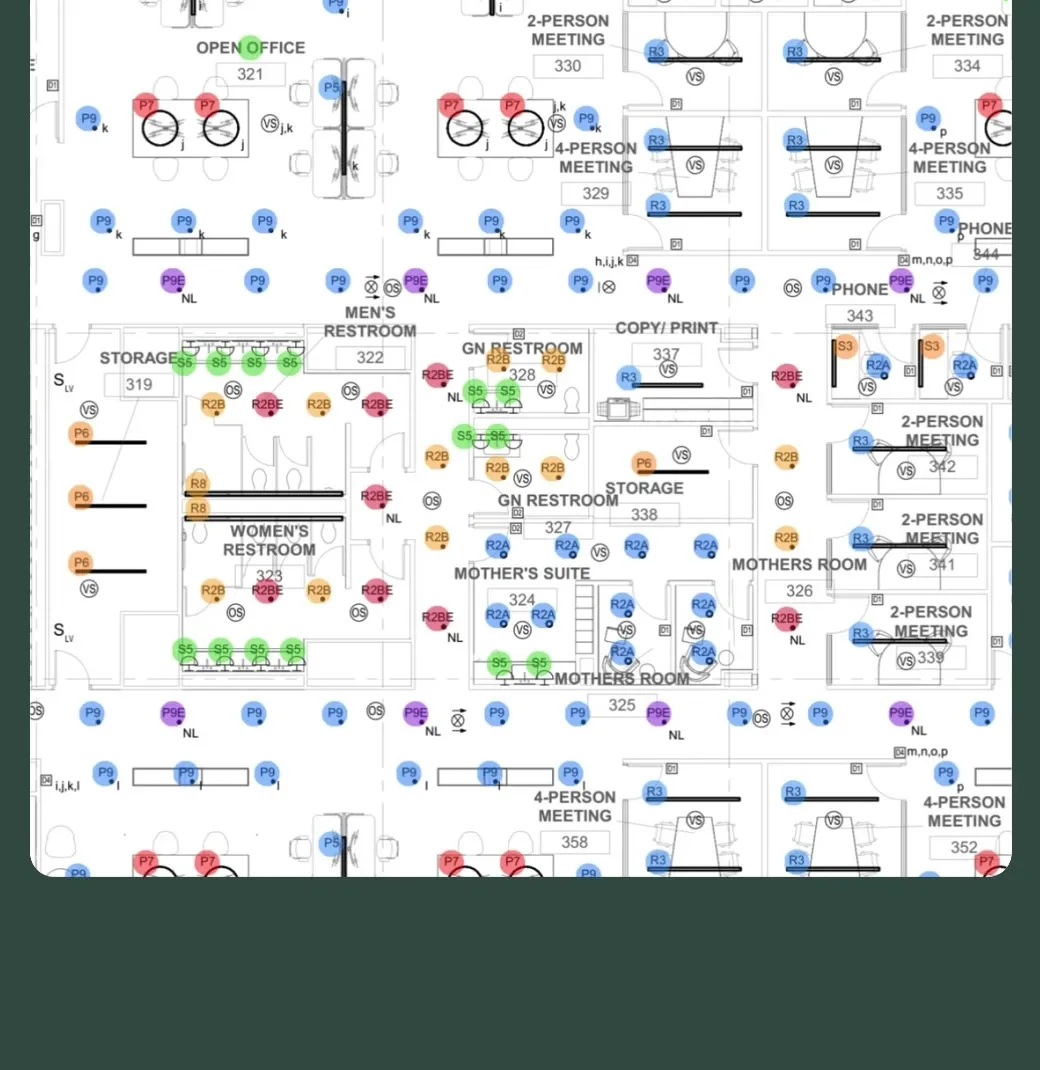
Four hours back on a small bid is the floor. The next set of features targets the parts of an electrical takeoff that still consume the most estimator time: home-run branching at scale, multi-sheet symbol counting across technology drawings, and faster panel-location overrides.
The accuracy line is the one we won’t cross. The reason AI has been slow to land inside electrical preconstruction isn’t that the counting is hard. The counting is the easy part. The hard part is that estimators bid against their own numbers. A bid built on a quietly inflated receptacle count loses money on the job. Fast and almost-right is worse than slow. HJD’s CEO would have noticed in month one.
What HJD’s experience says about the broader market is this: the bottleneck in preconstruction has never been the estimator’s skill. It’s been the share of their day eaten by mechanical work. Move that share, and the firm’s bid capacity moves with it.
Four months of waiting. One call that turned the meeting around. Four hours on the first bid, four hundred hours this year, a thousand next year. The investment Mark’s CEO had been asking about every month is now a senior estimator’s worth of annual capacity, on the same team, the same calendar, the same drawings the rest of the industry is still clicking through by hand.
That’s what changed in the fifth meeting.