By Deepti Yenireddy, CEO, Boon AI
A few weeks ago, the president of a regional electrical contractor sent me a one-line email. “Send me the numbers. I have a board meeting in two weeks.”
He didn’t want a demo. He wanted the same kind of business case he’d build for a new fleet of trucks. Acquisition cost, payback period, downstream impact. Numbers his CFO could defend.
That’s the right way to look at this. Preconstruction technology is a capital decision. So this post is the math, the way I’d write it on the back of a board deck. Every number has a source. Every claim is grounded in what firms are reporting publicly, not in vendor marketing.
What the industry baseline actually looks like
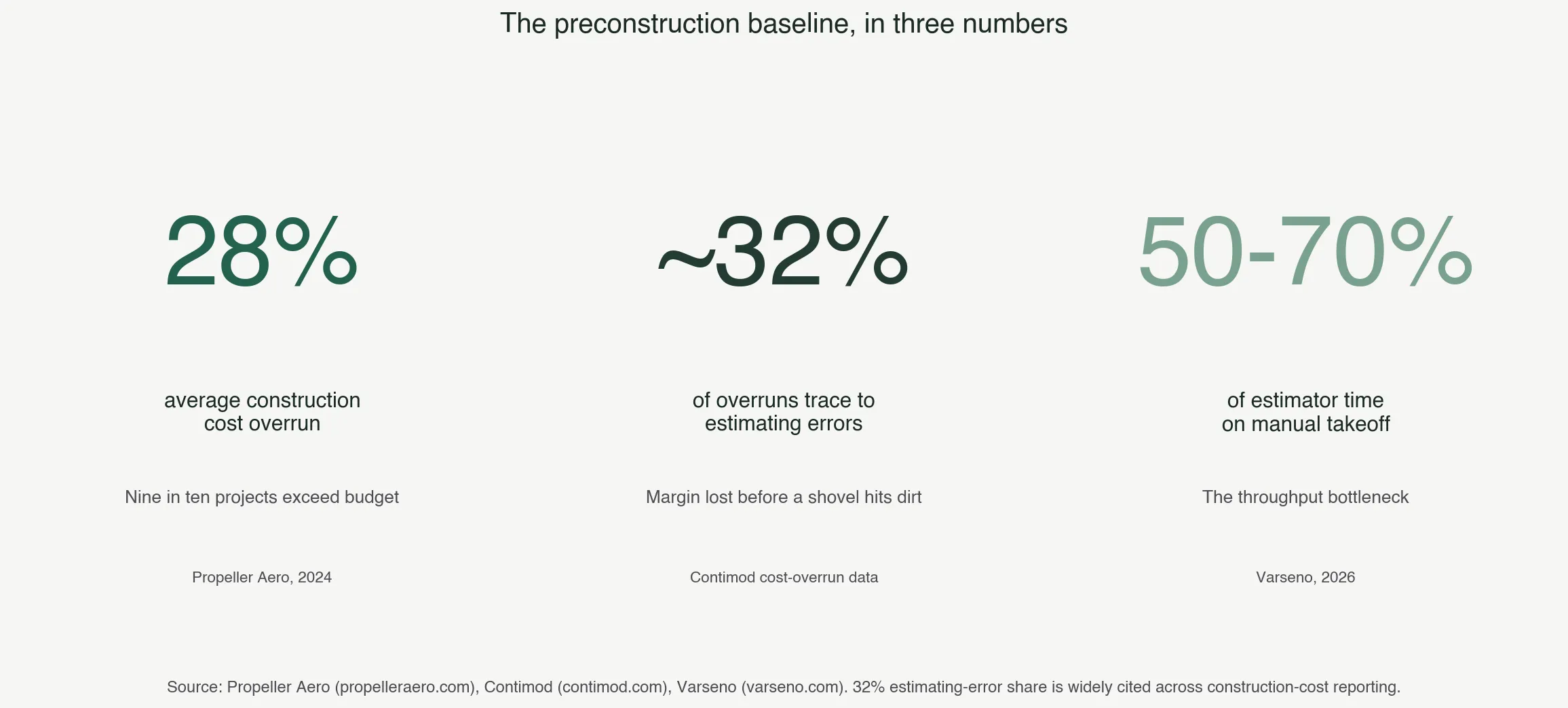
Three numbers set the table.
First, estimating accuracy. According to Propeller Aero’s compilation of cost-overrun data , the industry average cost overrun sits around 28%, and nine out of ten projects exceed their original budget. A widely cited figure pegs roughly 32% of those overruns to estimating errors . The number that matters for a CFO isn’t the headline. It’s that a meaningful chunk of margin erosion traces back to preconstruction, before a shovel hits dirt.
Second, throughput. Most firms cap their bid volume at the capacity of their estimating team. That capacity is largely consumed by repetitive measurement and quantity work. Several industry write-ups put manual takeoff at roughly 50 to 70% of total estimation time . Whether the right number for your shop is 50 or 70, it is the bottleneck. Removing it doesn’t just save hours. It changes how much work the firm can chase.
Third, the talent picture. The AGC and NCCER 2025 Workforce Survey reports 92% of construction firms struggle to fill open positions, and 45% have seen project delays from worker shortages. Estimators are among the hardest to replace. Hiring your way out of the throughput problem isn’t on the table for most firms.
The lift, where it shows up first
Time on takeoff is the most measurable change, so I’ll start there. AI-assisted takeoff platforms consistently report 50 to 80% reductions in takeoff time on standard scopes. That range is real. It varies by trade, by drawing quality, and by how much human review the estimator chooses to do. Our own customers report results in that band on electrical and mechanical scopes.
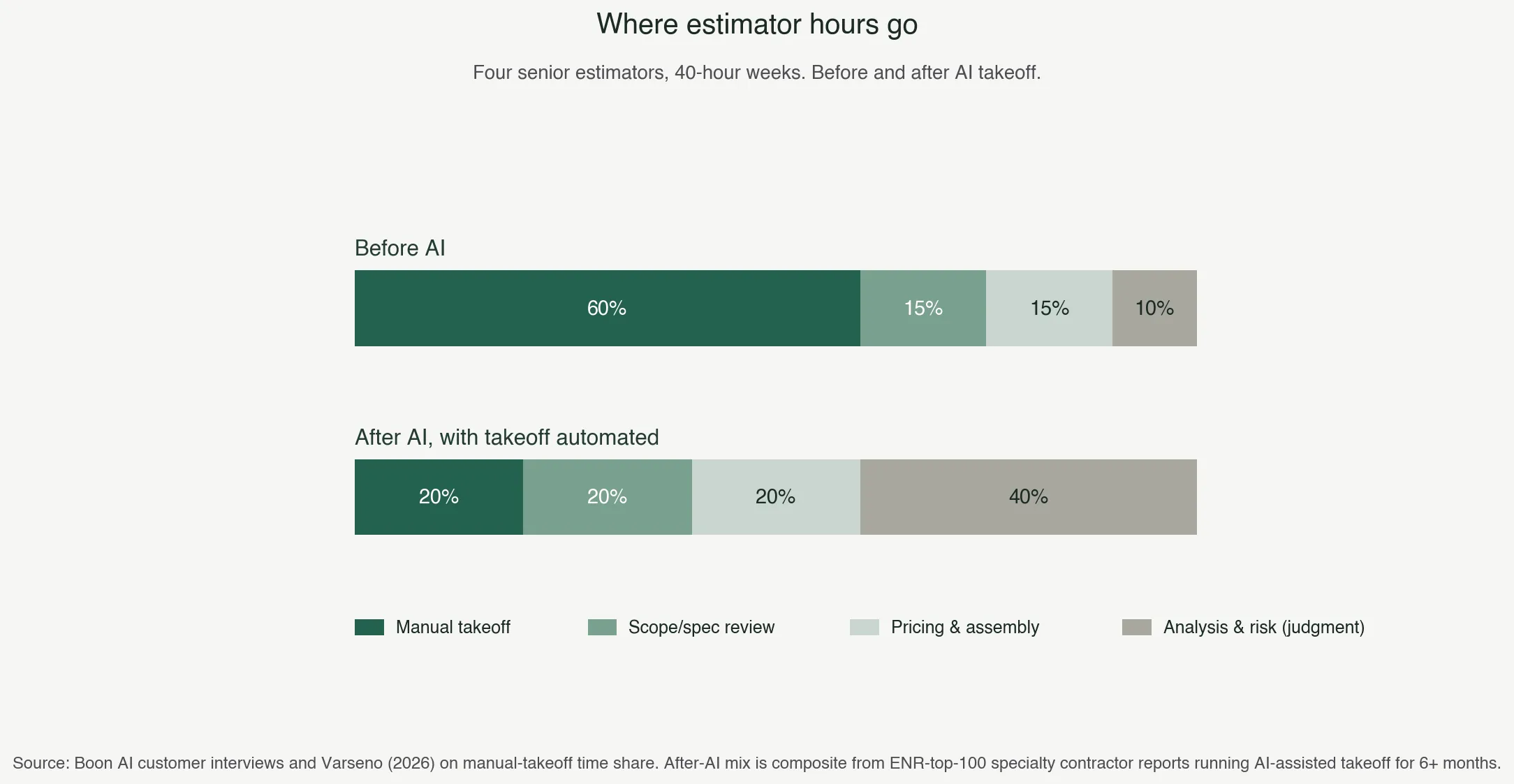
That doesn’t mean a smaller estimating team. It means the same team gets through more work. If you’re a national mechanical sub running four estimators, and 60% of their time was going to manual takeoff, halving that time isn’t a labor-cost story. It’s a bid-throughput story. The same team can carry 30 to 50% more bids without breaking.
This is the frame I keep coming back to with CFOs. The right question isn’t “how much will this save us.” It’s “how much more work can we chase without expanding the team.”
Where the real ROI sits
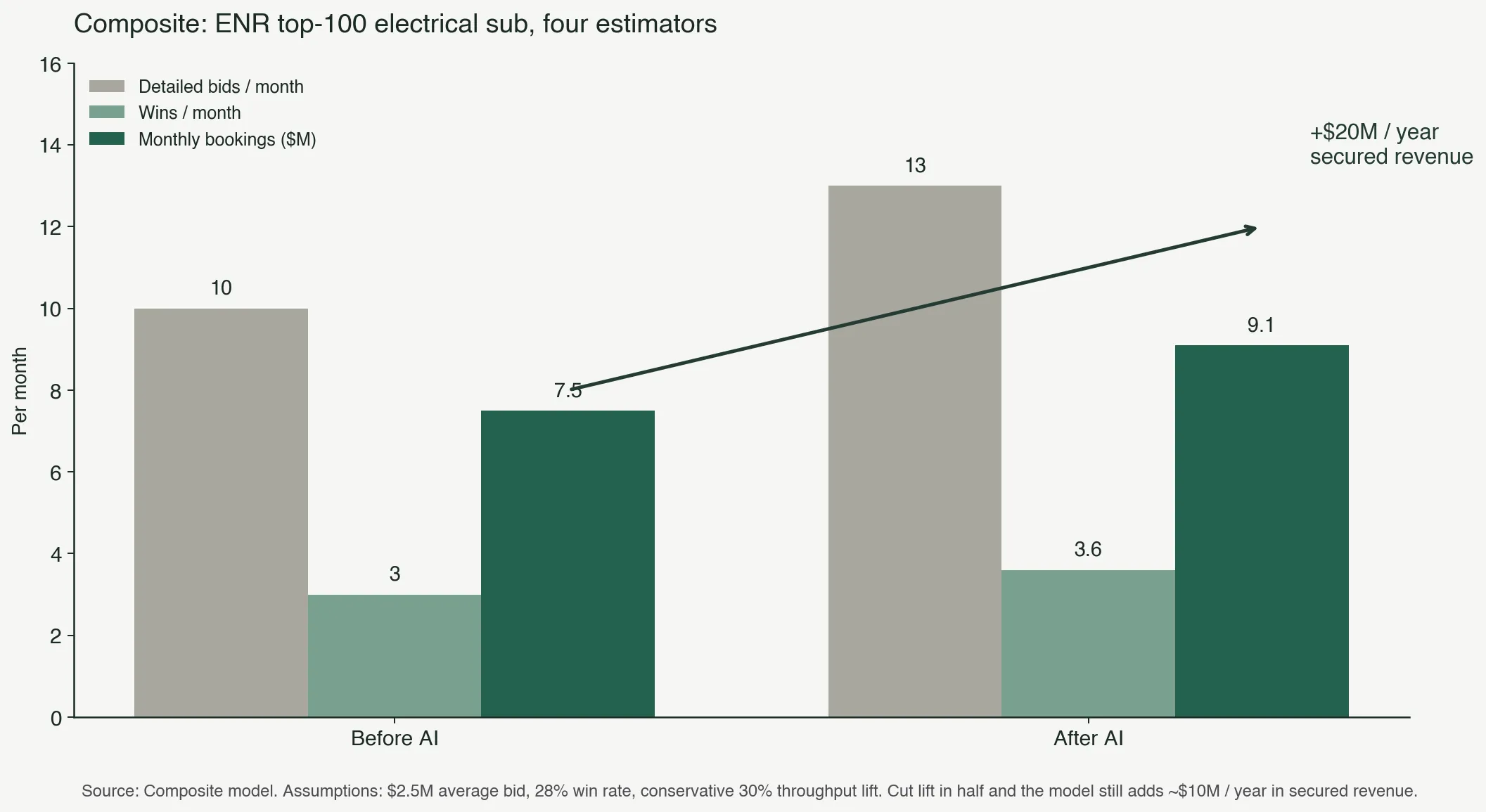
Here’s a composite from the kind of firm we typically work with. An ENR top-100 electrical sub bidding around $800M of work annually, four senior estimators, average bid value $2.5M, win rate 28%.
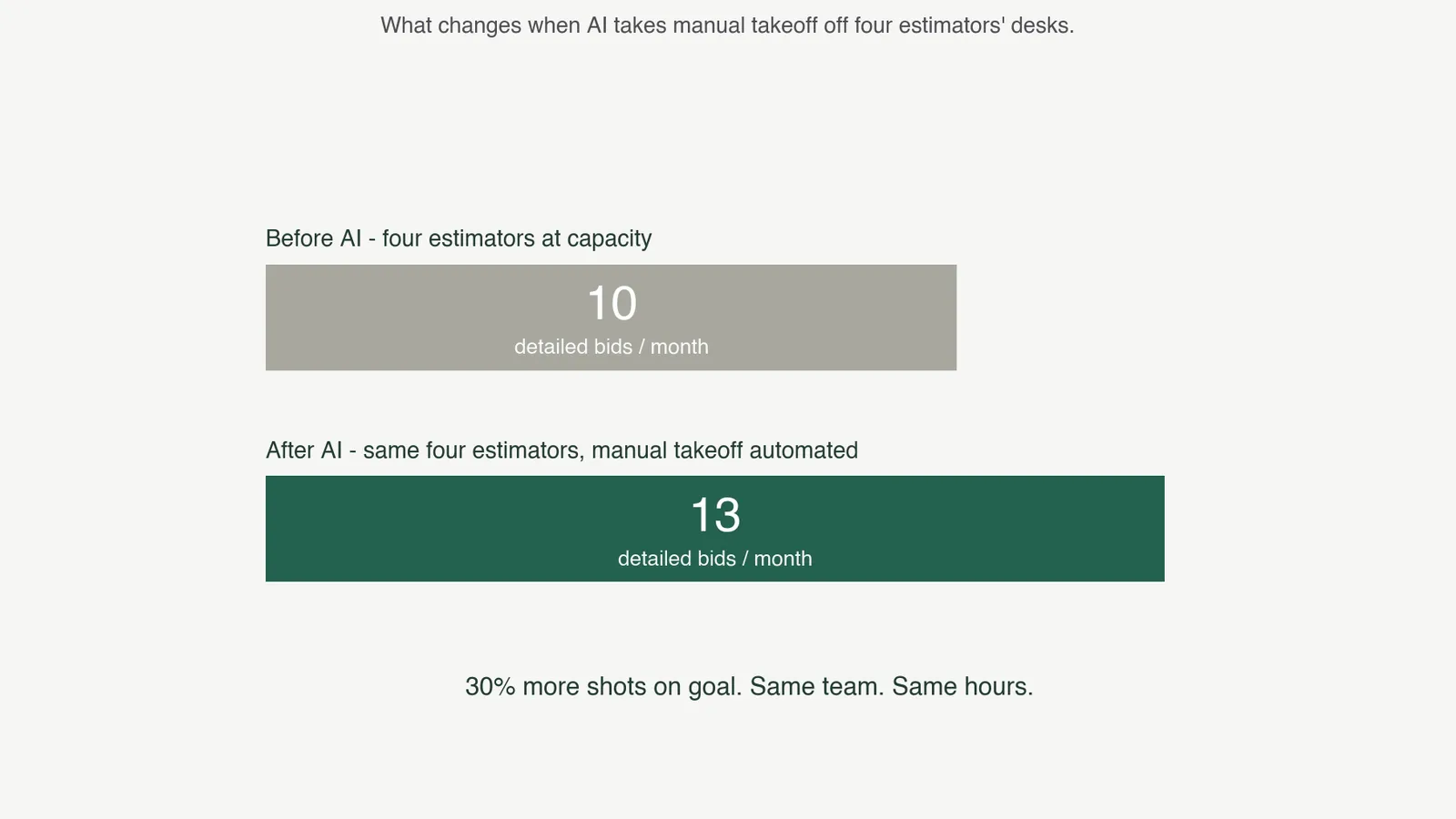
Before AI: 10 detailed bids per month, three wins, ~$7.5M in monthly bookings. The team is at capacity.
After AI, assuming a conservative 30% throughput lift: 13 detailed bids per month, same win rate, ~3.6 wins, ~$9.1M in monthly bookings. Roughly $20M of additional secured revenue per year. Cut the lift in half and the math still bends in the same direction, because you’re stacking two effects: more shots on goal, and tighter shots.
The 2022 FMI State of Global Preconstruction report , developed with Procore, makes the structural point. Firms with above-average preconstruction practices are 52% more likely to report higher profitability than firms with below-average ones. Fewer than one in five firms operate at that level.
Tighter numbers, not just faster ones
The second-order effect matters more than the first.
When manual measurement comes off an estimator’s plate, the time goes somewhere. The good firms spend it on analysis: cross-checking scope against specs, pressure-testing assumptions, looking at risk on assemblies the team has been burned on before. That’s the part of the job no software does for you. It’s also the part that decides whether a winning bid is profitable or just secured.
McKinsey’s analysis of AI in construction put the broader productivity number at up to 20% gains, with cost reductions of up to 15% and delivery time improvements of up to 30%. Those are ceiling figures across the whole industry, not specific to estimating. But they point in the same direction: when measurement gets automated, the analytical work gets more room, and that’s where margin lives.
The simple payback
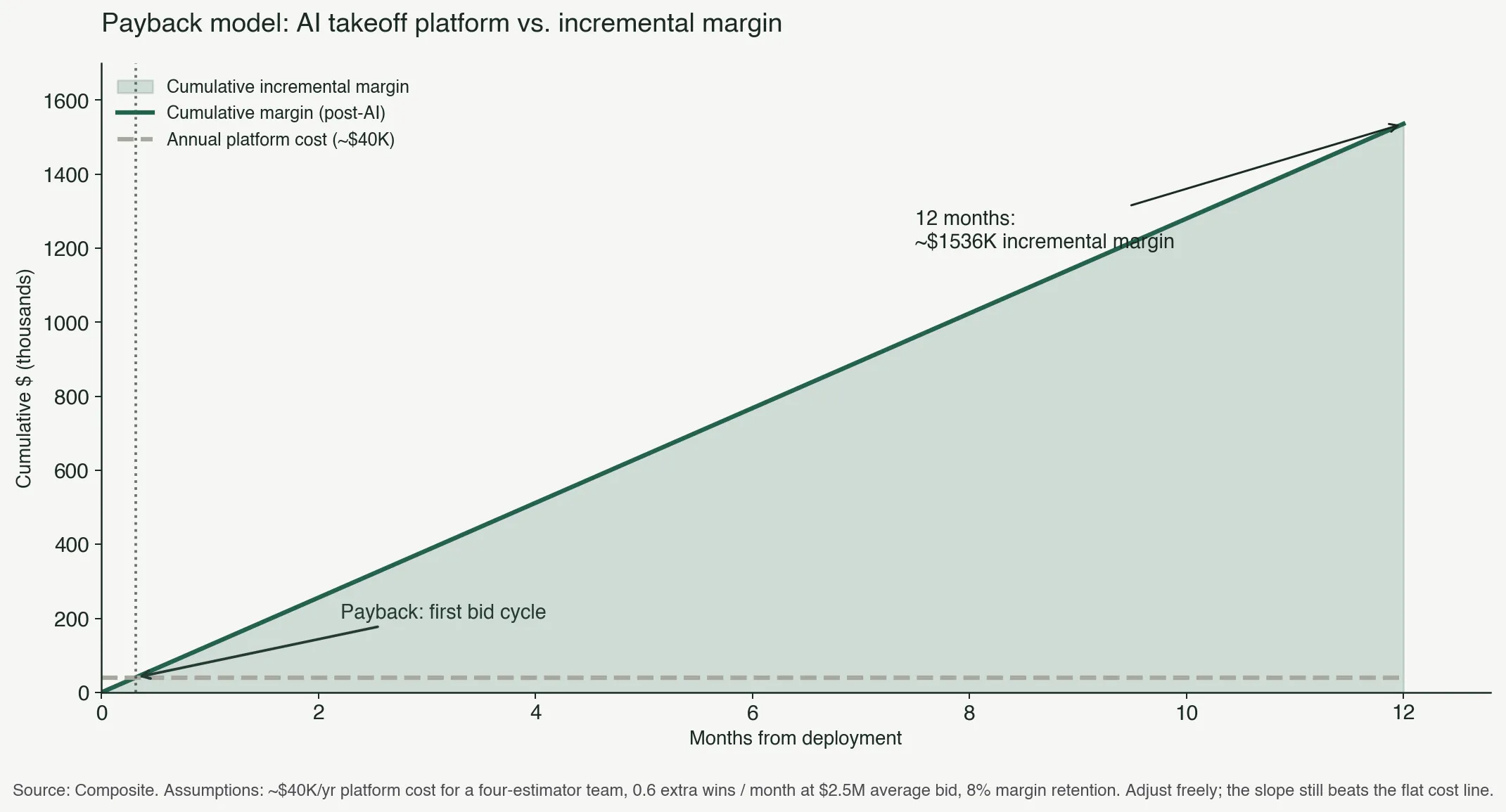
Cost of platform: in the low five figures per year for a mid-sized team. Payback hits when the firm wins one additional project it wouldn’t have had capacity to bid. For most subs and GCs, that’s a single bid cycle. For a firm bidding 100+ projects a year at $2M+ average, the payback is measured in weeks.
The harder number to put on a spreadsheet is the second one. A firm that bids more, with tighter numbers, written by an estimator who had time to think, wins more of the work it should win and walks away from more of the work it shouldn’t. Both move margin. Both compound.
What I’d tell a CFO to do this quarter
Ask three questions at your next leadership meeting. How many bids did the firm decline last quarter because of estimator capacity. What percentage of last year’s cost overruns started in preconstruction. What happens to bid volume if one senior estimator retires in the next 18 months.
If the answers are uncomfortable, the math for AI in preconstruction is already done. The ROI isn’t a hypothesis. It’s a function of how much more bid volume your firm can carry without expanding the team, and how much margin you stop leaking in the estimates you do write.
Build the case on those two numbers. The rest follows.
Sources
- Propeller Aero, Construction project cost overrun statistics
- Contimod, Construction cost overrun statistics
- Varseno, AI transforming construction estimating in 2026
- AGC and NCCER, 2025 Workforce Survey
- FMI, 2022 State of Global Preconstruction Report
- McKinsey, Artificial intelligence: construction technology’s next frontier
Deepti Yenireddy is the CEO of Boon AI. She works with preconstruction leaders at GCs and specialty contractors to quantify the business case for AI adoption.