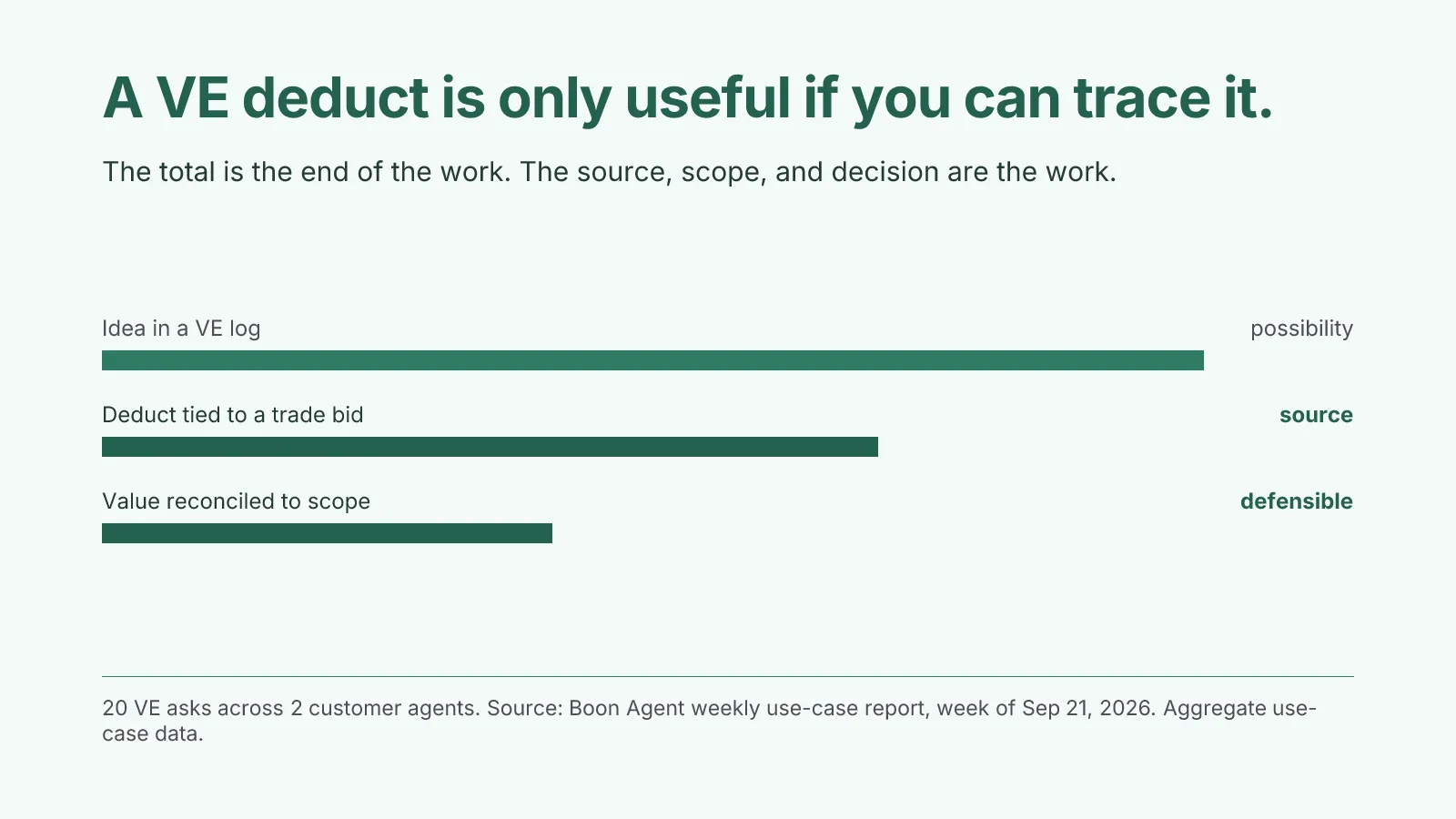
Twenty times in one week, someone asked the Boon agent to work a value-engineering log. Two customer agents produced those asks.
The phrasing was consistent. Validate every line item. Find where each deduct came from. Total the value in the actual trade bids. Look through the project documents for opportunities and put the result in Excel.
That isn’t a request for more ideas. It is a request to know which savings survive inspection.
I used to think a VE log became useful when the total was visible. It becomes useful when anyone can pick a row and trace it backward.
That is where a list of savings becomes a record of decisions, rather than another workbook someone has to reconstruct later.
A deduct starts as a possibility
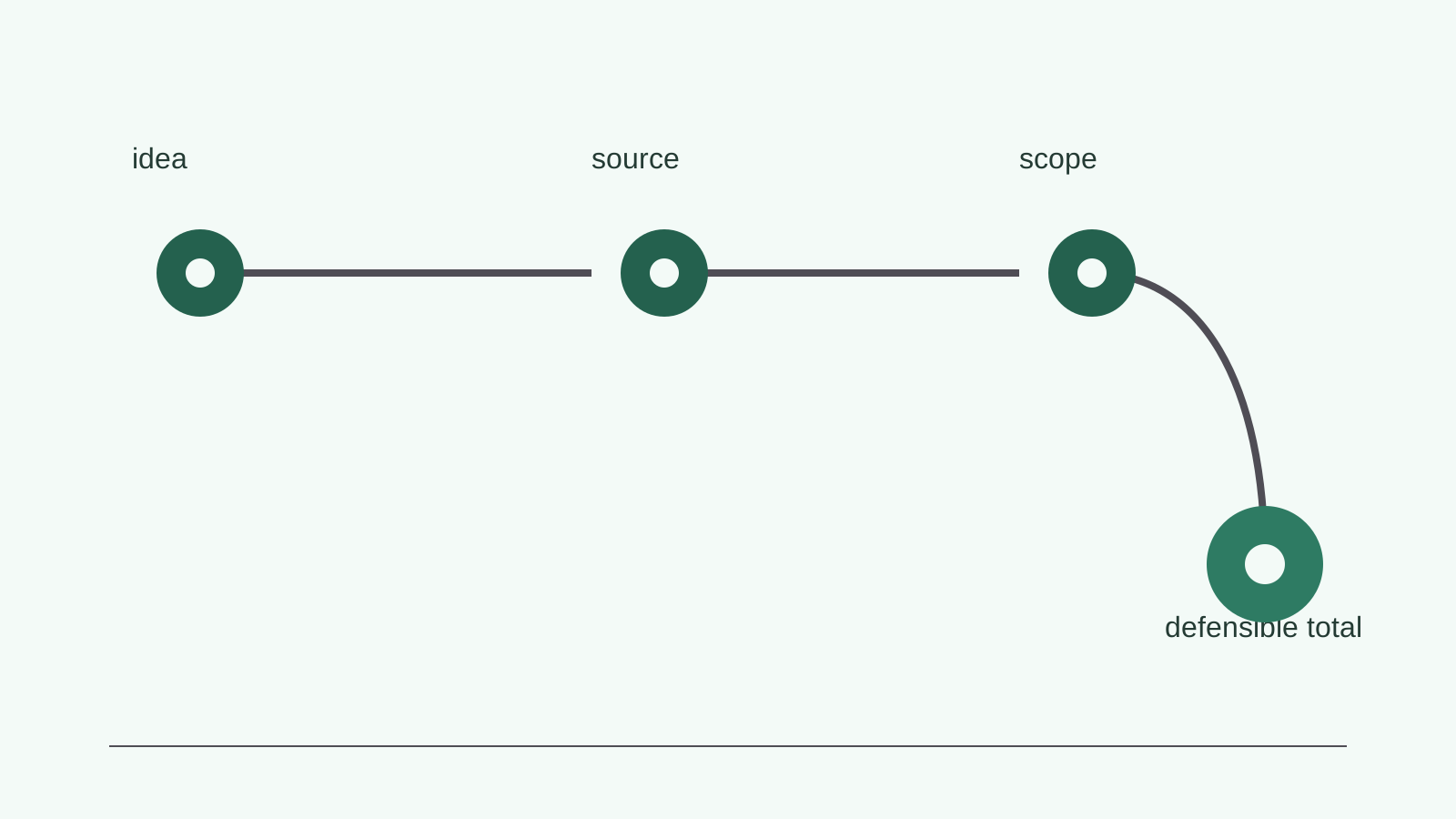
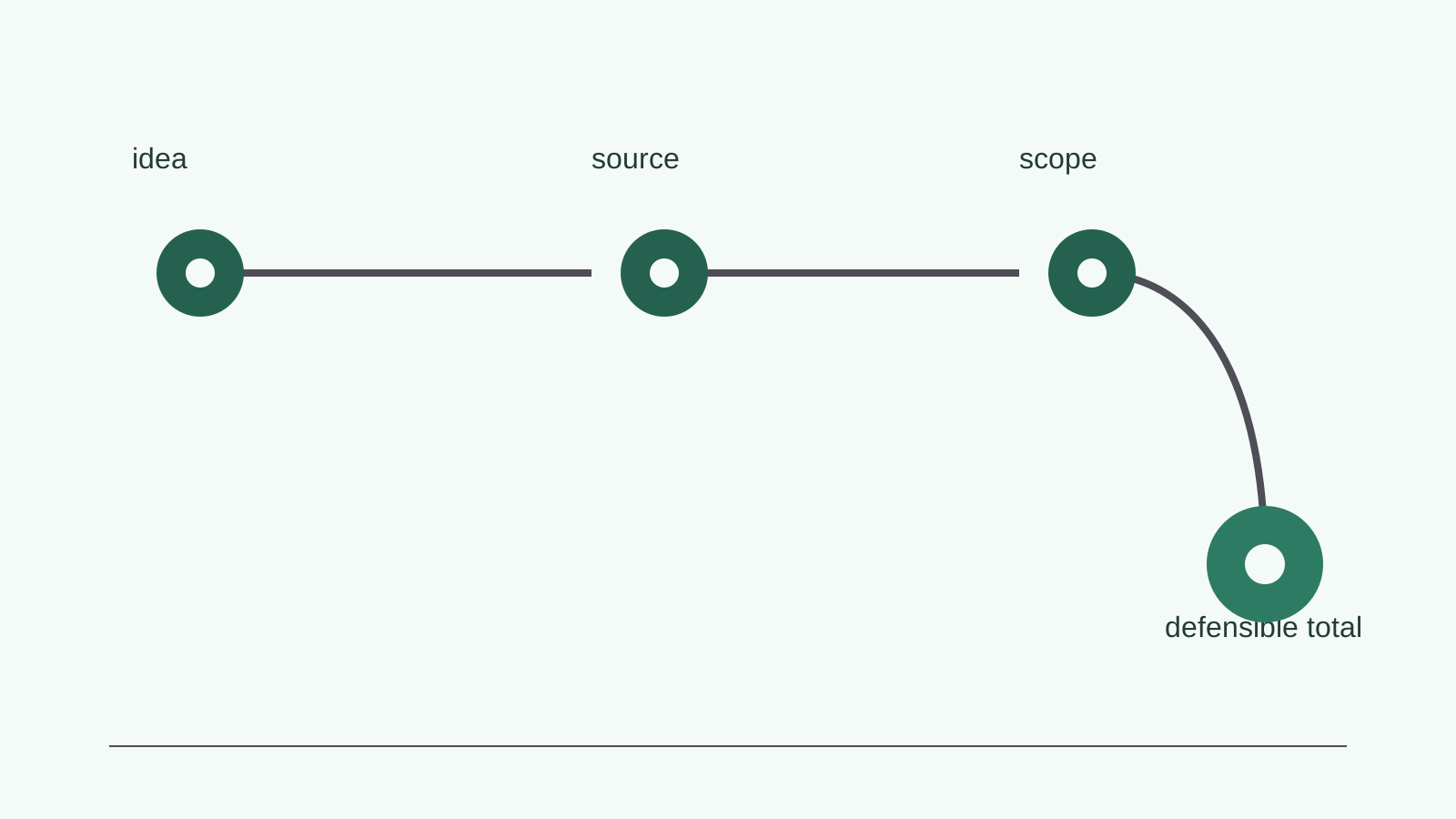
A VE proposal starts as a possibility.
Change the material. Remove a layer. Use a different assembly. Revisit a scope assumption. Each idea might lower cost, but the lower cost isn’t a fact just because the idea sounds reasonable.
It becomes a fact only when the documents and the trade bids support it.
That is where many VE logs lose their value. They capture the idea, the hoped-for savings, and sometimes a total. They don’t keep the original quote, the scope line, the specification language, or the decision that made the deduct valid.
The spreadsheet looks complete. The evidence is gone.
A defensible line has to answer four questions.
What changed? Which document or bid supports it? Who owns the affected scope? What is the value after the change is reconciled against the actual quote?
The last question is the one that keeps the total honest. A theoretical saving is not the same as a deduct in a trade bid. A lower proposal may exclude work another package carries. A substitution may reduce material cost while adding labor, lead time, or coordination. The line has to survive contact with the scope.
The source is part of the value
That isn’t a minor bookkeeping preference. The source isn’t a footnote, and it doesn’t just make the spreadsheet look careful. If the source isn’t attached, the line can’t travel to the next decision.
The output I want is not a list of cheaper ideas. It is a set of traceable lines.
A reviewer should be able to start with the total, open a line item, and work backward to its source. That source might be a trade quote, a proposal attachment, a specification section, or another project document. What matters is that it is named and connected to the value in the workbook.
The source won’t answer the VE decision by itself, but it can show whether the line belongs in the conversation at all.
That connection changes the meeting because the team can debate the decision instead of debating whether the number exists at all.
Instead of defending the total from memory, the preconstruction lead can say which trade bid produced the deduct and what scope was included. Instead of reopening the entire project folder, the estimator can inspect the exact source behind the line. Instead of arguing about whether the idea is worth a certain amount, the team can decide whether to accept the change, reject it, or send it back for clarification.
The spreadsheet becomes a map.
It stops being a graveyard of disconnected numbers.
The total can lie
A precise total feels authoritative because it is precise.
That feeling is dangerous. If two line items came from different versions of a quote, if one deduct includes a scope transfer and another does not, or if a proposed substitution has no confirmed price, the total is adding unlike things.
The arithmetic can be correct while the conclusion is wrong.
That is why validation comes before summation. Each line needs to be checked against the source that created it. The source needs to be checked against the scope the project is actually carrying. Only then does the total mean what the team thinks it means.
We don’t need an agent to make the VE decision for the owner or the project team. We need it to shorten the chain of evidence between the line item and the source.
That is a narrower promise. It is also the useful one.
The hard part is scope transfer
A document can support an idea without supporting the deduct.
A specification may allow an alternate material, but the trade bid may not price it. A proposal may show a lower number, but its exclusions may move work into another package. An addendum may change the requirement after the quote was issued. A line item can be valid in isolation and wrong in the project total.
That is why a VE review isn’t just a cheaper-alternate search. The project context has to stay attached while the documents are read. The output has to preserve the difference between an opportunity, a priced deduct, and an approved change.
The labels matter. So does the order.
First find the line. Then verify the source. Then reconcile the scope. Then total what is actually supported. When those steps are reversed, the spreadsheet starts to lead the evidence instead of reflecting it.
We made green rows too persuasive
The unflattering part is that a clean workbook can make weak reasoning look settled.
We built reports that were easy to scan because a row, a value, and a green highlight feel like progress. But a VE line without its source asks the reviewer to trust the author. That is exactly the hidden handoff an agent should remove.
The goal isn’t a better-looking log. It is a log that can survive a skeptical question from the owner, the estimator, the trade partner, or the person who joins the project later.
The source belongs next to the value. The scope boundary belongs in the line. Unpriced ideas need to stay labeled as unpriced. A total should only include the lines the documents and bids support.
The work is less impressive when the spreadsheet is honest. It is more useful.
What still belongs to the team
No agent can decide whether a project should accept a VE change. It can’t know which relationship, schedule risk, or design intent matters most when the documents leave room for judgment. It can miss a source that never reached the project folder. It can reconcile a bid correctly and still be working from a requirement the team changed in a meeting.
The agent can make the uncertainty visible before the number becomes an expectation. It can keep the source beside the claim. It can make the next question cheaper to answer.
That is enough. The decision should stay with the people who own the project.
Still probably wrong
Traceability is not certainty. It is a way to see where certainty ends.
The standard for a VE tool should be simple. Pick any deduct in the total and ask where it came from. The answer should take you to the source, the scope, and the decision still owned by a person.
If it can’t, the log is only decoration with arithmetic.