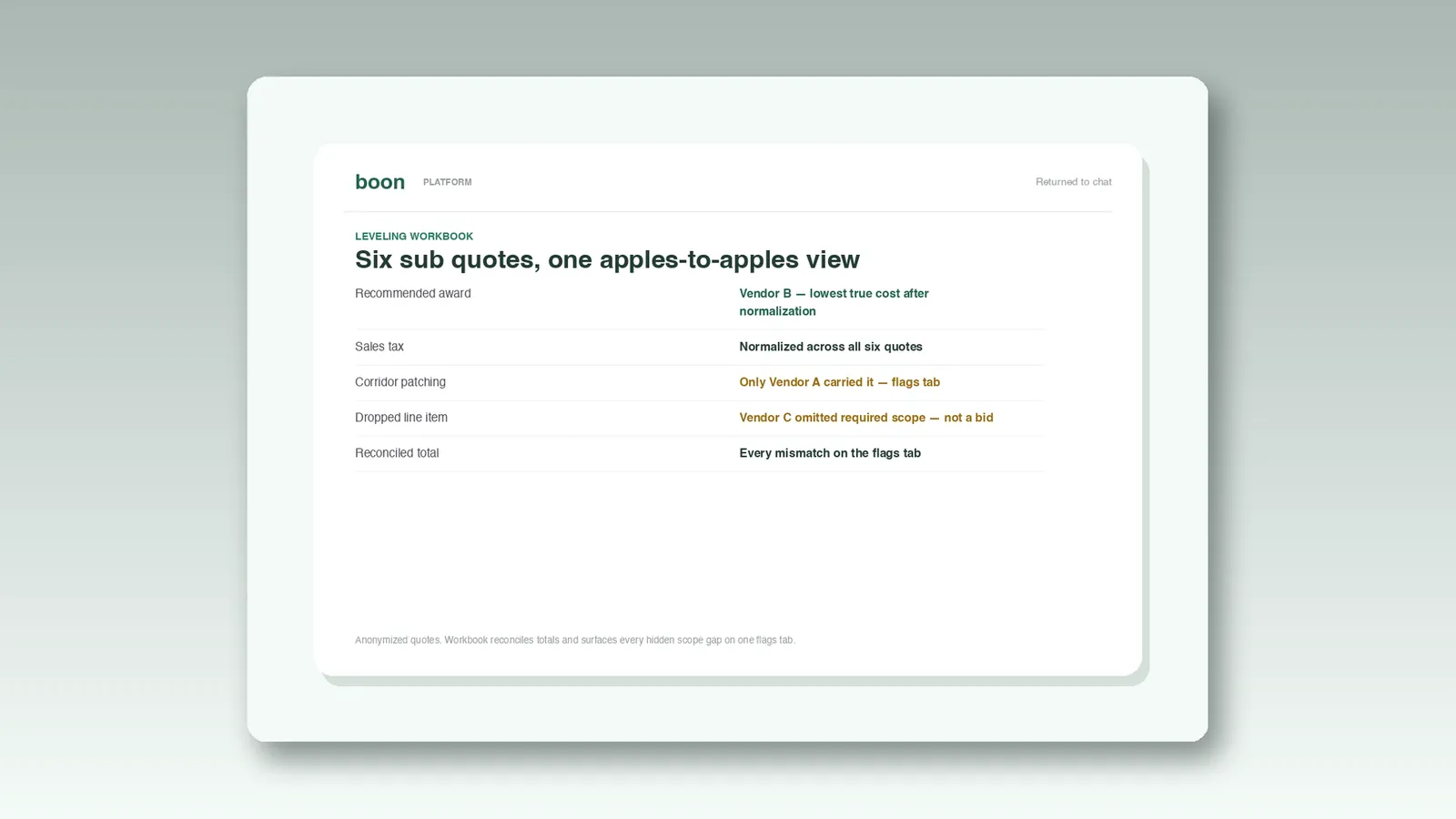
The Boon agent working this exact use case, in product. Customer details anonymized.
Try this in Boon in about two minutes
You send: the subcontractor quote PDFs and the bid form, with one message: “Level these against our bid form and flag every scope gap.”
Boon returns: a leveling workbook that normalizes all quotes apples-to-apples (tax, inclusions, exclusions), a recommended award, and a flags tab listing every mismatch and dropped line item.
Where: inside the Teams or Slack your team already uses, no new tool to learn.
Level your next bid free at getboon.ai/boon-agent
Bid day has a specific kind of pressure. The number is due at 2:00, and at 11:00 you have six subcontractor quotes for the same scope sitting in your inbox as six PDFs that agree on nothing. One vendor wraps taxes into the total. One drops corridor patching without saying so. One omits a line item entirely and you will not notice until the job is running. Your job in the next three hours is to turn those six incompatible documents into one apples-to-apples comparison and a recommendation you can defend.
That reconciliation is where bids get won and lost, and it is also where the worst mistakes hide. A missed exclusion on a 2 to 5 million dollar subcontract does not show up on bid day. It shows up six months later as an owner-absorbed cost or a chunk of margin that quietly bleeds out of the job.
Nineteen times last month, across seven of the GCs we work with, an estimator sent our AI estimator a stack of subcontractor quote PDFs and asked it to level them against the bid form. The workbook that came back reconciled the totals apples-to-apples and, more importantly, put every scope mismatch buried in those quotes on a single flags tab.
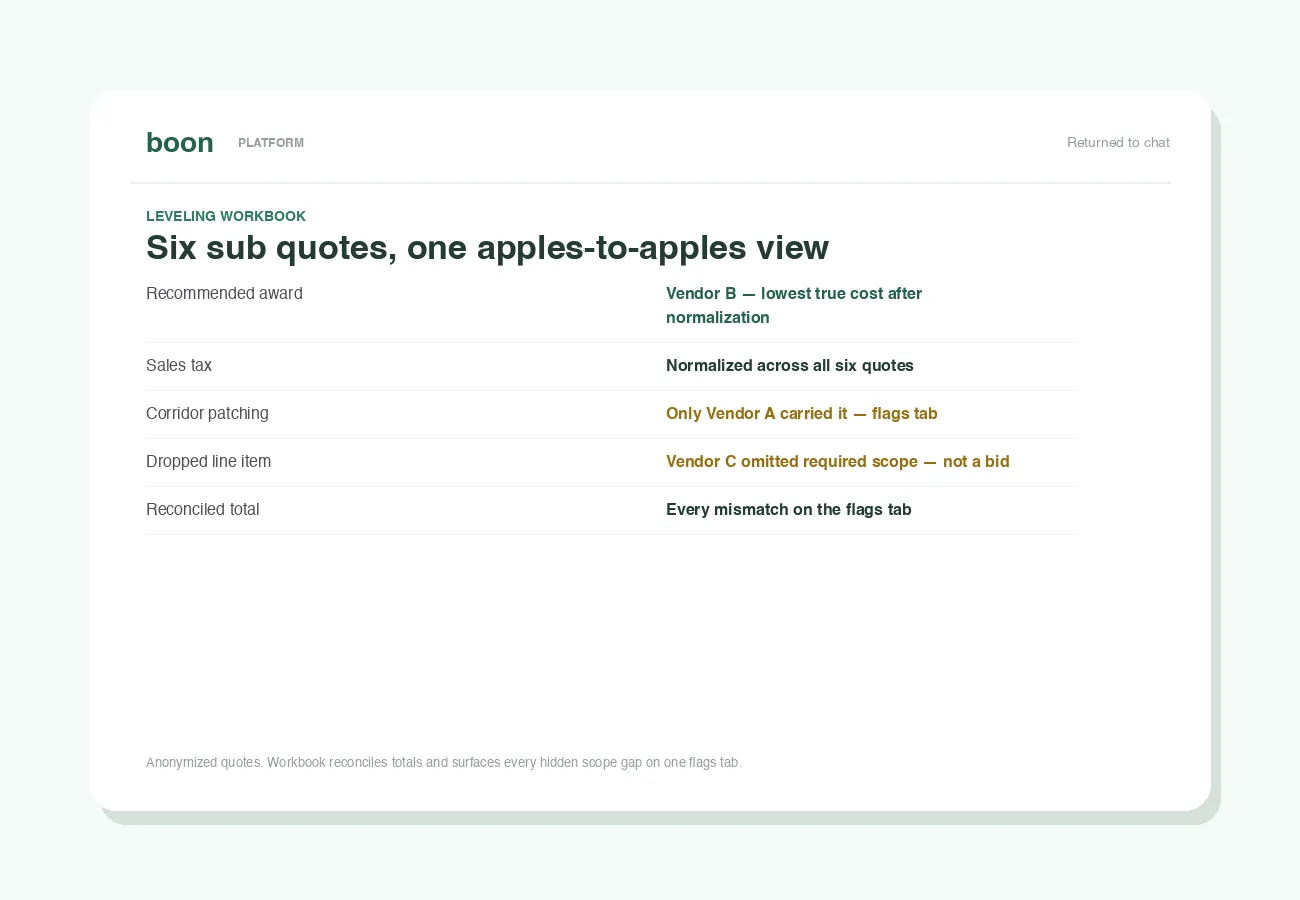
The returned deliverable, shown in product. Anonymized.
Leveling is not addition
People outside preconstruction think bid leveling is arithmetic. Line up the numbers, pick the low one, done. Anyone who has actually done it knows the number is the easy part. The hard part is that the six vendors are not quoting the same thing, and the differences are deliberately or accidentally invisible.
Vendor A’s total looks 40K higher than Vendor B’s, until you notice A included the sales tax that B left off, and B excluded the corridor patching that A carried. Now A is the cheaper real number. Vendor C came in lowest of all, because C quietly dropped a line item the bid form requires, which means C’s number is not a bid at all, it is a trap. The estimator’s job is to find every one of those differences before recommending anyone, and to find them under a clock.
Under that clock, things get missed. Not because estimators are careless, but because reading six PDFs line by line against a bid form and against each other is genuinely hard, genuinely slow, and genuinely the kind of work that degrades when you are tired and it is 12:30 on bid day.
What the agent actually surfaced
The estimators sent the PDFs and the bid form. The agent read all of them, reconciled the totals so the comparison was true apples-to-apples, and produced a workbook with a flags tab that called out every mismatch. One vendor excludes corridor patching. Another wraps taxes into the total. A third is missing a line the bid form requires. Each one named, on one tab, in front of the estimator before they made a call.
That changes where the estimator starts. Instead of starting from six incompatible PDFs and building the reconciliation by hand, they start from a reconciled picture with the risks already flagged, and they spend their time on the judgment: which vendor, why, and what to watch. The mechanical reconciliation is done. The decision is theirs.
Where the real dollars sit
Manual leveling of six or more vendor quotes runs three to five hours per bid at senior estimator rates. That time is real and returning it matters. But the time savings is not the number that should keep a precon leader up at night.
The number that matters is the miss. A single missed scope mismatch on a mid-size subcontract, a corridor-patching exclusion nobody caught, a required line item a low bidder quietly dropped, can cost 20K to 100K or more in scope the owner ends up absorbing or margin the job bleeds. Those figures are industry ranges, not a specific customer’s reported loss, and I want to be clear about that. But the shape is right, and every estimator reading this has a story that fits it.
Across 19 leveling exercises in a month, even if only one in five surfaced a mismatch the estimator might have missed under bid-day pressure, the risk mitigated is an order of magnitude larger than the hours saved. The point of the flags tab is not speed. The point is that the recommendation going up to the PM starts from a picture where the traps are already visible.
The teammate frame
The estimator is not trying to be replaced on bid day. They are trying to make a defensible call fast, with the risks in view. Our AI estimator does the reading and the reconciliation, the part that is slow and error-prone and that no estimator enjoys, and hands back a reconciled workbook with the mismatches flagged. The estimator does what they are actually paid to do: weigh the residual risk and make the recommendation.
Best value is rarely the lowest number. It is the lowest number after you account for what each vendor quietly left out. That accounting is the whole game on bid day, and it is exactly the part that gets rushed when the clock is running.
If you want to see the leveling workbook run on a real anonymized quote stack, our AI estimator works inside the Teams and Slack your team already uses. Start here: https://www.getboon.ai/boon-agent
Acknowledgements
Thanks to the Boon preconstruction and product teams for reviewing the workflow described here.