There’s a number that should keep every GC and subcontractor up at night: 41%.
That’s the share of the current construction workforce projected to retire by 2031, according to the National Center for Construction Education and Research (NCCER, 2026 ). Not “sometime in the future.” Not “eventually.” Within five years.
And the people walking out the door aren’t laborers or apprentices. They’re your most experienced estimators, your VPs of preconstruction, the people who look at a set of drawings and know, from 25 years of pattern recognition, that the mechanical scope is understated or the site conditions will add 15% to concrete.
That knowledge lives in their heads. When they leave, it leaves with them.
The Numbers Are Worse Than You Think
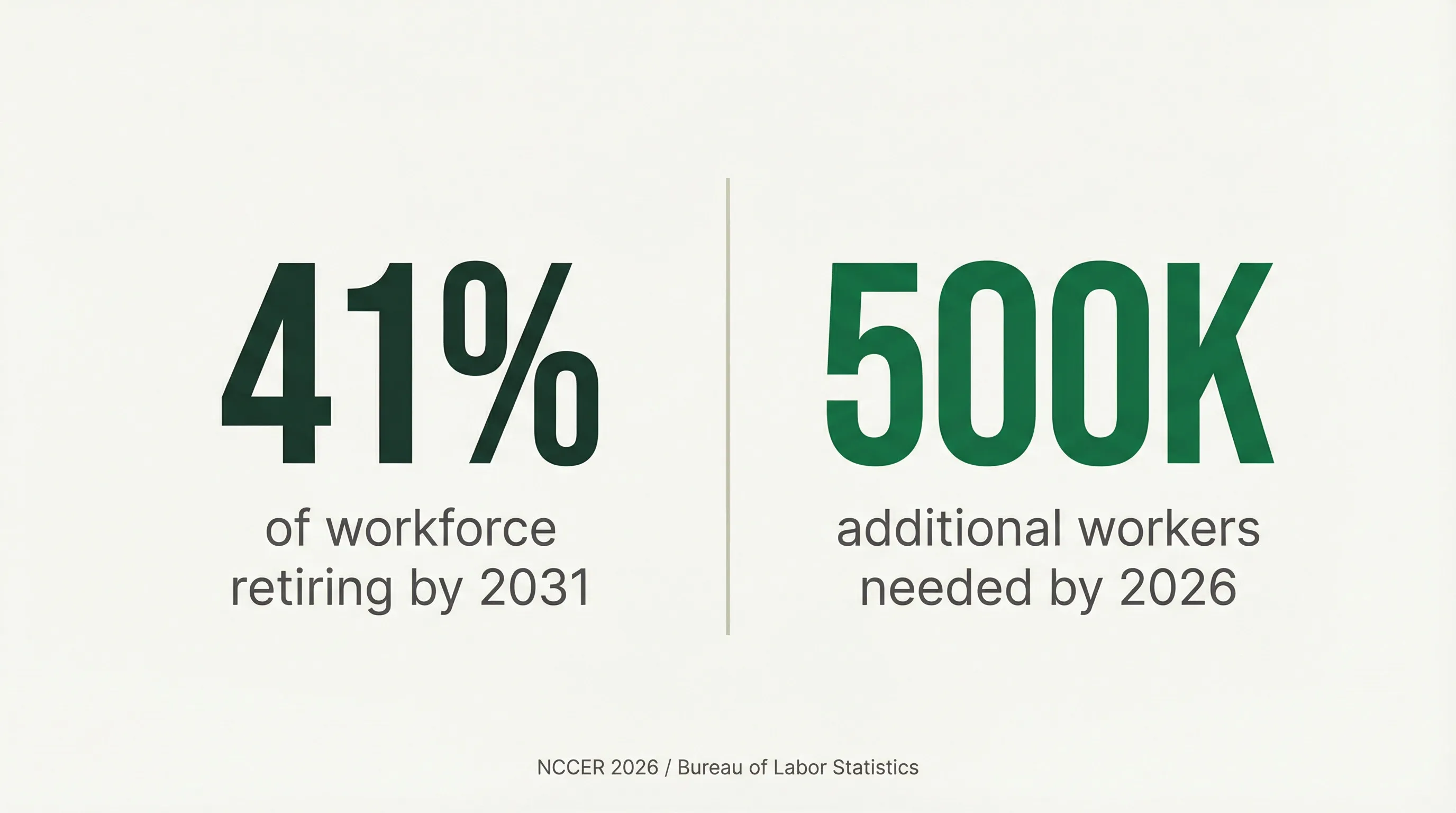
The headline shortage is bad enough. The industry needs roughly 500,000 additional workers by late 2026 just to meet current demand (Contractor Accelerator, 2025 ). But the preconstruction side of the house faces a compounding problem most firms aren’t talking about.
Consider what’s happening simultaneously:
Demand is surging. Data centers, infrastructure spending from the IIJA and IRA, reshoring of manufacturing. Construction starts are climbing. 63% of firms plan to increase headcount in 2026, yet more than 80% struggle to find qualified workers (AGC / Amtec Workforce Report, 2026 ). More projects means more bids, more takeoffs, more estimates. Supply is shrinking. 53% of the construction workforce is expected to retire in the next decade (Fixr.com / NCCER, 2025 ). The pipeline of young estimators is thin. Universities don’t produce construction estimators at scale, and the role takes years to learn on the job. Complexity is increasing. Buildings are more technically demanding. Specs are longer. Sustainability requirements, prefab coordination, BIM deliverables. The cognitive load on preconstruction teams has doubled while headcount hasn’t.
A mid-market GC we spoke with recently has 10 projects in conceptual phase right now with a preconstruction team built for five. They’re not unusual. They’re typical.
What Happens When Your Best Estimator Retires
Here’s what nobody says out loud: most construction companies don’t have a succession plan for their senior estimators.
The 30-year veteran who can qualify a 3,000-page spec book in a day, who knows which GC contracts actually match what was discussed versus boilerplate, who can conceptually budget a $40M school project from 50% DD drawings because she’s done ten similar ones. That person is irreplaceable through hiring alone.
And when she’s gone, you’re left with capable but less experienced team members staring at the same drawings. They’ll get it done. It’ll take three times as long. Some things will get missed.
“My junior staff is good. But if I show them what this technology can do right now, it’s going to scare them.”. Pre-Construction Manager, $100M General Contractor
She wasn’t worried about the technology. She was worried about the gap between where her team is and where the industry is headed.
That gap is the real crisis.
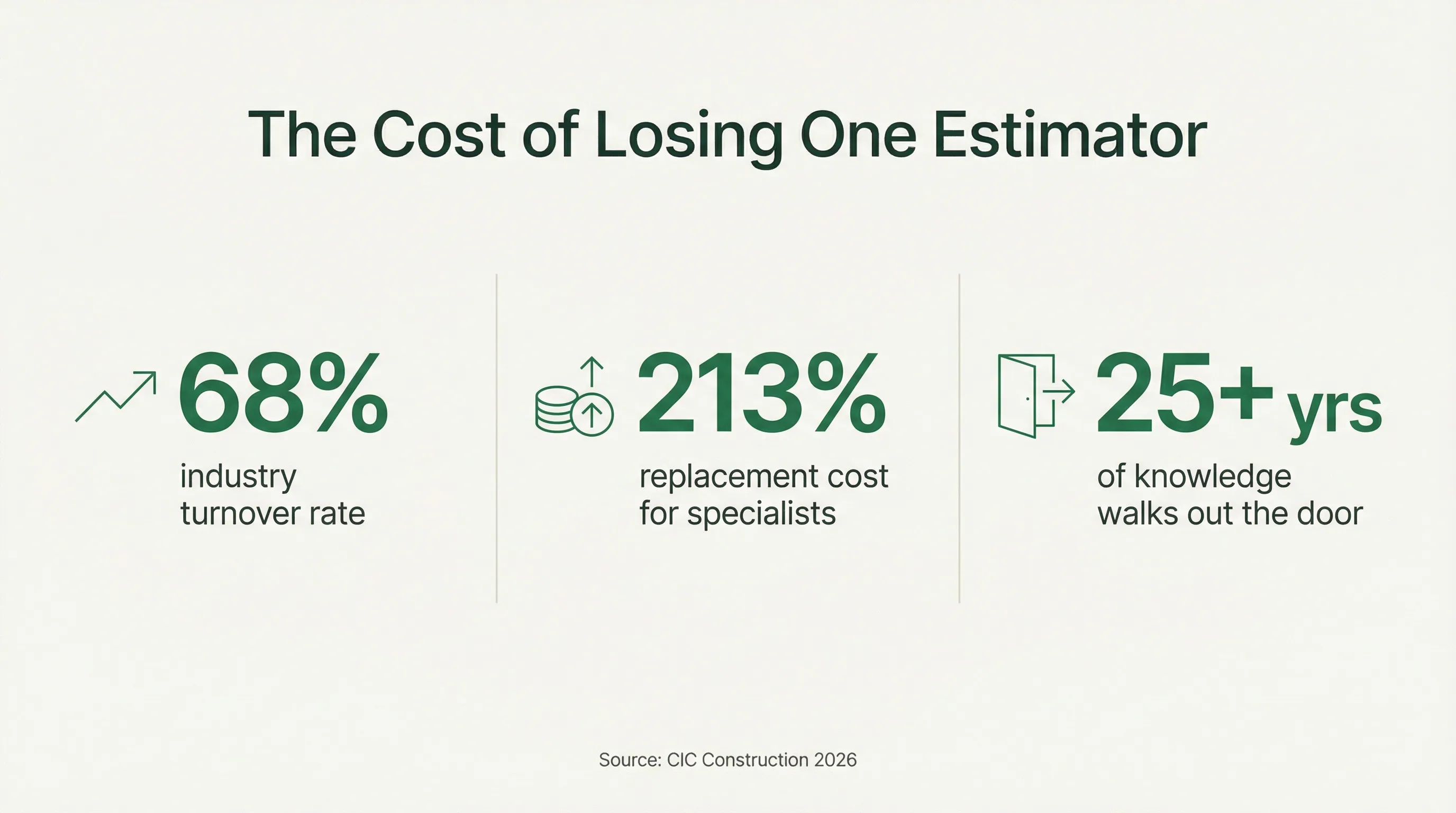
Industry-wide turnover rates have reached 68% in recent years, with skilled trades positions experiencing separation rates of 73%. Replacing a specialized construction position costs up to 213% of their annual salary (CIC Construction, 2026 ). You’re not just losing a person. You’re losing a quarter-million dollars in replacement costs plus decades of institutional knowledge.
The Two Responses We’re Seeing
Across hundreds of conversations with GCs and subcontractors, a pattern is emerging. Companies are splitting into two camps.
Camp 1: “We’ll figure it out when we get there.”
This is most of the market. Firms that know the workforce challenge is coming but haven’t changed how they operate. They’re hiring when they can, hoping retention holds, and running their senior estimators at 110% capacity.
It works until it doesn’t. Usually it stops working at the worst possible time. When your best person retires during your busiest quarter, and you realize nobody else knows how they priced that type of project.
Camp 2: “We’re restructuring now to be ready.”
A smaller but growing group of firms are making deliberate moves. Not panicking. Not adopting every tool that sends them a cold email. But thinking strategically about what their preconstruction operation looks like in three years when the workforce math gets truly painful.
“I’d rather miss some near-term upside than adopt tools into a broken process. We’re running ten parallel paths internally to get the business structured right.”. President, Growing Mechanical Subcontractor
That’s the smart approach. With one caveat. The market won’t pause while you restructure. Your competitor who figured this out six months earlier will bid more projects, bid faster, and win the work you didn’t have bandwidth for.
What “Smart” Looks Like in Practice
The firms adapting well aren’t doing anything radical. They’re doing three things consistently:
1. Capturing institutional knowledge before it walks out the door.
Your best estimator’s 25 years of experience isn’t in a manual. It’s in how she reads a set of drawings, which details she checks first, what cost assumptions she makes for certain building types. The firms getting ahead are finding ways to codify that intelligence. Whether through mentorship programs, documented estimation frameworks, or technology that can learn from historical project data.
One GC has seven years of project estimates trapped in individual files in their legacy estimating system. They’ve done dozens of similar school additions but can’t compare them. That historical data is a competitive advantage sitting in a locked filing cabinet.
2. Augmenting junior estimators instead of replacing senior ones.
The fear is that technology replaces experienced people. The reality is the opposite. The firms doing this right use AI and automation to handle the repetitive, time-intensive work (spec qualification, initial quantity takeoffs, bid leveling) so their senior estimators can focus on judgment calls, client relationships, and mentoring.
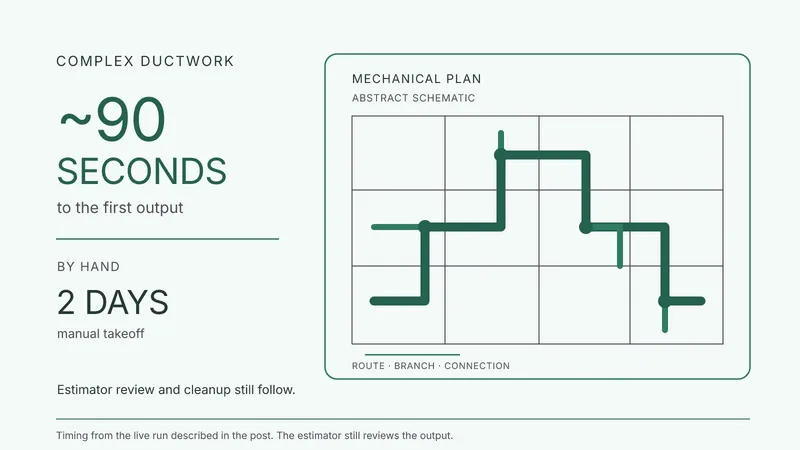
A plumbing sub told us their estimators spend “at least a day on plumbing specs and a day on HVAC specs” just qualifying a single project. That’s two days of an experienced person’s time doing work that technology can accelerate dramatically. The goal isn’t to fire the estimator. It’s to give her back 40% of her week.
3. Bidding more work with the same team.
This is the quiet advantage. Firms using technology effectively aren’t hiring more estimators. They’re getting more throughput from the team they have. That means bidding projects they would have passed on, competing in adjacent markets, and never saying “we couldn’t get to it” when an opportunity lands.
In a shortage environment, the firms that can bid the most work with the smallest, most efficient preconstruction team win. Not by cutting corners. By eliminating the work that shouldn’t require human judgment in the first place.
The Clock Is Running
Here’s the uncomfortable truth: the workforce crisis isn’t a 2031 problem. The retirements are already happening. The talent pipeline was thin five years ago and hasn’t improved. Every quarter you operate without a plan is a quarter where institutional knowledge bleeds out and isn’t replaced.
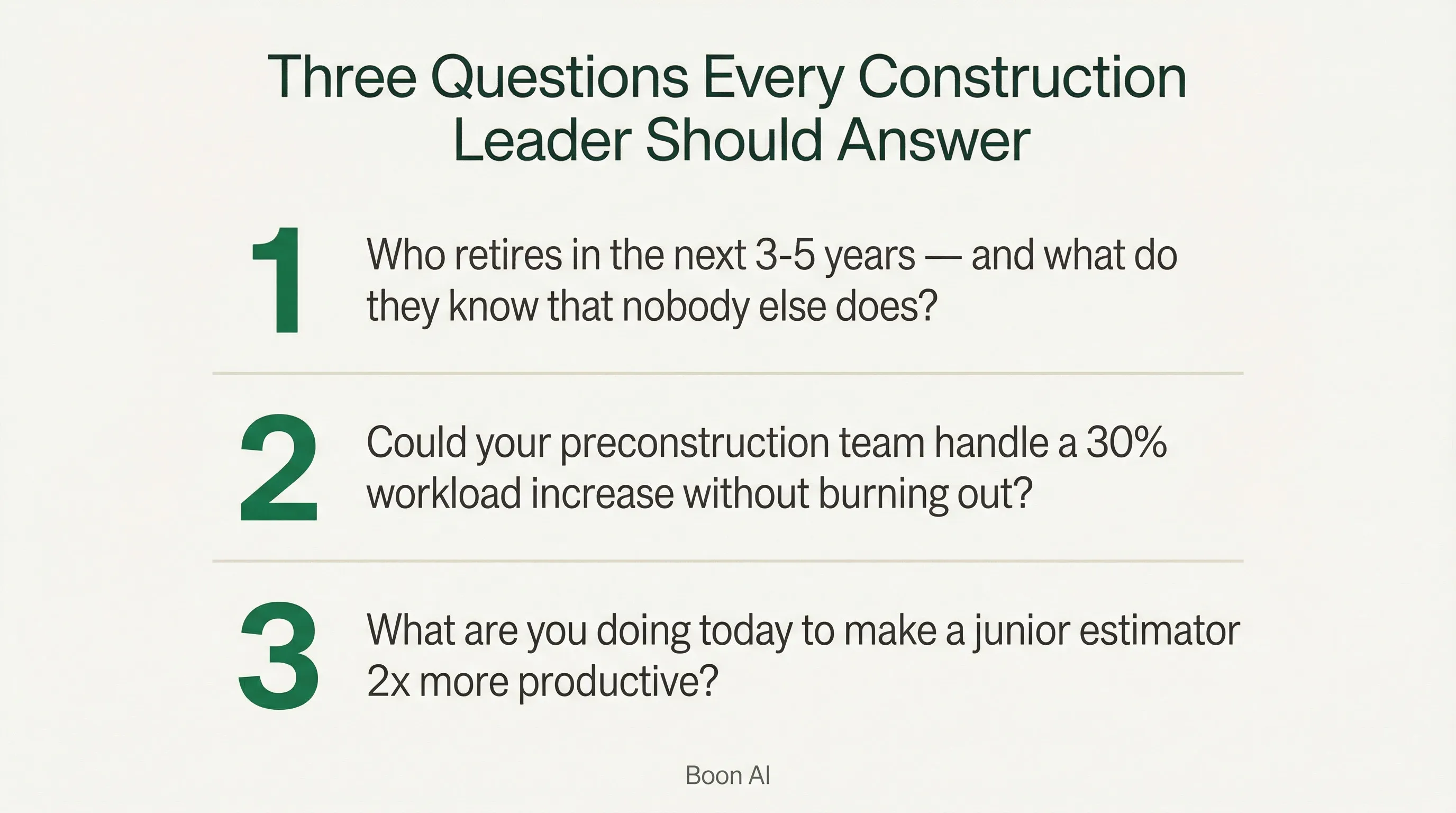
You don’t need to overhaul your operation overnight. But you need to answer three questions honestly:
- Who on your team retires in the next 3-5 years, and what do they know that nobody else does?
- If your workload increased 30% tomorrow, could your preconstruction team handle it without burning out?
- What are you doing today to make a junior estimator 2x more productive, and when will you start?
The firms that answer those questions now will own the next decade of construction. The ones that wait will be scrambling to hire from the same shrinking pool as everyone else.
The estimator shortage is here. The only question is whether you’re building a bridge or hoping the river gets narrower.
Deepti Yenireddy is the CEO of Boon AI , a platform that helps general contractors and subcontractors automate preconstruction workflows. She can be reached at deepti@getboon.ai . ---