The estimator has the reflected plan open on one screen and the finish specification on the other. The drawing calls out one wall treatment. The specification describes another. The bid deadline is close enough that either reading could be carried into the price by habit.
The risk isn’t that one page is unreadable. Both are clear on their own. The risk is treating the first clear instruction as if it settles the package.
In Boon Agent chat, the estimator asks Boon to compare the relevant plan sheet with the specification section and surface any possible conflict. Boon returns the cited locations and names the difference as a possible drawing/specification mismatch. The estimator checks the references and decides whether to price an explicit assumption or request clarification.
That is a useful pre-bid job. The question gets moved from a private hunch into a reviewable issue before it becomes a number.
Clear pages can disagree
Construction documents are authored for different purposes. The drawing shows placement and form. The specification states material, performance, or installation requirements. They are meant to work together, but they don’t always describe the same condition in the same way.
The mistake is to assume the conflict must be obvious. A drawing can look complete while leaving an important performance requirement in the specification. A specification can name a product while the detail shows a different assembly. A note can look local even when the bid package uses it across a wider area.
A keyword search may find both passages. It won’t necessarily put them together or explain why they matter to the bid. A useful comparison keeps each reference attached to its own words.
The useful question isn’t “Which page do I trust?” It is “What do these two sources say about the same work, and what is still unsettled?” That shift keeps the discussion precise.
Sometimes the passages can be reconciled by reading their context. A note may point to a detail that changes how a general specification applies, or the package may contain a true inconsistency. The review names the difference plainly and leaves both sources visible.
Put the conflict on the table
A good review note names both relevant locations and the difference in plain language. It keeps the original passages visible and gives the reader context to open the pages and inspect the surrounding notes.
Boon compares relevant plan sheets with specification sections and shows references beside possible mismatches. The output places the potential issue and its source pair together for review.
The contract documents, bid instructions, and project context determine how the issue is handled. If the package leaves it open, the team can request direction or carry a clearly stated assumption before pricing.
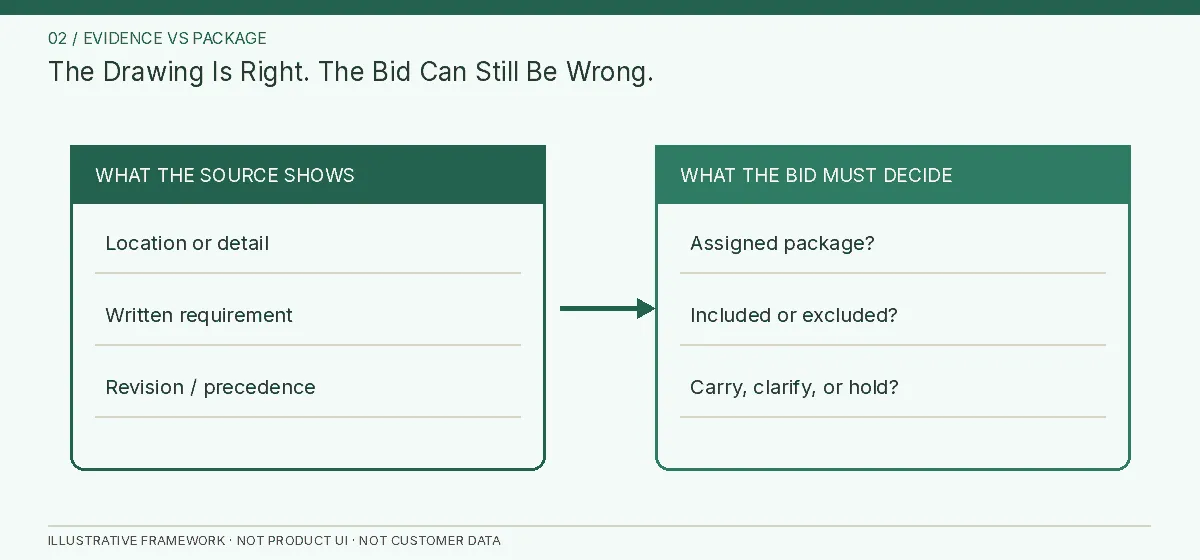
Don’t price the cleaner sentence
There is a temptation to choose the sentence that sounds easier to estimate. One option may match a familiar assembly. Another may have a neat quantity or a product name. That convenience doesn’t make it the governing requirement.
A confident-looking answer can also be misleading if it removes the disagreement. In the synthetic example, the finish callout and specification stay visible together, with the possible mismatch named plainly for the bid discussion.
That distinction protects the work from a quiet form of drift. An assumption that enters the estimate as a fact is hard to find later. A conflict recorded before pricing is still a decision the team can address.
Preconstruction already has a place for unresolved conditions. They can be clarified, carried with an assumption, or excluded pending direction. The least useful option is allowing an unresolved condition to disappear inside a price with no visible note.
A better pre-bid question
When a drawing and specification appear to disagree, ask the comparison question before asking for a price. Which plan detail and which spec passage address the same work? What differs? Does the package state how to resolve it? If not, who needs to answer before the bid is committed?
The answer may be a clear instruction. It may be a scope assumption. It may be an RFI. The right next step depends on the source context, not on the cleanest line in a summary.
An AI preconstruction teammate is more useful when it points back to the source. A cited conflict gives the team a way to test the statement against the original documents.
Beyond conflict review, Boon is your AI precon teammate for go/no-go summaries, trade-specific scope lists, and estimate data ready for Excel or CSV export.
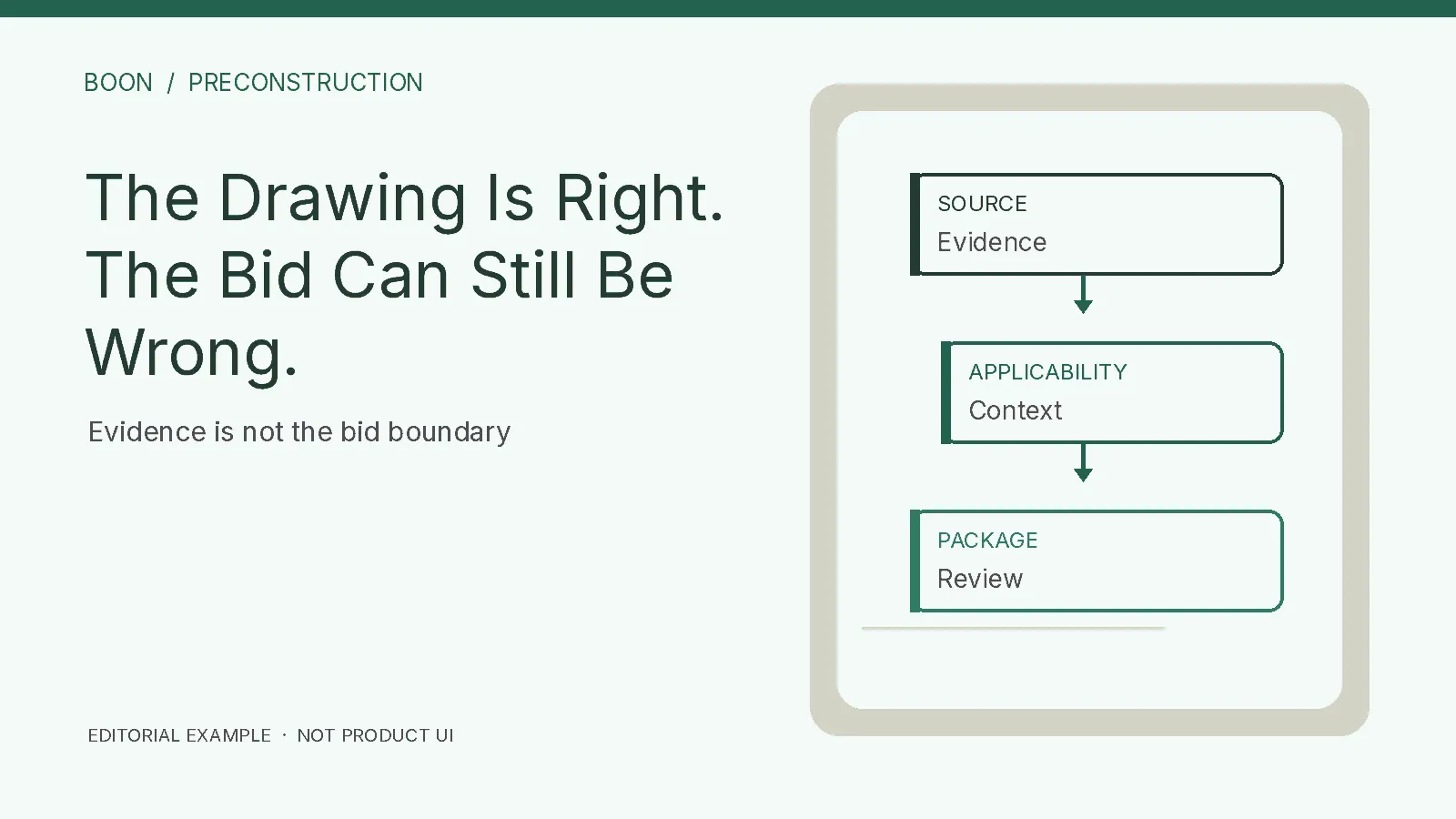
The drawing can be right. The specification can also be right on its own terms. The bid can still go wrong if the difference between them isn’t seen before pricing. Make the conflict visible first, then make the commercial call.
Related: Boon Agent · Preconstruction series hub The Spec Book Is Not a Search Box · Book a demo