A president of a growing specialty contractor told me something recently that stuck with me. We were discussing AI tools, and I expected the usual questions: What does it cost? How fast is the ROI? Can we try it on one project?
Instead, he said: “I’d rather miss near-term upside than adopt into broken processes.”
He wasn’t dismissing AI. He was telling me his timeline was different. He’s not thinking about next quarter. He’s building for 2029. And his approach, while unconventional, is more strategic than most of what I see in this industry.
The question is whether his competitors will give him the time he’s planning for.
Two Approaches to AI in Construction
There are broadly two camps in how construction firms approach AI construction takeoff software adoption right now.
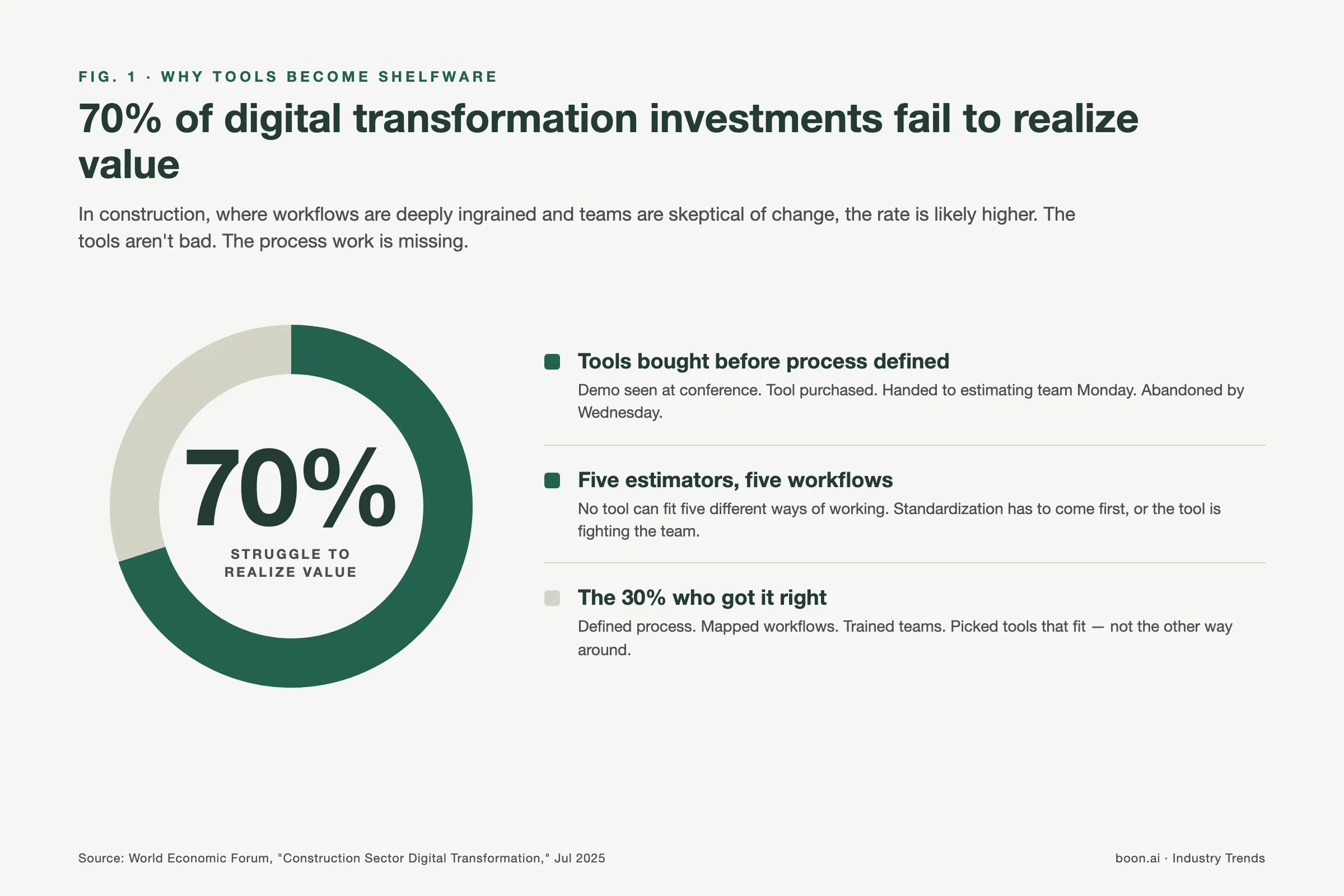
The plug-and-play crowd buys tools first and asks questions later. Someone saw a demo at a conference. Someone’s nephew said this app is amazing. A tool gets purchased, handed to the estimating team on a Monday morning, and abandoned by Wednesday. Six months later, they try a different tool. Same result.
This pattern is more common than anyone in the industry wants to admit. 70% of organizations struggle to realize value from their digital transformation investments . In construction, where workflows are deeply ingrained and teams are skeptical of change, that number is likely higher. Tools adopted without strategy don’t fail because the tools are bad. They fail because nobody mapped them to how work actually gets done.
The strategic planners take a different path. They define processes before choosing tools. They assess their team’s readiness. They think about training, change management, and long-term integration. They’re not slower because they’re less capable. They’re slower because they’re building something durable.
The president I mentioned is firmly in the second camp. Here’s what his roadmap looks like.
“Every tool we’ve ever adopted without a plan ended up as shelfware. I’m not doing that with AI. We’re going to get our house in order first, and then we’ll move fast.”. President, $120M specialty contractor
The Four-Phase Approach
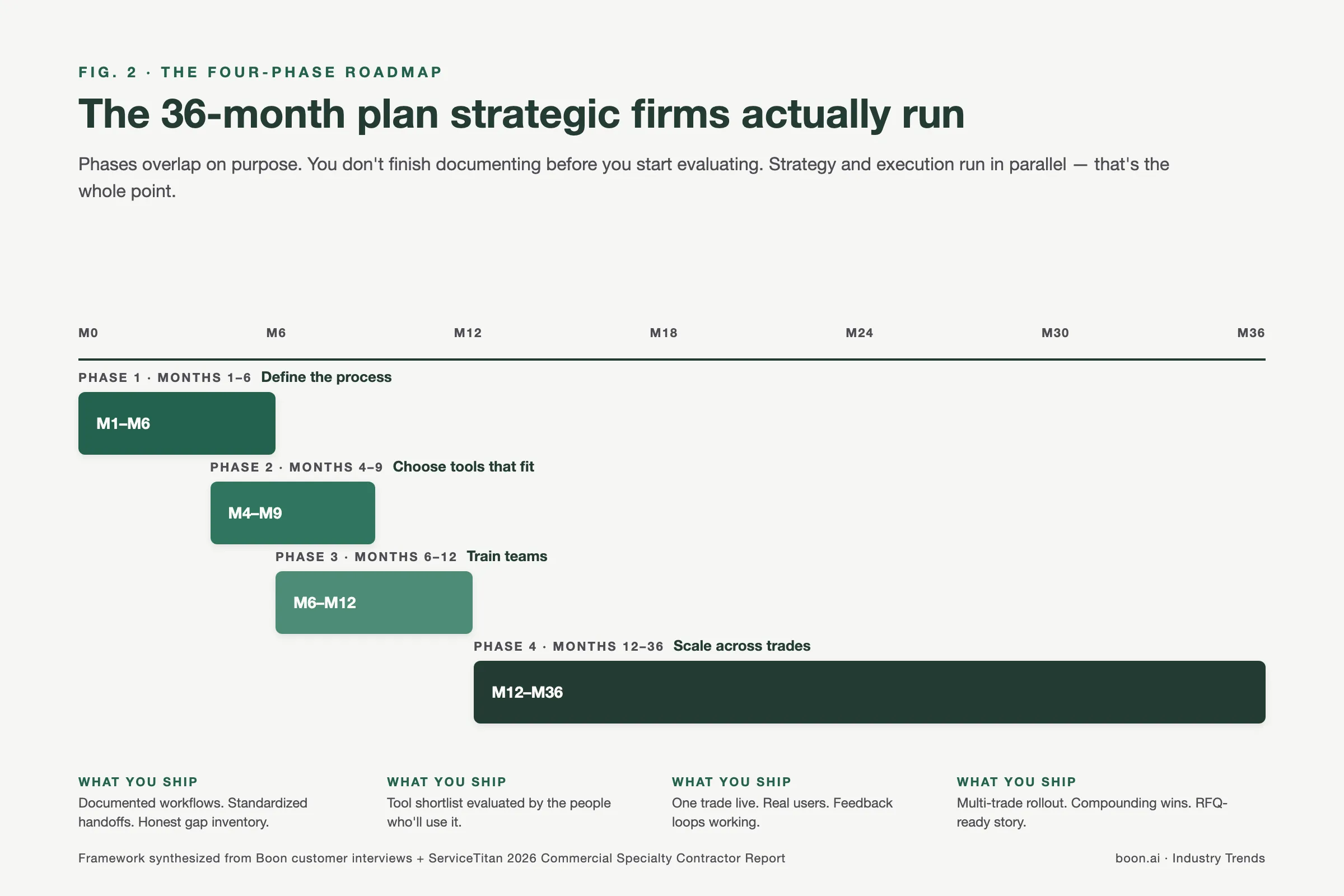
The firms that are planning for 2029 tend to follow a similar framework, whether they’ve articulated it formally or not.
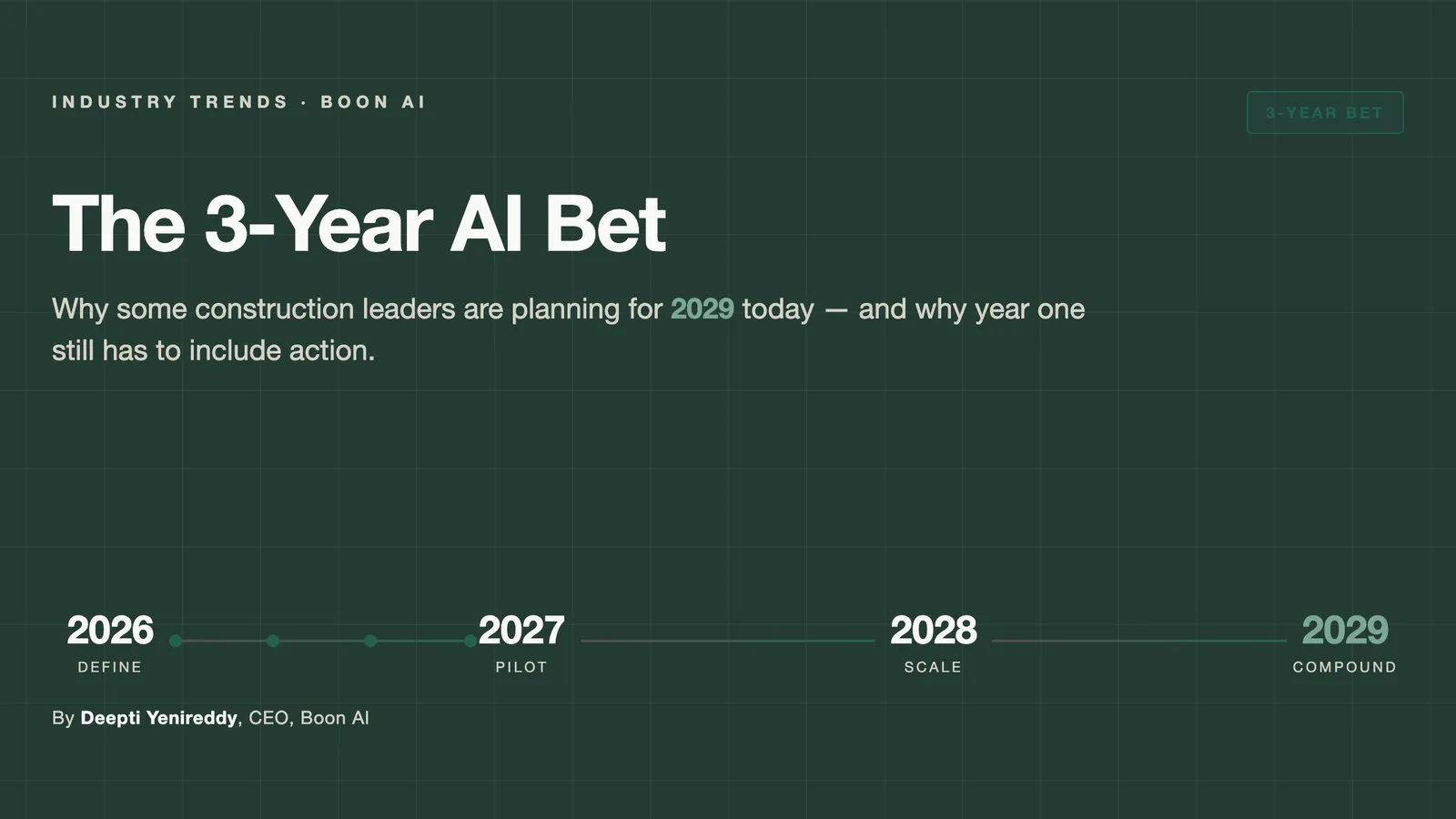
Phase 1: Define the process (Months 1-6)
Before any technology conversation, document how your team actually works. Not the idealized version. The real one. How do estimators handle spec review? How are takeoffs organized? Where do handoffs happen? Where do things fall through the cracks?
This step is uncomfortable because it reveals inconsistency. Every estimator has their own approach, their own spreadsheets, their own shortcuts. That inconsistency is exactly why technology adoption fails. If five estimators do takeoffs five different ways, no tool will work for all of them until the process is standardized.
Phase 2: Choose tools that fit (Months 4-9)
Notice the overlap with Phase 1. You don’t need to finish process documentation before evaluating tools. But you need to start it. The goal is to choose technology that fits your standardized workflow, not to reshape your workflow around a tool’s limitations.
The best evaluations I’ve seen involve the people who will actually use the tools. Not just leadership. Not just IT. The estimators, the pre-con managers, the people doing the work.
Phase 3: Train teams (Months 6-12)
This is where most firms underinvest. Training isn’t a two-hour webinar on day one. It’s ongoing support, feedback loops, and the patience to let people get comfortable. The ServiceTitan 2026 report found that firms reporting measurable AI impact jumped from 17% to 38% in one year. The firms in that 38% didn’t just buy tools. They invested in making sure their teams could actually use them.
Construction teams are practical. They’ll adopt tools that make their jobs easier and reject ones that add complexity. Training needs to demonstrate value in the first week, not promise it for next year.
Phase 4: Scale (Months 12-36)
Once a tool works on one trade or one project type, expand. Apply what you learned. Adjust the process. Train the next group. This is where the compounding returns start to show: faster takeoffs, more bids pursued, fewer errors, better margin protection.
The Case for Taking Your Time
There’s real wisdom in the “process first” approach. Here’s why.
Estimating errors account for 32% of construction cost overruns . If your current process produces errors, adding AI to that process doesn’t fix it. It accelerates it. A tool that does bad takeoffs faster is worse than no tool at all, because now you’re making mistakes at scale with a false sense of confidence.
The president who said he’d rather miss near-term upside wasn’t being conservative for its own sake. He was saying: I’d rather get this right than get it fast. In an industry where a single estimating mistake can cost hundreds of thousands of dollars, that’s not caution. That’s math.
“We watched two of our competitors adopt estimating AI last year. One of them loves it. The other one ripped it out after four months because they tried to skip the process work. Same tool. Different outcomes. The difference was preparation.”. Director of Operations, mid-market GC
The Case for Moving Now
But here’s where the strategic planner needs to be honest with themselves. While you’re defining processes and building training plans, the market is moving.
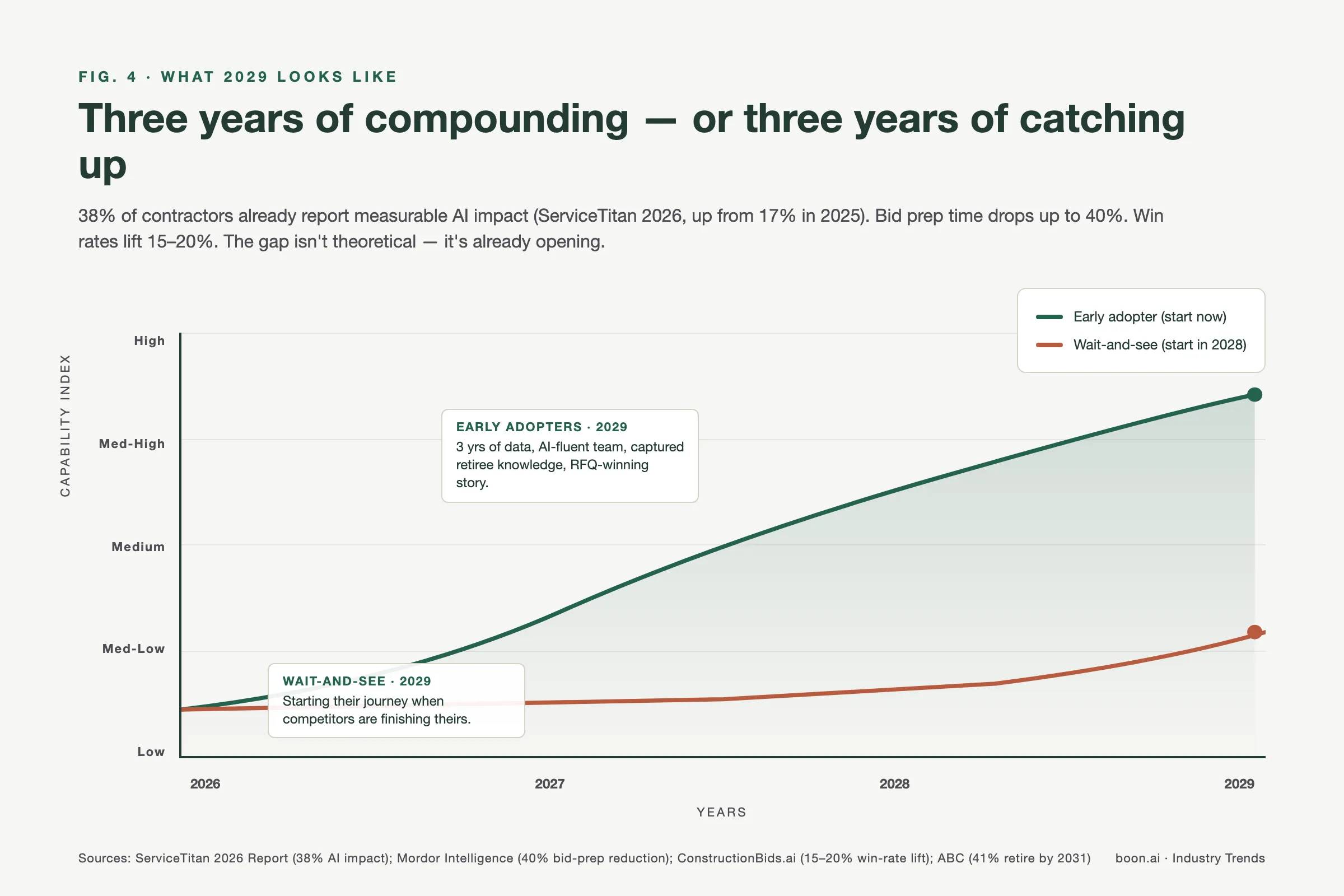
38% of contractors now report measurable AI impact . That’s more than a third of the industry. AI-enabled estimating platforms trim bid preparation time by up to 40% . Firms using these tools report 15-20% improvements in win rates .
Your competitors who moved six months ago are now bidding on projects you’re not seeing. They’re winning work you’re not pursuing. They’re protecting margins you’re still losing to manual errors.
The three-year plan is sound. But what happens in year one matters. If year one is all planning and zero execution, you’ve given your competition a head start you may not recover from.
The industry needs 349,000 new workers in 2026 , and 41% of the workforce will retire by 2031 . The knowledge walking out your door doesn’t wait for your roadmap to be complete.
The Right Balance
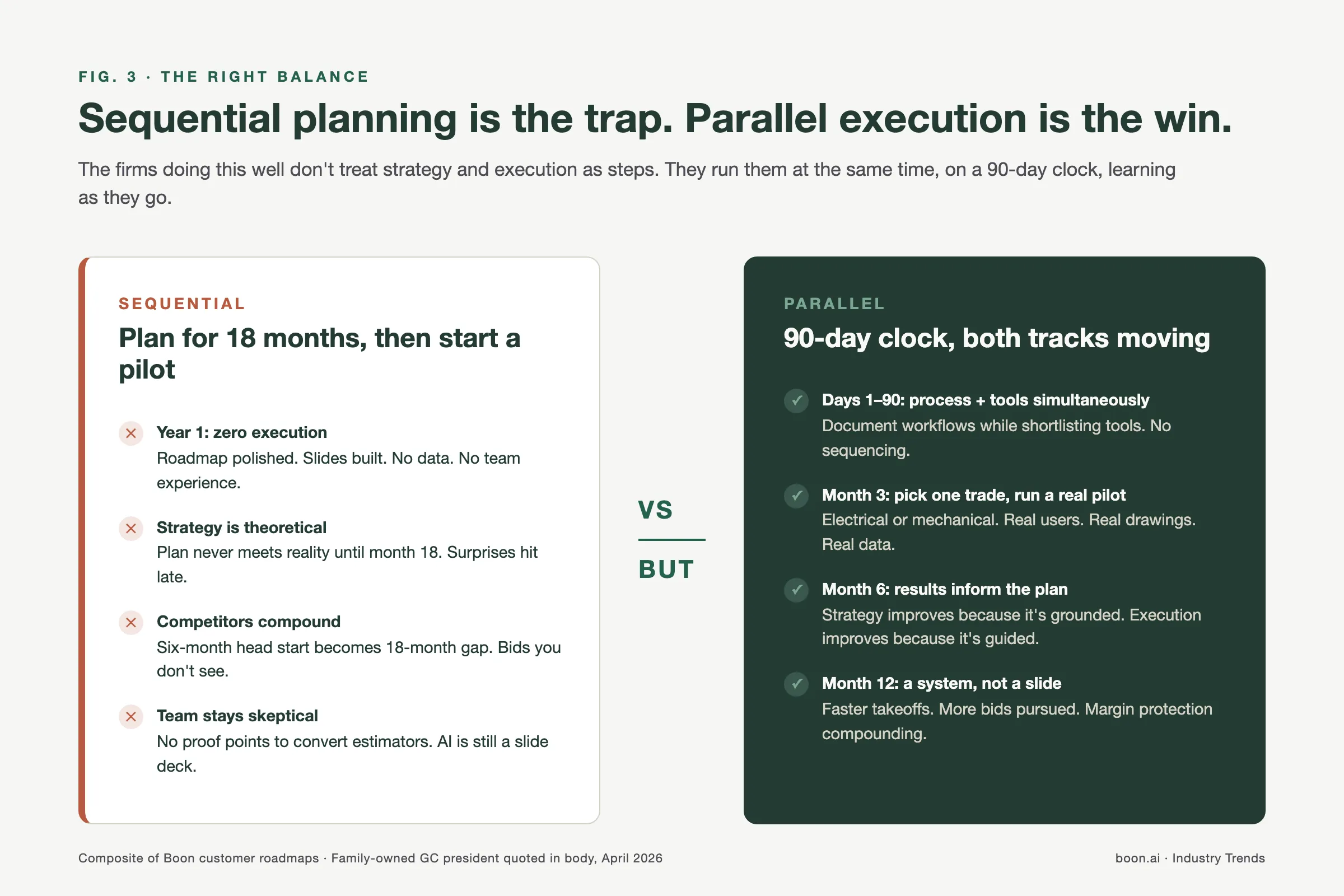
The firms I admire most are doing something that sounds contradictory but works in practice: they’re being strategic and fast.
They spend the first 90 days documenting processes and evaluating tools simultaneously. They pick one trade, one project type, and run a real pilot in month three. They gather data, adjust, and expand. By month six, they have results. By month twelve, they have a system.
They don’t treat planning and execution as sequential. They treat them as parallel. The plan improves because it’s informed by real-world results. The execution improves because it’s guided by strategy.
“Our plan was originally 18 months before we’d even start a pilot. Then I looked at what our competitors were doing and cut it to six. We’re running the pilot on electrical takeoffs right now, and we’re still working on process documentation for the other trades. Both things are happening at once.”. President, family-owned GC
What 2029 Looks Like
The firms that start now, even imperfectly, will be in a fundamentally different position by 2029. They’ll have:
- Three years of data on what works and what doesn’t
- A team that’s comfortable with AI tools, not terrified of them
- Institutional knowledge captured digitally rather than locked in retirees’ heads
- The ability to bid more work with fewer people, at higher margins
- A technology story that wins RFQs
The firms that wait will be starting their journey when their competitors are finishing theirs.
I respect the president who’d rather get it right than get it fast. That impulse will serve him well. But I’d tell him this: you can be strategic and still start tomorrow. The three-year plan is stronger when year one includes action.
Your competitors are planning for 2029 too. The difference is whether you’re building toward it or just talking about it.
Sources
- Construction Sector Digital Transformation. World Economic Forum
- ServiceTitan 2026 Commercial Specialty Contractor Report. GlobeNewsWire
- Construction Cost Overrun Statistics. Contimod
- Construction Estimating Software Market. Mordor Intelligence
- AI Construction Bidding Software Guide. ConstructionBids.ai
- Labor Demand Gap. Construction Dive / ABC
- Construction Worker Shortage. ABC Rocky Mountain Chapter
Deepti Yenireddy is the CEO and founder of Boon AI. She works with construction leaders who are thinking about where the industry is headed and how to get there without breaking what already works.