By Deepti Yenireddy, CEO, Boon AI
A pre-con manager at a family-owned GC told me something last month that I haven’t stopped thinking about. We were discussing what AI takeoff software might look like in his estimating workflow, and he paused. Took a breath. Then said: “I think this is going to scare my team.”
He wasn’t resistant. He wasn’t dismissive. He was being honest. He’d been with this company for 14 years. He knew every estimator by name, knew their families, knew who was two years from retirement and who had just bought their first house. The idea of walking into a Monday meeting and saying “We’re bringing in AI” carried weight that had nothing to do with technology.
That’s not a weakness. That’s responsible leadership. And it’s exactly what makes family-owned construction firms different.
A Different Kind of Company
Family-owned firms make up the backbone of the construction industry. They’re not running on venture capital timelines. They’re not chasing quarterly earnings calls. They think in decades, not fiscal years. Relationships, both with clients and with their own people, aren’t just important. They’re the foundation.
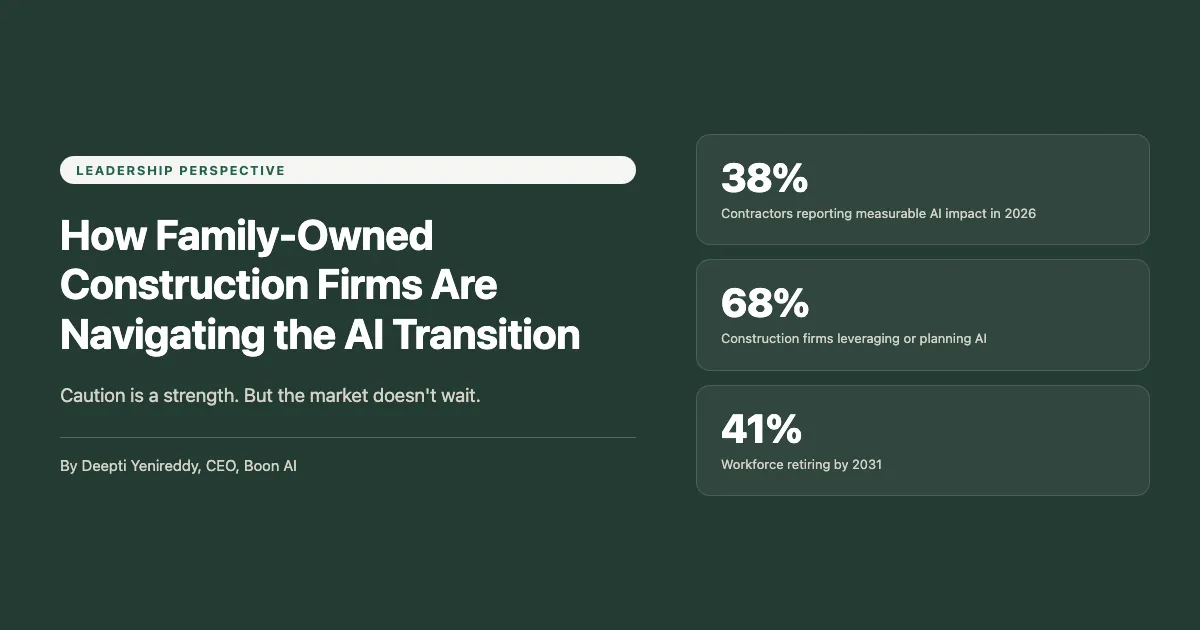
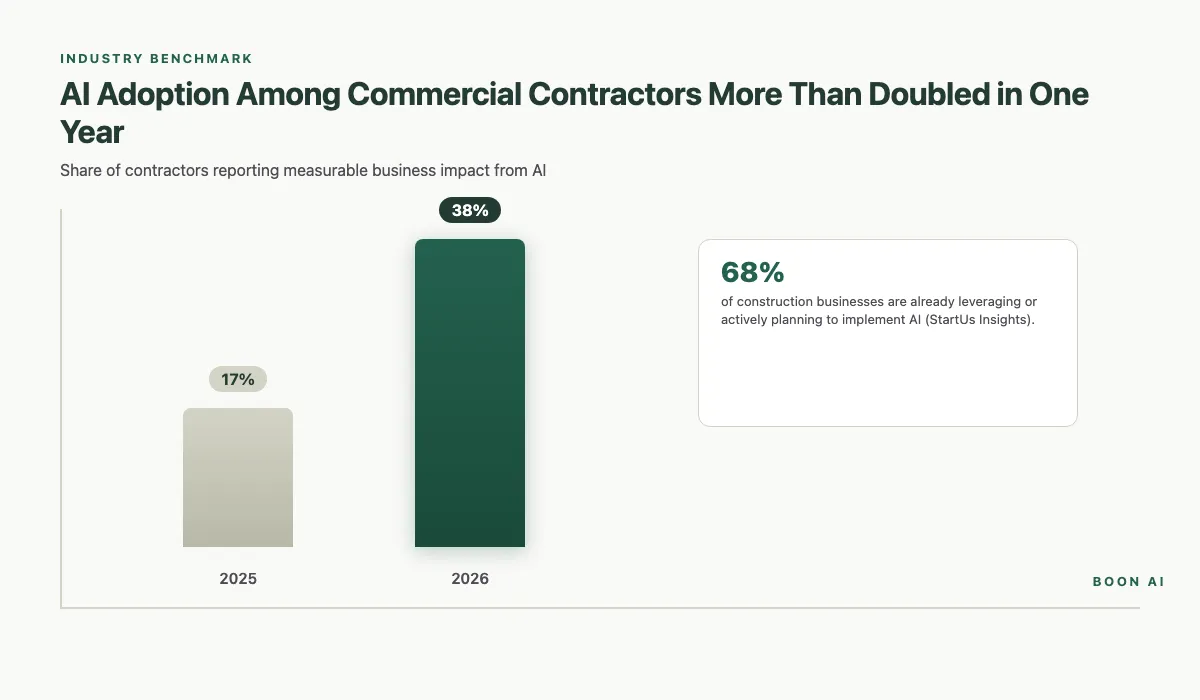
This creates a natural tension with technology adoption. The industry as a whole is moving fast. 38% of contractors now report measurable business impact from AI, up from 17% in 2025. 68% of construction businesses are either already leveraging or actively planning to implement AI. But family firms don’t move because the market tells them to. They move when they’re convinced it’s right for their people and their clients.
That caution is a strength. It’s also a risk, because the market doesn’t wait.
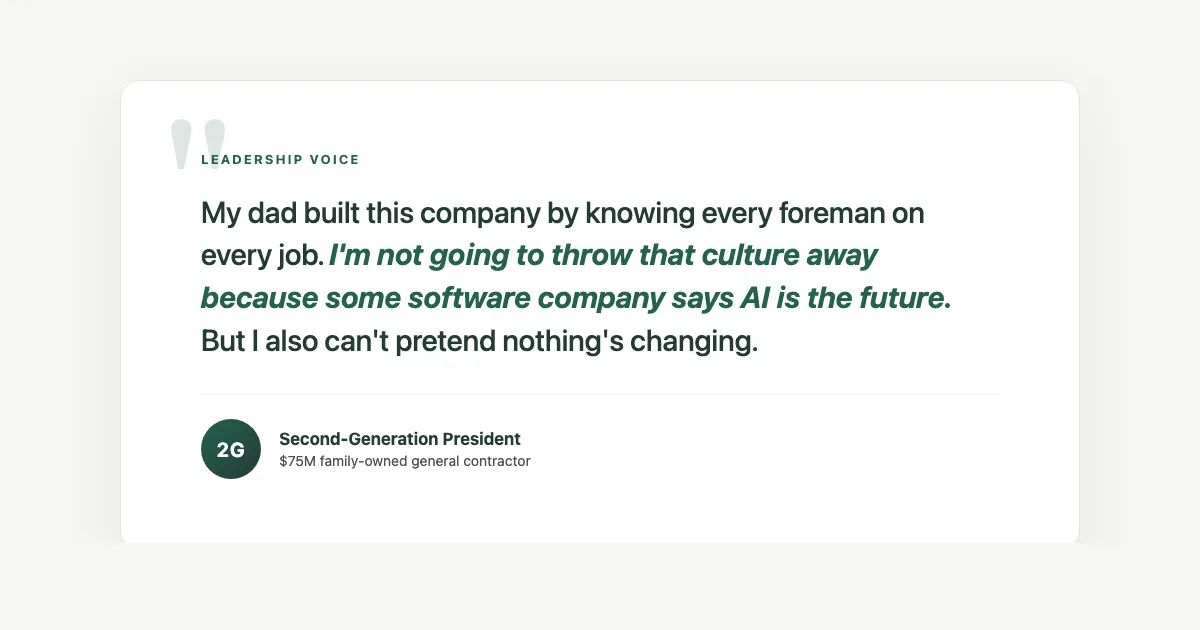
“My dad built this company by knowing every foreman on every job. I’m not going to throw that culture away because some software company says AI is the future. But I also can’t pretend nothing’s changing.”. Second-generation president, $75M GC
The Fear Factor Is Real. And Valid
When that pre-con manager said “this is going to scare my team,” he was naming something that most technology conversations skip over entirely. In a family-owned firm, the team isn’t interchangeable labor. Many of these people have been there for a decade or more. They’ve earned their spot. They take pride in what they know.
Introducing AI into an estimating workflow touches the core of what those people do. It’s not like switching project management software. It’s asking someone who’s spent 20 years developing a skill to trust a machine with part of that skill. That feels personal because it is personal.
The firms that handle this well share a common approach: they lead with honesty.
“We told our team straight up: this isn’t about replacing anyone. Our best estimator is retiring in two years. We need a way to capture what he knows and make sure the next person doesn’t start from zero. That’s what this is.”. Owner, family-run electrical contractor
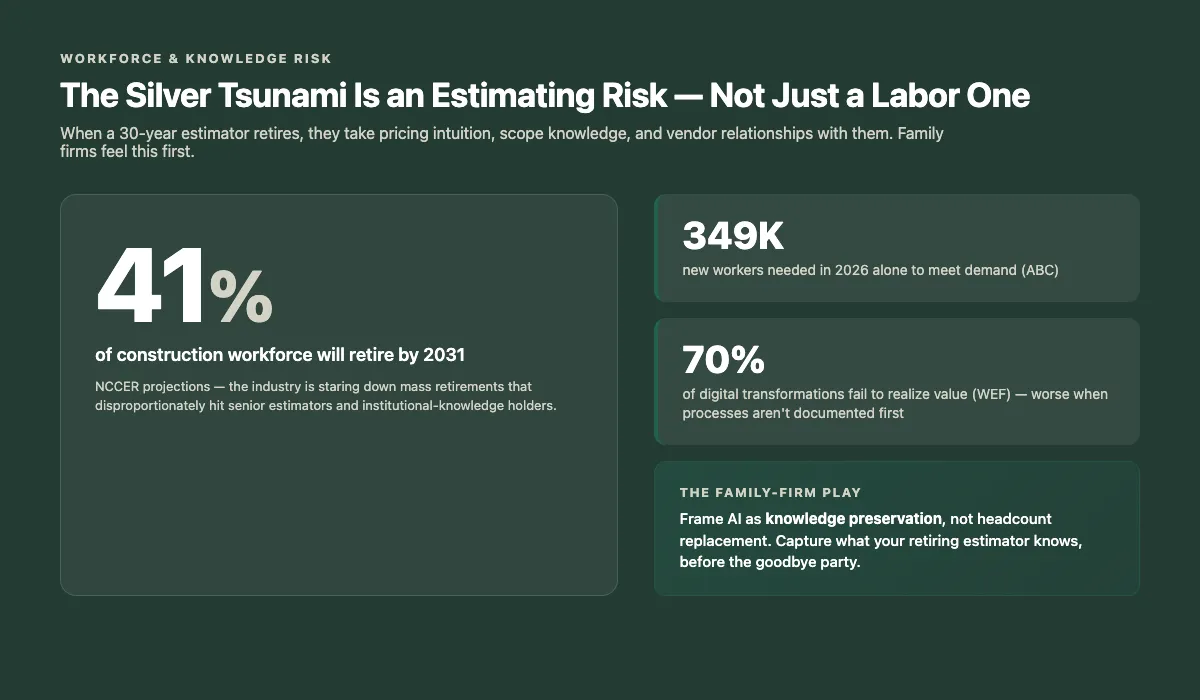
The NCCER estimates about 41% of the construction workforce will retire by 2031. For family firms, where institutional knowledge lives in the heads of long-tenured employees, this isn’t an industry statistic. It’s an existential threat. Technology adoption framed as knowledge preservation lands differently than technology adoption framed as preconstruction workflow efficiency.
The “Fix the Process First” Approach
I spoke with a president of a family-owned GC who took a deliberate approach that I find both admirable and instructive. His plan: restructure internal processes first, then choose tools.
“We spent six months documenting how we actually estimate,” he told me. “Not how we think we estimate. How we actually do it. Every estimator had their own shortcuts, their own spreadsheet templates, their own way of reading specs. Before we could adopt any technology, we needed a consistent process.”
This is sound strategy. 70% of organizations struggle to realize value from their digital transformation investments, according to a World Economic Forum study. A significant reason? They layer tools onto broken processes and wonder why the results disappoint.
The family firm that documents its processes, standardizes its workflows, and then selects technology that fits those workflows is more likely to succeed than the one that impulse-buys software at a trade show.
But there’s a caveat. And it’s an important one.
The Timing Problem
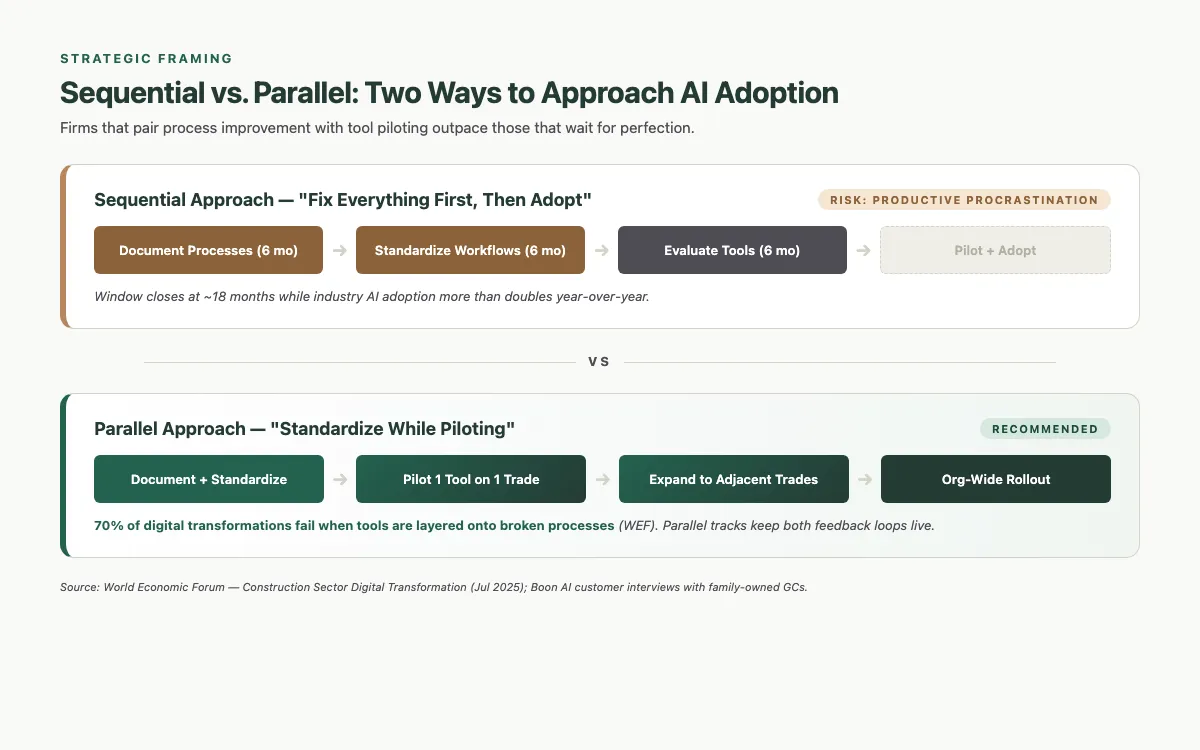
The process-first approach works. But it can also become a form of productive procrastination. If “getting our processes right” takes two years, and the market moves in 18 months, you’ve traded strategic advantage for internal comfort.
The construction industry is not moving slowly. AI adoption among contractors more than doubled in a single year. Owners are asking about technology in qualification interviews. Competitors are forming AI committees. The window for deliberate, unhurried adoption is narrowing.
“I’d rather move deliberately than make a mistake. But I’m also watching three of our competitors adopt new estimating tools this year. At some point, ‘deliberate’ starts to look like ‘late.’”. VP, third-generation family sub
The firms navigating this best are doing both simultaneously. They’re standardizing processes and piloting tools. Not waiting for perfection before taking action. Treating process improvement and technology adoption as parallel tracks rather than sequential ones.
The Generational Dynamic
In many family-owned firms, the technology conversation is also a generational conversation. The founder or second-generation owner built the business on relationships and field expertise. The next generation, often in their 30s or 40s, sees the market shifting and wants to move faster.
This tension isn’t unique to construction. But it’s sharper here because the stakes are tangible. A bad technology decision doesn’t just waste money. It can disrupt job sites, blow budgets, and damage client relationships that took decades to build.
The healthiest family firms I’ve seen treat this as a feature, not a bug. The older generation’s caution protects against reckless adoption. The younger generation’s urgency protects against falling behind. When both perspectives have a seat at the table, the decisions tend to be better.
One family firm I know created what they call a “technology council” with representatives from three generations of the family and three departments. They meet monthly. Every tool recommendation requires both a business case and a team impact assessment. It slows things down just enough to get it right while keeping things moving.
What Family Firms Get Right
Family-owned construction companies have advantages in this transition that they often underestimate:
Long-term thinking. You can invest in technology with a five-year horizon because you’re not answering to quarterly results. That patience lets you adopt more thoughtfully and with better outcomes.
Trust with employees. Your team has stayed because they trust you. That trust is your strongest asset when introducing change. Use it. Be transparent about why you’re adopting new tools and what it means for them. As one contractor put it: “Any automation for us is going to be a huge tool. Taking those repetitive tasks and putting them into an automated space.”
Client relationships. Owners who’ve worked with you for years will give you runway to modernize. They’d rather you evolve than watch you fall behind.
Decision speed. Family firms can make decisions without board approval cycles or committee bureaucracy. When you decide to move, you can move fast.
The Clock Is Running
I respect the family firm approach deeply. The care for people, the commitment to doing things right, the refusal to chase fads. These are virtues.
But the market is sending signals that are hard to ignore. Adoption is accelerating. Owners are asking new questions. Competitors who moved early are starting to show results. The firms that thrive in the next five years will be the ones that honored their values and kept pace with the market.
Whether your team starts with electrical takeoff software, HVAC takeoff tools, or a broader AI construction takeoff platform, the key is starting. Deliberate is smart. But the market won’t wait for you to be ready.
Deepti Yenireddy is the CEO and founder of Boon AI. She works with construction firms of all sizes, including many family-owned businesses navigating their first steps with AI.