By Deepti Yenireddy, CEO, Boon AI
Inside Boon Agent, the AI that runs full material audits with zero human intervention in 90 seconds.
There’s a lie embedded in most construction AI marketing.
The word is “assist.”
AI-assisted takeoff. AI-assisted estimation. AI-assisted bid preparation.
“Assist” means a human is still doing the work. The AI highlights things. It suggests things. It fills in a few fields. Then the estimator spends the next three hours doing exactly what they were doing before, except now they also have to manage an AI tool’s opinions.
That’s not a technology shift. That’s a workflow tax.
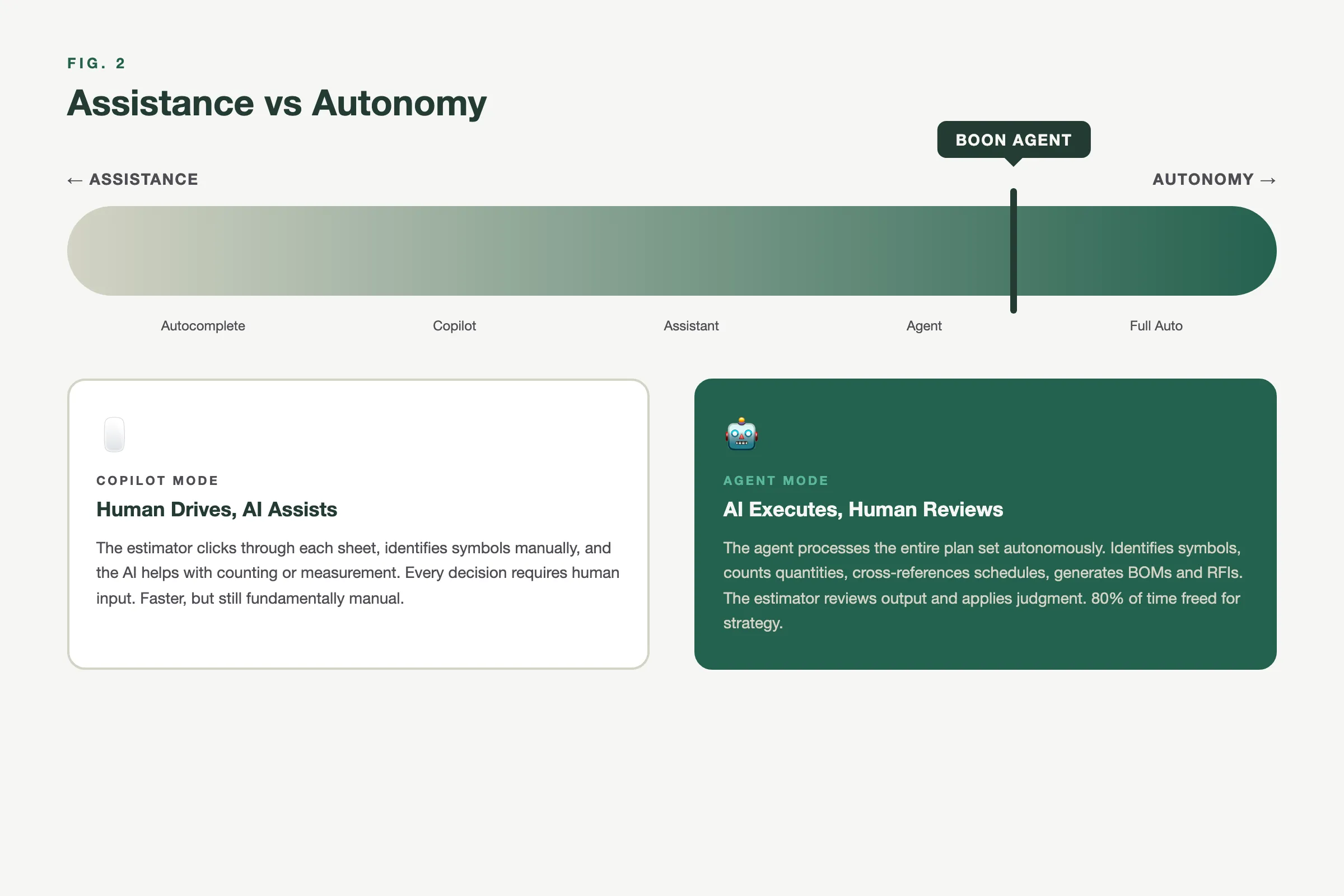
What changes the economics of preconstruction isn’t assistance. It’s autonomous execution. An AI that doesn’t just help with the work but actually does the work. End to end. Without a human hovering over it.
We built that. And an estimator proved it works by running a full 24-page electrical takeoff from his phone on a Saturday night.
The Saturday Night Takeoff
Jon Maltais, one of our power users, was at home with his family on a Saturday evening. A bid set landed. 24 pages of DD electrical drawings. The kind of package that would normally mean a full day at the desk on Monday.
Instead, he opened his phone, sent a message to Boon Agent, and told it to start.
Over the next four hours, Jon checked in from his phone every twenty minutes or so. “Start the takeoff.” “Continue with lighting.” “Add RFIs to the Excel.” Brief instructions. No laptop. No Bluebeam. No desk.
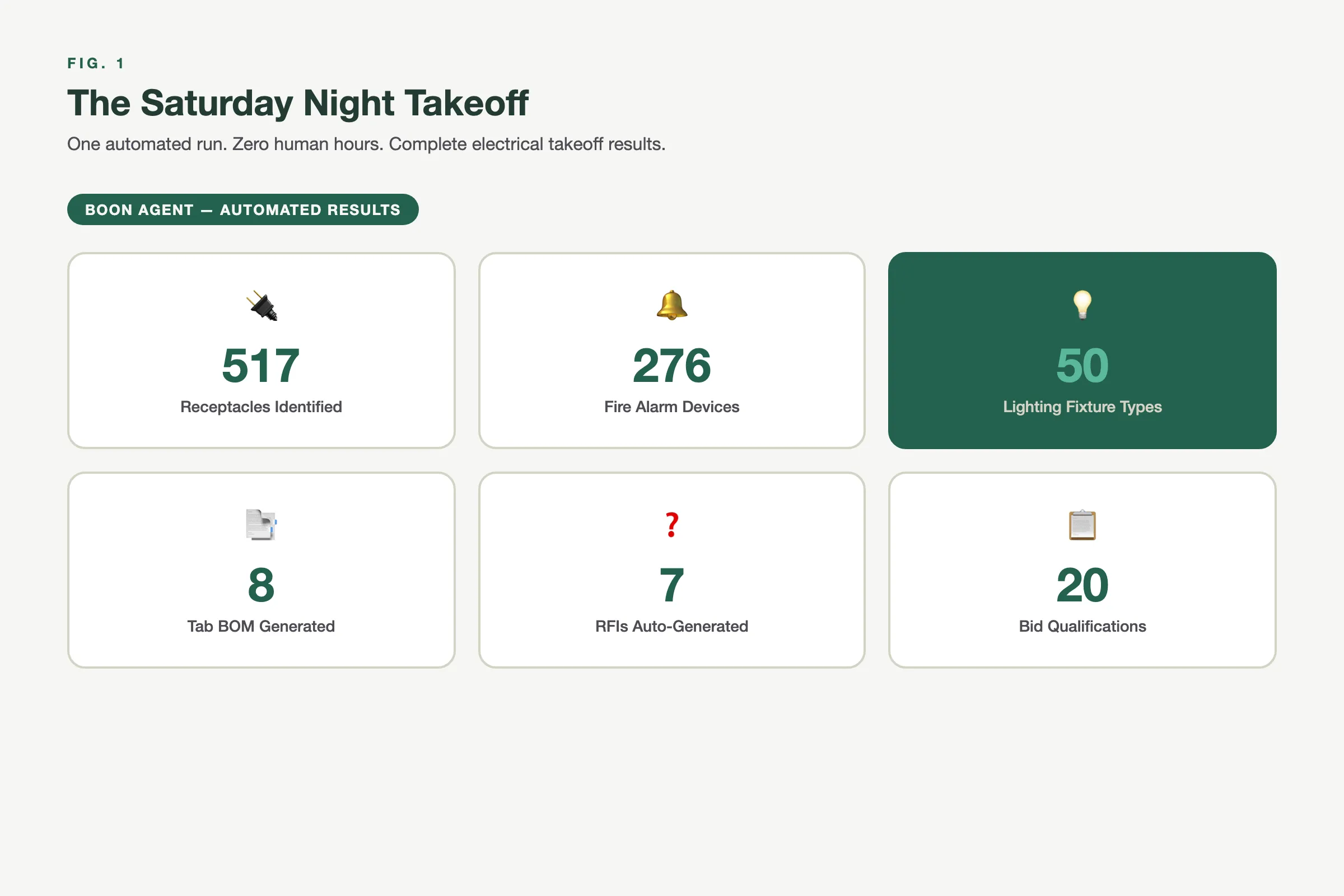
Here’s what Boon Agent delivered:
- 517 receptacles detected and counted across all floors
- 276 fire alarm devices identified and categorized
- 50 lighting fixture types extracted with schedule cross-references
- An 8-tab BOM with live formulas, organized by trade scope
- 7 RFIs flagged from spec ambiguities
- 20 bid qualifications generated from scope gaps
Halfway through the run, the underlying AI engine hit a two-hour authentication outage. Boon Agent detected the failure, automatically switched to an alternative vision analysis pipeline, and kept going. Jon didn’t even notice until after the fact.
That’s not “AI-assisted estimation.” That’s an AI employee that handles problems on its own and delivers completed work product.
What “Agentic” Actually Means in Preconstruction
The word “agentic” has become one of those AI buzzwords that means everything and nothing. So let me be specific about what it means here.
An agentic system doesn’t just respond to prompts. It maintains context across a complex, multi-step workflow. It makes decisions about what to do next. It recovers from failures without human intervention. It produces output that’s ready for the next stage of the business process, not output that requires a human to clean up, reformat, or verify.
In preconstruction, that means:
Multi-step workflow execution. A takeoff isn’t one task. It’s a chain: categorize drawings by trade, identify scope on each page, detect and count elements, cross-reference against spec schedules, compile quantities into a bill of materials, flag discrepancies as RFIs, generate bid qualifications from scope gaps. Boon Agent executes this entire chain. Not one step at a time waiting for human approval, but continuously, step after step, composing the final deliverable.
Autonomous decision-making. When the agent encounters a drawing that’s ambiguous (unclear scale, conflicting legend, low-quality scan), it doesn’t stop and ask a human. It flags the ambiguity, applies its best interpretation, documents the assumption, and continues. The human reviews the flagged items at the end, not during the run.
Failure recovery. Systems break. APIs go down. Authentication expires. Models occasionally produce malformed output. A tool that requires a human to restart it after every hiccup isn’t autonomous in any meaningful sense. Boon Agent handles these failures internally: retry logic, fallback pipelines, state preservation. The Saturday night auth outage is a real example. Two hours of infrastructure failure, zero disruption to the deliverable.
Structured output. The end product isn’t a chat response or a summary. It’s a formatted BOM in Excel with formulas, an RFI log, bid qualifications, all structured for the next step in the preconstruction workflow. Ready to send to the PM. Ready to price. Ready to submit.
The Economics of Autonomous Execution
Here’s where the math gets interesting.
A senior estimator in California costs roughly $250,000 per year fully loaded. They can typically handle 3 to 5 mid-complexity takeoffs per week, depending on trade and drawing quality.
Boon Agent completes a comparable takeoff, including BOM generation, RFI flagging, and bid qualifications, with zero human intervention during execution. The estimator reviews the output, makes corrections on the 5% that needs attention, and moves on.
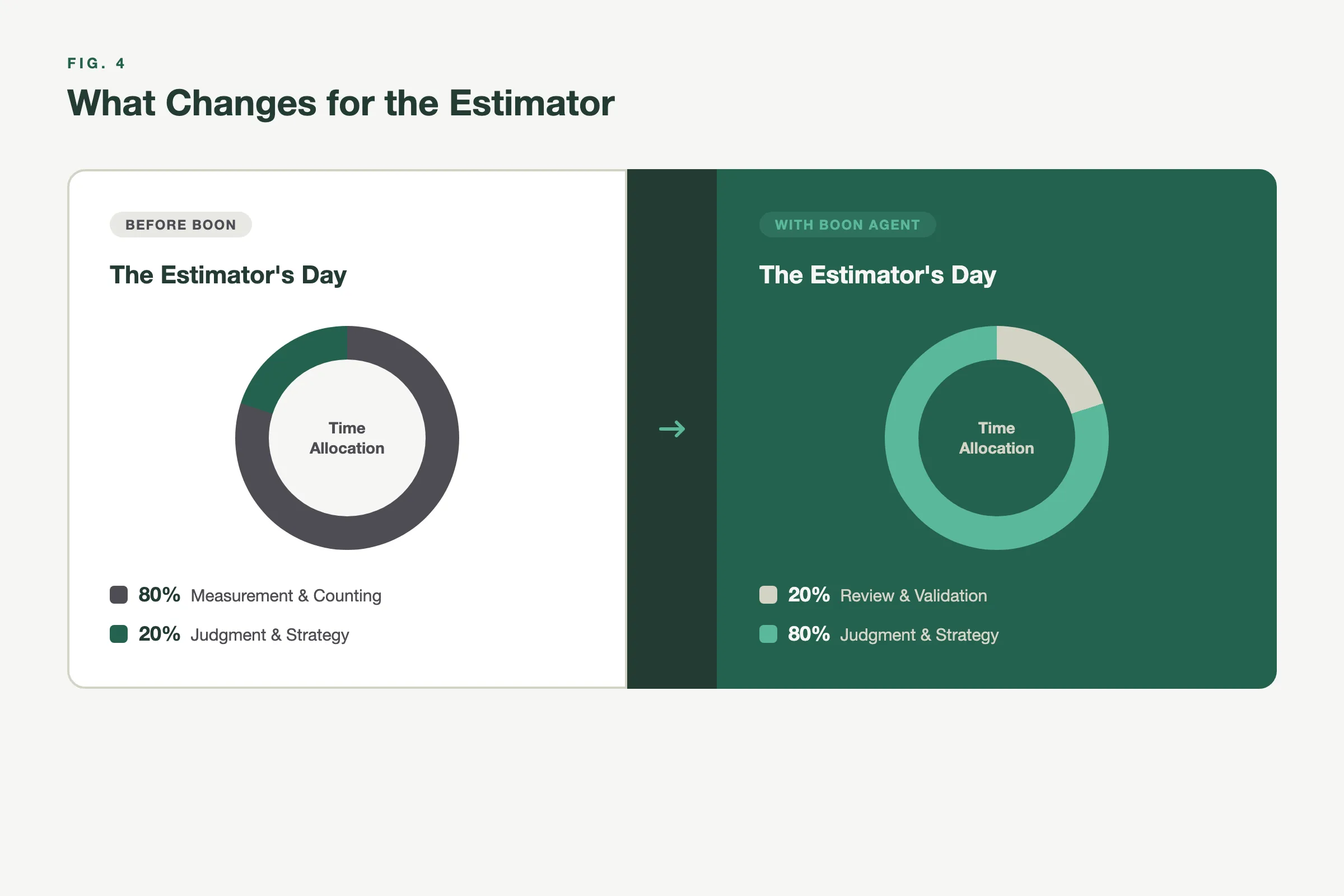
This doesn’t replace the estimator. It changes what the estimator does. Instead of spending 80% of their time on measurement and counting (the mechanical work), they spend 80% of their time on judgment work: reviewing flagged items, making scoping decisions, refining pricing strategy, talking to subcontractors.
One estimator working with Boon Agent has the throughput of three estimators working without it. Not because anyone is working harder. Because the AI is doing the grunt work that doesn’t require senior judgment.
Multiply that across a preconstruction department of 10 estimators. You’ve just gained the capacity of 20 additional estimators without hiring anyone. In an industry with a documented labor shortage, that’s not a nice-to-have. It’s the difference between bidding 40 projects a quarter and bidding 120.
Why Speed of Autonomy Is the Real Metric
The typical metrics for construction AI are time savings and accuracy. Both matter. But they miss the more fundamental shift.
The metric that matters for the next generation of construction AI is the ratio of human time to autonomous execution time.
If a takeoff takes 4 hours of total compute time but requires 3.5 hours of human involvement, you have a tool with a thin automation layer. If the same takeoff takes 4 hours of compute time but requires 15 minutes of human review, you have something categorically different.
Here’s how to think about where Boon Agent sits:
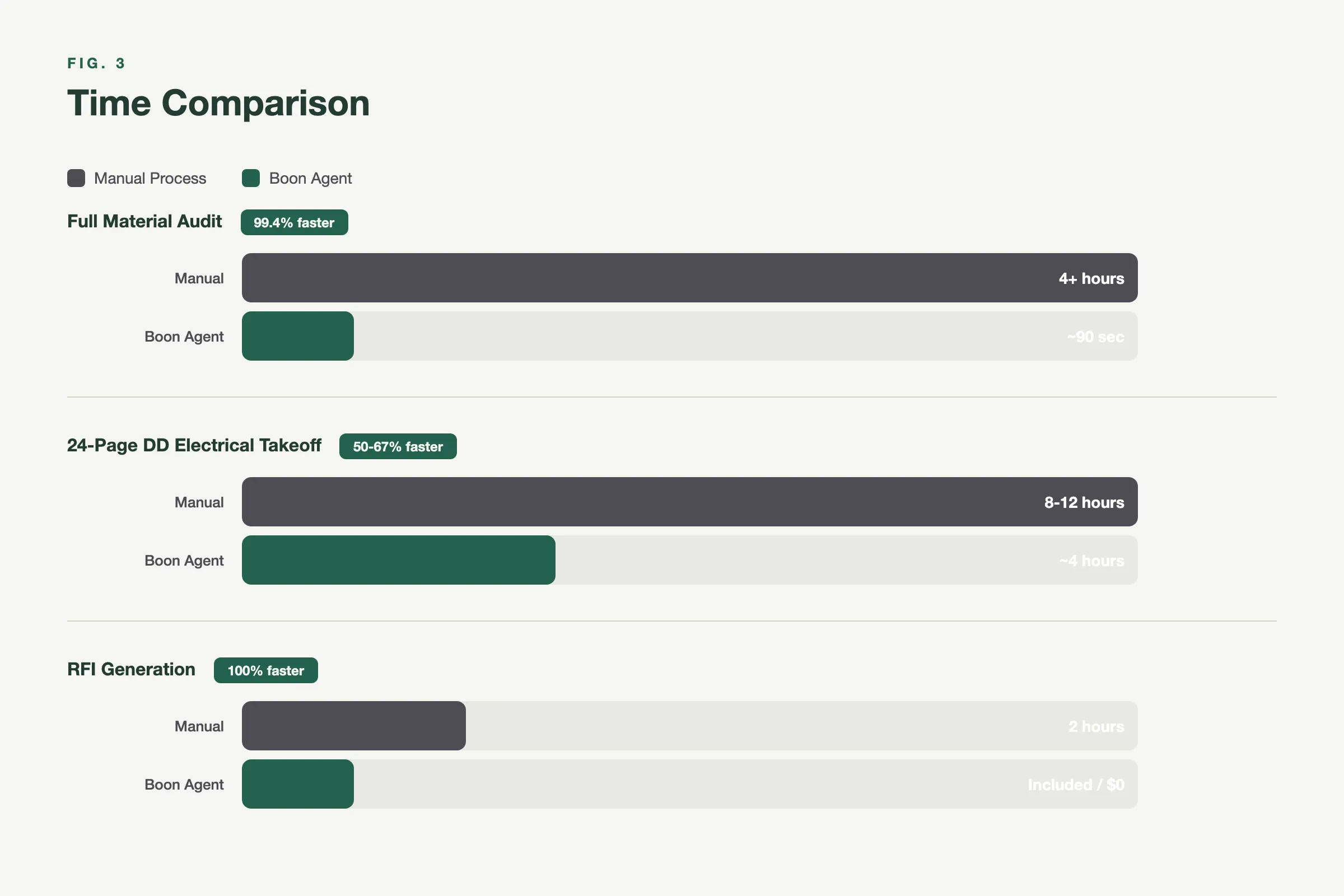
- Full material audit: ~90 seconds of autonomous execution. Previously 4+ hours of senior engineer time.
- 24-page DD electrical takeoff: ~4 hours of autonomous execution. Previously 8 to 12 hours of estimator time. Human review time: 30 to 45 minutes.
- RFI and bid qualification generation: Included in the takeoff run at zero additional time. Previously a separate 2-hour task.
The human-to-autonomous ratio on these workflows has shifted from roughly 95:5 (human doing most of the work with AI assistance) to 10:90 (human reviewing and directing, AI executing).
That ratio is the agentic velocity metric. And it’s the number that tells you whether a construction AI company has built something real or something that demos well but doesn’t change anyone’s workflow.
What Comes Next
The Saturday night takeoff was a single estimator on a single project. But it demonstrated something that scales.
If an AI agent can autonomously execute a full electrical takeoff from a phone command, the same architecture applies to mechanical, structural steel, civil, and architectural. Each trade scope becomes a skill the agent can run. Each project becomes a dataset that makes the next run better.
The vision is straightforward: a preconstruction department where AI agents handle the mechanical execution of estimation around the clock, and human estimators focus entirely on the judgment, strategy, and relationships that actually win bids.
We’re not building toward that future. We’re already running it in production. On a phone. On a Saturday night.
Boon Agent executes full takeoffs autonomously, including BOM generation, RFI flagging, and bid qualifications. An estimator recently ran a complete 24-page DD electrical takeoff from his phone while at home with his family.
If you want to see what autonomous preconstruction execution looks like, book a demo.
Ready to see autonomous takeoffs in action?
Book a 20-minute demo and watch Boon Agent execute a full takeoff on your own drawings.