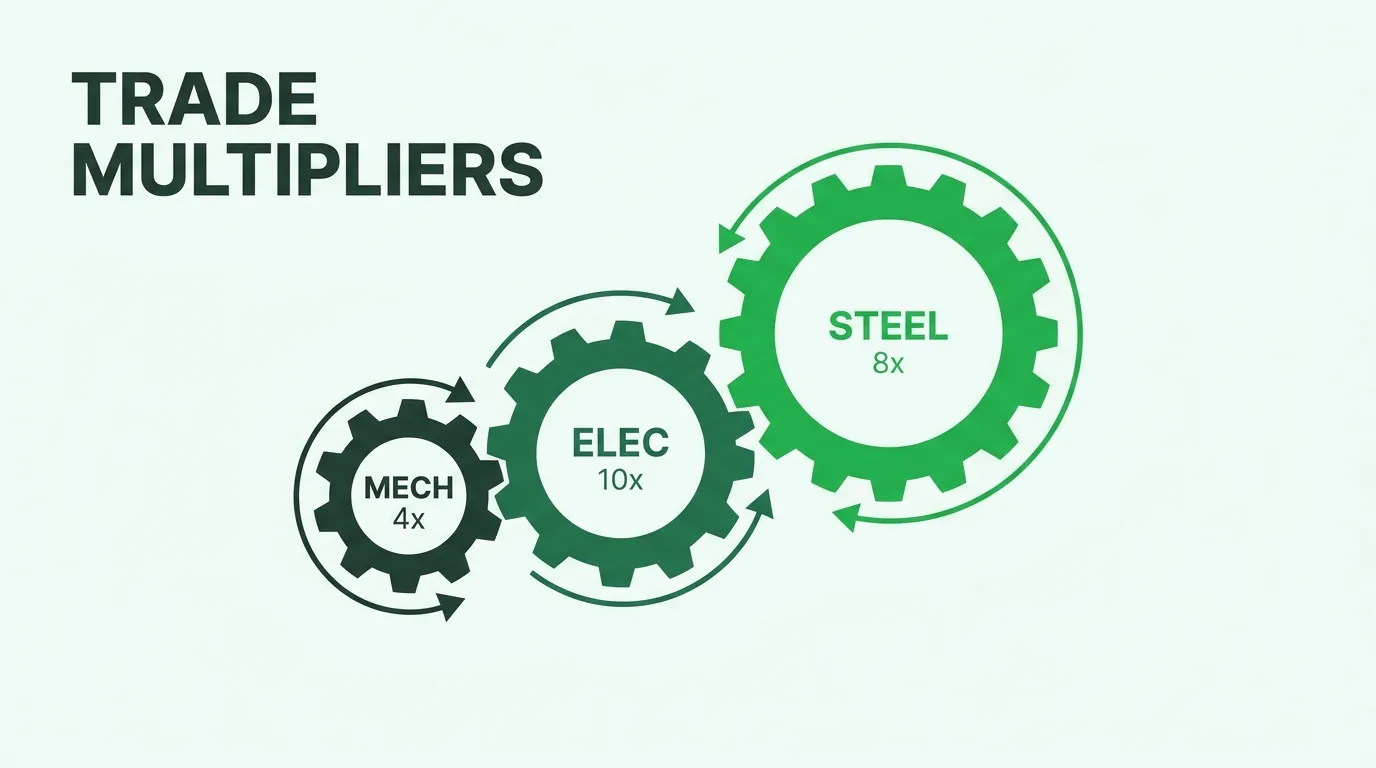
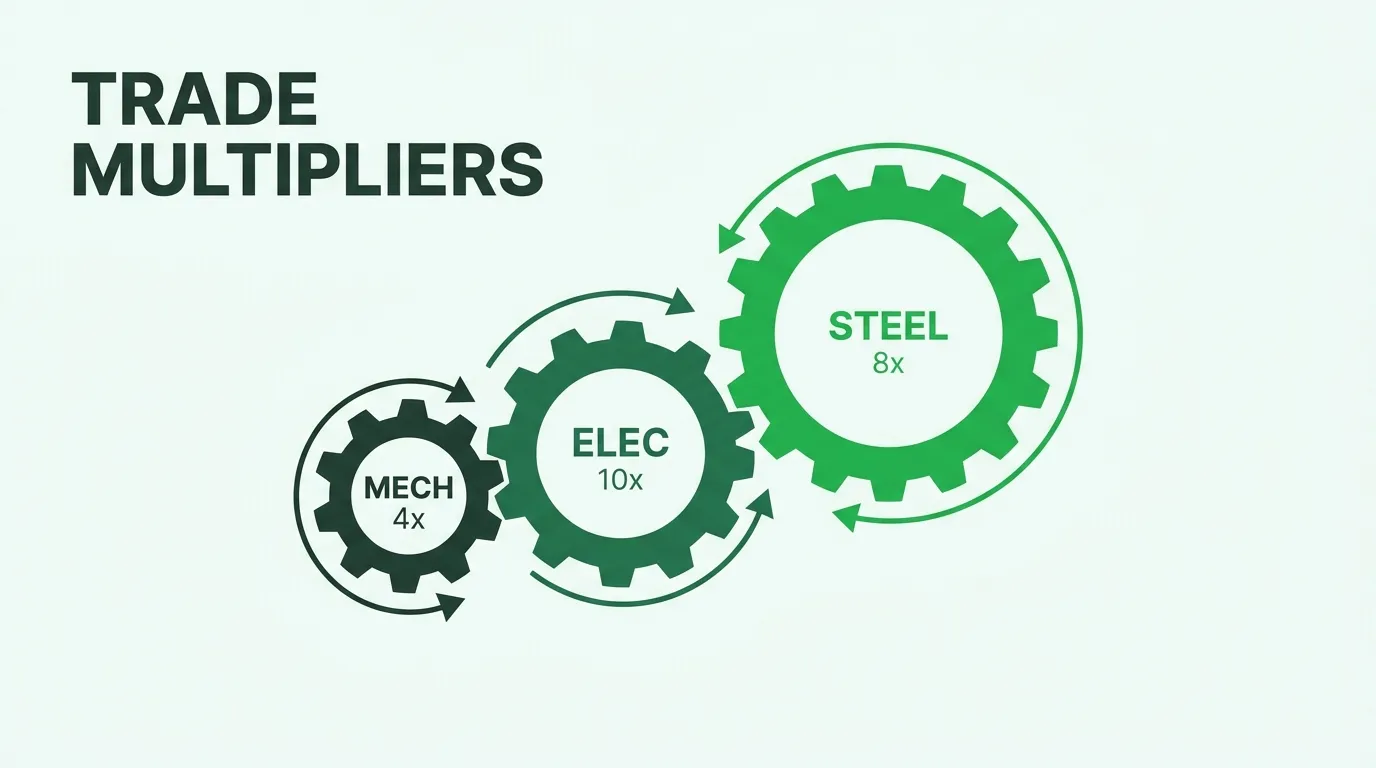
One-line takeaway: The compression is not a technical stat, it’s a business unlock. Steel firms get 10x pursuit capacity. Mechanical firms get 4x. The trade-shape decides your ROI ceiling before you buy any tool.
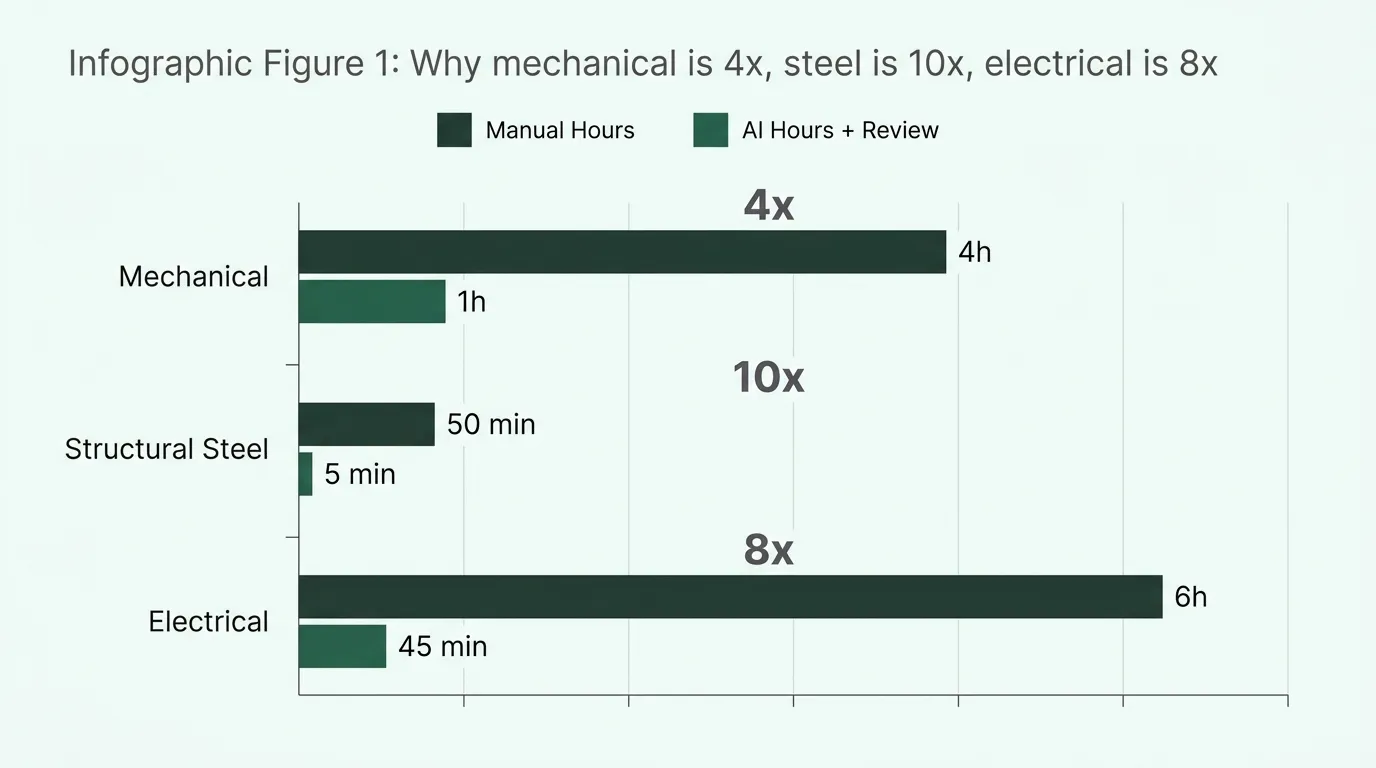
The trade multipliers show up as soon as you start measuring elapsed hours instead of quantity accuracy. On the sets I have been running the last two months the shape is consistent: mechanical takeoffs land near a 4x compression, structural steel closer to 10x, electrical around 8x. Those are ratios of manual hours to hours-including-review, not raw AI throughput. The variance is not because one trade’s AI is better than another. It is because the trades produce different kinds of drawings.
Start with mechanical. A ductwork or piping set is dense. There is a lot of geometry per sheet, and the quantifiable scope is well drawn, but the fittings and transitions are numerous and the schedule-implied additions are constant. AI compresses the raw counting work by ten or twenty times. The estimator’s review pass then adds back non-trivial minutes because there is real trade knowledge to apply on every mechanical set: transition fittings that always exist, room-pair connections that live in the schedule, drop-and-rise geometry the mechanical sheet does not draw. That is why mechanical lands at 4x, not 10x. The review pass is real work, and mechanical is the trade where that work is largest.
Structural steel is the other end of the spectrum. A steel set is a tag-count job. Beams, columns, connections, everything is tagged and scheduled and the geometry is spare. AI reads the tags cleanly, matches them against the schedule, and produces a count that a senior estimator can spot-check in a few minutes. There is very little undrawn scope in structural steel because the fabricator would refuse to price a set that leaves connection details to inference. So the estimator’s review pass is short, the manual counting was long, and the compression lands near 10x. On the specialty subcontractor sets I have run, structural steel is the closest thing we have to full automation, and the estimator’s role becomes review and QA rather than production.
Electrical is intermediate density and intermediate 8x. There is drawn scope, tagged and countable: devices, homeruns, panels. There is also judgment scope: whether a given panel is fed from the closest transformer, whether a homerun is 20A or 30A given a piece of gear on a different sheet, whether the AI’s device count includes or excludes fire alarm devices depending on how the specs are structured. The device-counting part compresses hard. The panel and gear judgment stays estimator-only. Net comes out around 8x on the sets I have seen.
The takeaway is not that mechanical is worse than steel. It is that different trades have different amounts of undrawn scope, and undrawn scope is the estimator’s job forever. The trades with the least undrawn scope compress the most. The trades with the most compress the least. The multiplier you should expect for your work is knowable before you buy any tool, and it is knowable from your own bids.
The way to calibrate for your firm is to pick three recent bids across your primary trade, run the AI, time the review, and compute the ratio. If your ratio comes out lower than the numbers above, that is not necessarily a problem with the tool. It usually means you carry more experience-adds than average, which is a strength. Your review pass will always be longer than a firm that trusts the drawings literally. The compression is smaller in absolute terms, but the value of your review is larger.
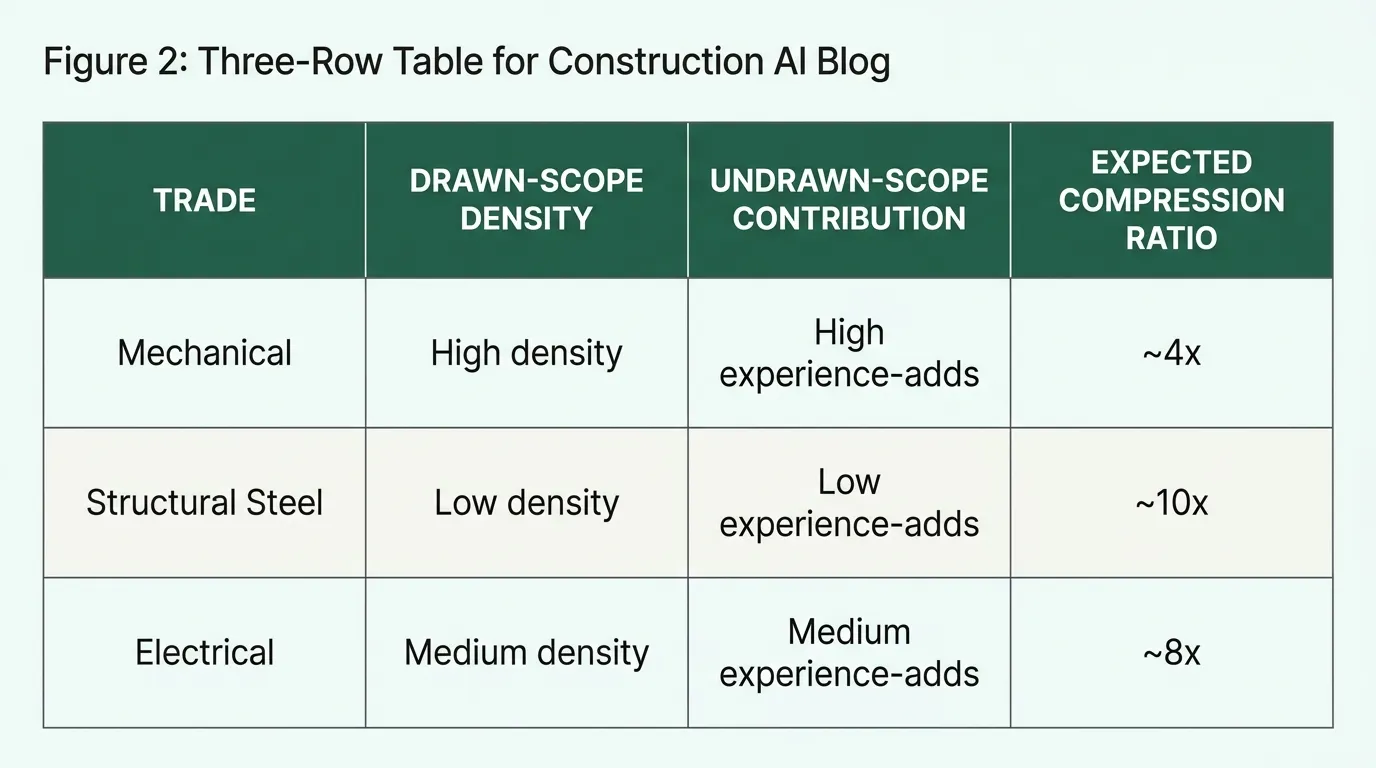
There is a second-order lesson in the ratios. The trades that compress the most are the ones where AI can meaningfully change your bid capacity. Structural steel firms can chase 10x the pursuits per estimator without additional hires. Mechanical firms can chase 4x. Electrical firms can chase 8x. That is a very different business shape by trade, and it maps directly to where AI creates the most strategic optionality for the firm rather than just individual estimator time savings.
The bid-capacity implication is next week’s post. This week the point is narrower: measure your own ratio, calibrate to your own trade and your own drawings, and use that number as the input to every AI takeoff purchase decision you make.