Electrical Takeoff Software: What Changes When the AI Actually Reads the Drawings

By Deepti Yenireddy
Electrical estimators have a Friday problem.
It looks like this. The bid is due Monday. Three packages came in this week. The set you're staring at is 187 sheets. Branch circuits are scattered across nine drawings. Panel schedules are in the spec book, not the plans. Fixture types are called out on the lighting plan but counted by symbol on the power plan. You have about sixteen hours of focused time between now and the deadline, and most of it is going to be spent moving a highlighter across drawings and tapping numbers into a spreadsheet.
This is the part of estimating nobody trained for. Branch-circuit counting, fixture takeoff, conduit run lengths. You learned it on the job because somebody had to do it. The senior estimator who actually wins the work does almost none of this. The bottleneck is junior labor you can't hire fast enough, and the cost of getting it wrong shows up months later as a change order or a missed bid.
So when a vendor walks in and says their AI does electrical takeoff in minutes, the right question isn't "how fast." It's "how right." Most of the AI takeoff tools that landed in your inbox over the last twelve months were trained on architectural plans. Walls, doors, openings. They demo well on the plans they were trained on. Hand them a $30M electrical package and the accuracy collapses, because a branch circuit isn't a wall and the model has never seen one labeled correctly.
That's the problem we built around.
The trade
The shorthand version of what Boon does on an electrical package: you send us the bid set, we run takeoff on every trade in it, and every quantity we report back is clickable down to the region on the drawing it came from.
The longer version is the part that matters.
Our model reads electrical the way an electrician reads it. Branch circuits get traced across home runs and panel feeds. Devices are typed by symbol legend and cross-referenced to the schedule. Conduit runs are measured along their actual route, not the bird's-eye distance. Light fixtures are counted per drawing and reconciled to the lighting schedule. When the panel schedule in the spec book disagrees with the panel feeds on the one-line, we flag it before it becomes a change order.
The output isn't a black box. Every number has a source. Every count, every length, every fixture type lands in a takeoff report with a click-through to the polygon on the drawing it was measured from. If the AI is wrong, you can see exactly where and fix it in a few clicks. If the AI is right, your estimator spends the rest of the day on the judgment calls that need a human. Material price spread across vendors. Sub coverage on the harder portions of the package. The kind of thinking nobody hires you to do because you're stuck counting receptacles.
The point isn't speed for its own sake. The point is what an estimator can do with the hours that come back. A team that used to ship two bids a week ships four. The same firm bids more work, on bigger packages, with more confidence, because the accuracy is verifiable and the audit trail is intact.
Marathon
Marathon Electrical is an electrical contractor that runs preconstruction at a scale most firms haven't seen. Bradley Brock, their VP of Preconstruction, has been working with us for the better part of a year. He's been blunt about what works and what doesn't, which is what you want from a customer.
The bid Bradley talks about most is the one where Marathon's estimating team had two large packages due the same Friday and one estimator out for a family event. The kind of week that, in a normal year, means you no-bid one of them. Marathon ran both through Boon and submitted both. They won one and were second on the other. The lesson Bradley draws from it isn't about hours saved. It's about the bids the firm gets to compete on that it otherwise wouldn't.
I won't put a quote in his mouth that he didn't say. What I'll say is that the conversations with Marathon have shaped how we build. The reason we publish per-trade F1 every month is because Bradley asked us to, on a call where he told me that vendors who quote a single accuracy number aren't telling him anything useful about his trade.
Receipts
If a vendor talks about AI takeoff accuracy without mentioning F1, walk away.
Precision is the share of things the AI marked that were actually on the drawing. Low precision means false positives, and your team spends Friday afternoon deleting work. Recall is the share of things on the drawing that the AI caught. Low recall means false negatives, and your bid is short by the things that didn't make it in. F1 is the harmonic mean of the two. It moves with whichever side is weaker. It's the metric an engineer would ask for, and it's the one a marketing site doesn't want to show you.
"95% accuracy" is a marketing number. F1 is an engineering number. The other thing to ask for is per-trade. An average F1 across every trade we support is a number you can hide things behind. Per-trade F1 is the number that tells you whether the tool actually works on the package you're holding.
We publish ours. Every month. Per trade.

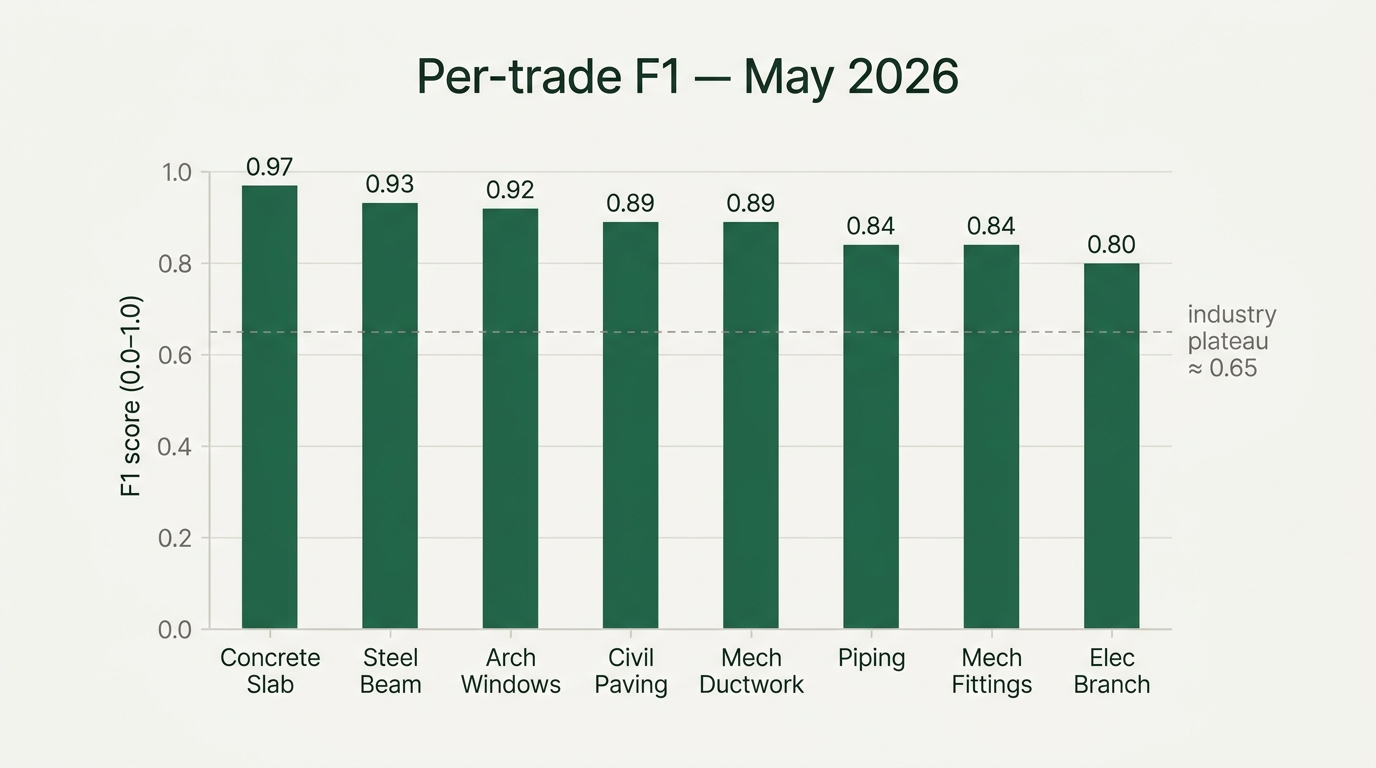
| Trade | F1 (May 2026) |
|---|---|
| Electrical (branch circuits, devices, fixtures) | 0.80 |
| Mechanical (ductwork, equipment) | 0.89 |
| Piping (centerline) | 0.84 |
| Steel (beam centerline, columns) | 0.93 |
| Architectural (windows, doors, walls) | 0.92 |
| Concrete (slab, footings) | 0.97 |
Electrical at 0.80 is honest. Not flattering. Honest. It's the trade where our recall on small symbols and on hand-drawn callouts is still climbing. We expect it to be at 0.85 by end of summer, and we'll tell you the month we get there. Concrete at 0.97 is where you'd hope a vendor's strongest trade lands. The point isn't that the numbers are perfect. The point is that they're real, they move month over month, and you can hold us to them.
Architecture
You don't have to care about the architecture for this part to matter, but it explains why the F1 trajectory looks the way it does.
Most AI takeoff vendors built one model per trade. Thirty-something siloed classifiers, each learning in its own corner. What the model figured out about ductwork didn't help it read pipe. The flywheel never compounded.
We built one. One shared model reads every trade. Architectural, electrical, mechanical, structural, civil, all going through the same backbone. On top of that backbone sit trade-specific heads, one per trade, that handle the parts that are genuinely different. A relational reasoning layer connects elements across drawings and across the spec book.

What compounds is the cross-trade learning. What the model learns about wall labels improves duct routing. Pipe segmentation makes clash detection sharper. Every new labeled drawing improves every trade, not just its own. That's the reason the mechanical F1 climbed from 0.59 to 0.82 in a single month earlier this year on the same underlying model, with no headcount added. The backbone got better. Every trade got better.
Three things
I get asked the same question by buyers across the industry. What separates the takeoff tools that will be running production bids next year from the ones that get unplugged by Q4. My answer has hardened into three things.
The first is the foundation model. One shared backbone trained on every trade's labeled drawings, not a bag of single-trade classifiers. Without it, every trade has to be solved separately, and the accuracy plateaus. The vendors who didn't build this six months ago aren't going to catch up.
The second is the data. Construction drawings aren't on the open internet at scale. The labeled corpus that lets a model read electrical the way an electrician reads it took us years to assemble, with customer permission, under NDA. There's no shortcut to it. A vendor who started training on construction drawings this year is two years behind, and the gap widens because the customer-feedback loop compounds for whoever is running production bids today.
The third is the audit trail. An AI takeoff that an estimator can't trace back to a region on a drawing is a liability, not a tool. Every quantity has to click down to the polygon it was measured from. Every assumption has to be visible. Without this, no senior estimator will sign their name to the bid, and the bid is the only thing that matters.
We've built all three. Most of the field has built one. None of the three is enough alone.
The strongest argument I can make is the agent running on your own package.
Send us a real electrical bid set on a trade where bid risk lives. We'll run Boon on it end-to-end and walk you through the output, every quantity traceable to a region on a drawing. If the F1 doesn't land where we said it lands, that's a useful answer too. We'd rather hear it from your package than from your reference call.
Book a thirty-minute call with me: calendly.com/deeptiyr.
Deepti Yenireddy is the founder and CEO of Boon. The Boon takeoff product is at getboon.ai/electrical-takeoff-software.