By Deepti Yenireddy, CEO, Boon AI
Let me tell you about a conversation I had with the CFO of a $200M specialty contractor last month. I asked him how many projects his team bids per quarter. He said around 40. I asked how many they win. He said six or seven. Then I asked the question that stopped him: how many projects did they not bid last quarter because their estimators were buried?
He didn’t know the number. But he knew it wasn’t zero.
That’s the cost that never shows up on a P&L. Not the overruns. Not the rework. The work you never pursued because your preconstruction team was drowning in manual takeoffs for the projects already on their desk.
The Number Your Board Should Know
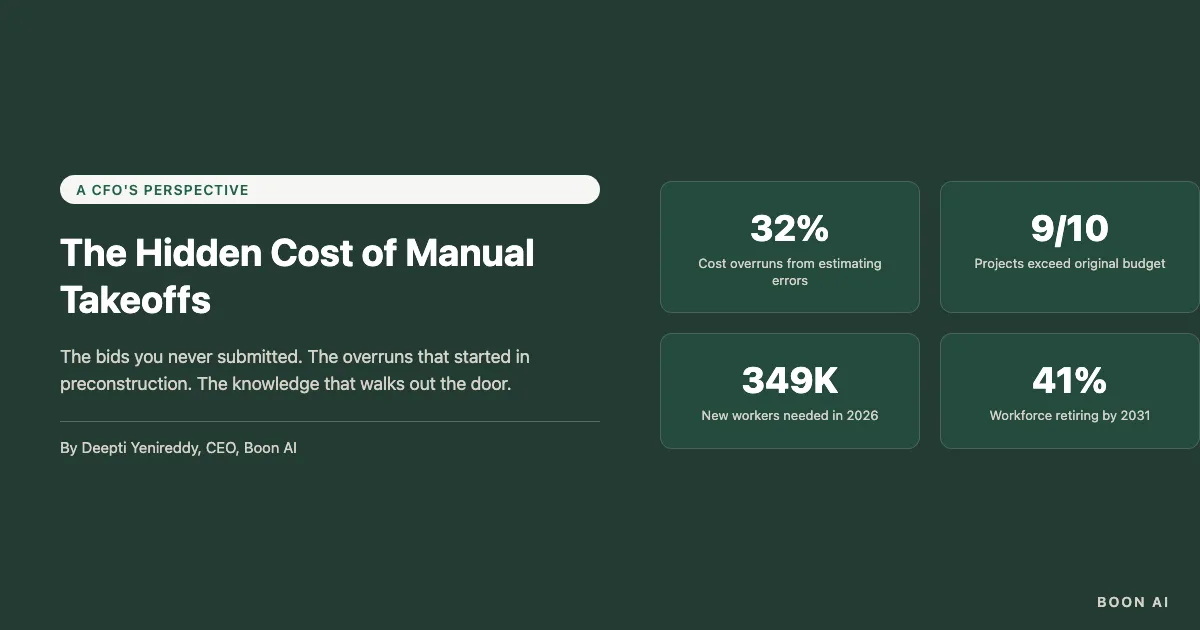
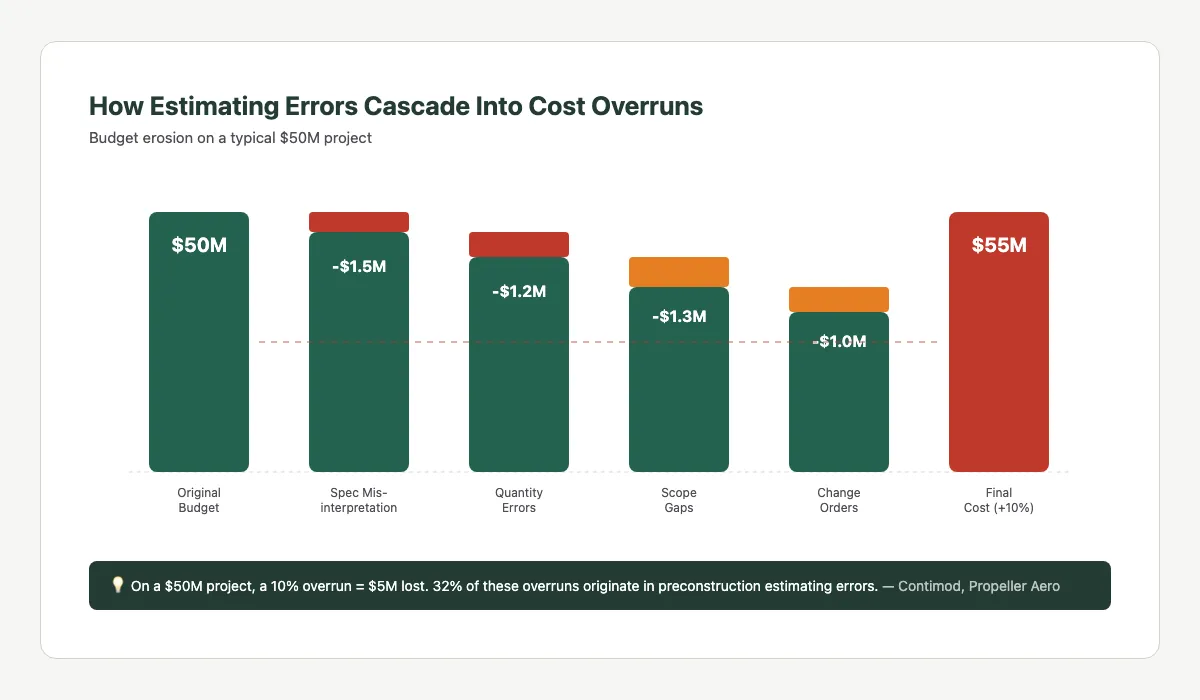
32% of construction cost overruns trace back to estimating errors. That’s not a rounding error. On a $50M project, a cost overrun in the range of even 10% means $5M walking out the door, and nearly a third of the time, the root cause is something that happened in preconstruction. Before a shovel hit dirt.
For the person signing checks, this should be a fire alarm. The industry average for cost overruns sits at 28% across all projects, with nine out of ten projects exceeding their original budget. These aren’t outliers. This is the norm. And the financial exposure starts in the estimating department.
“I always assumed our overruns were a field problem. When we actually traced them back, more than half started with something we missed in the specs or got wrong in the takeoff.”. CFO, regional mechanical contractor
The Estimator’s Day, by the Numbers
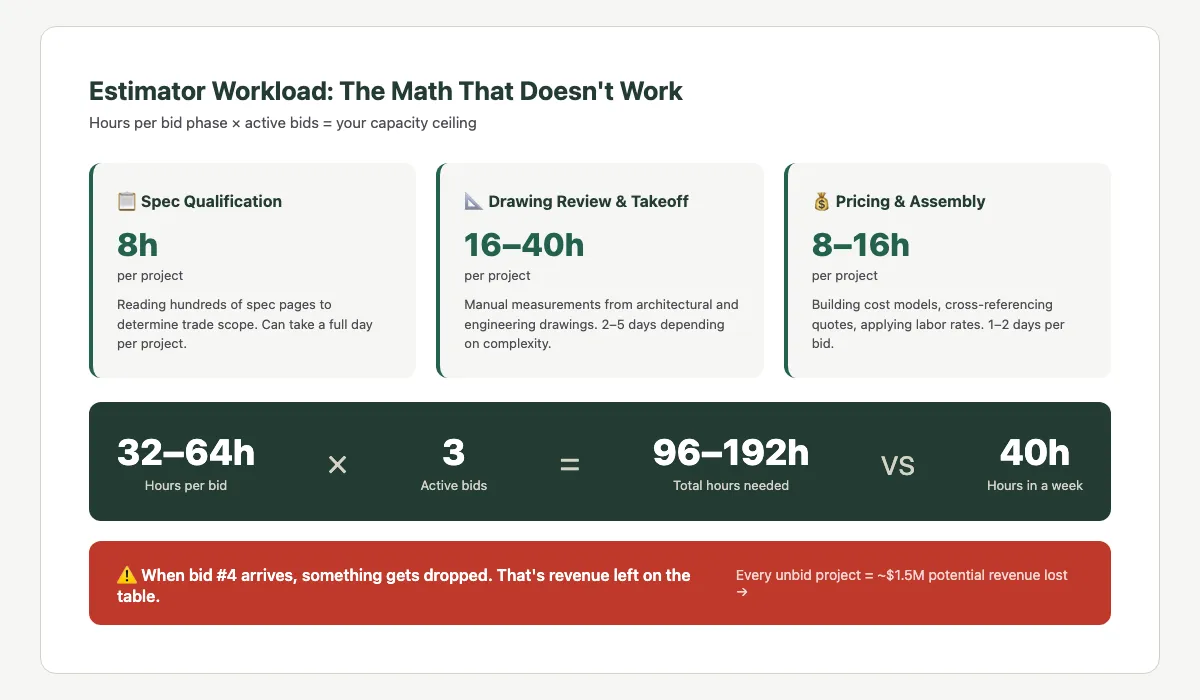
Here’s what a typical estimator’s week looks like at a mid-market GC or sub. They’re working on two or three active bids. Each one requires:
- Spec qualification: Reading through hundreds of pages of specifications to determine what’s in scope for their trade.
- Drawing review and takeoff: Manually measuring quantities from architectural and engineering drawings. 2-5 days per project.
- Pricing and assembly: Building the cost model, cross-referencing supplier quotes, applying labor rates. 1-2 days.
Multiply that across three active bids and your estimator is working flat out. When bid #4 arrives, something gets dropped. That’s revenue lost every quarter.
“We had an estimator spend three full days on spec qualification for a project we ended up no-bidding.”. VP of Preconstruction, national GC
The Bids You Didn’t Submit
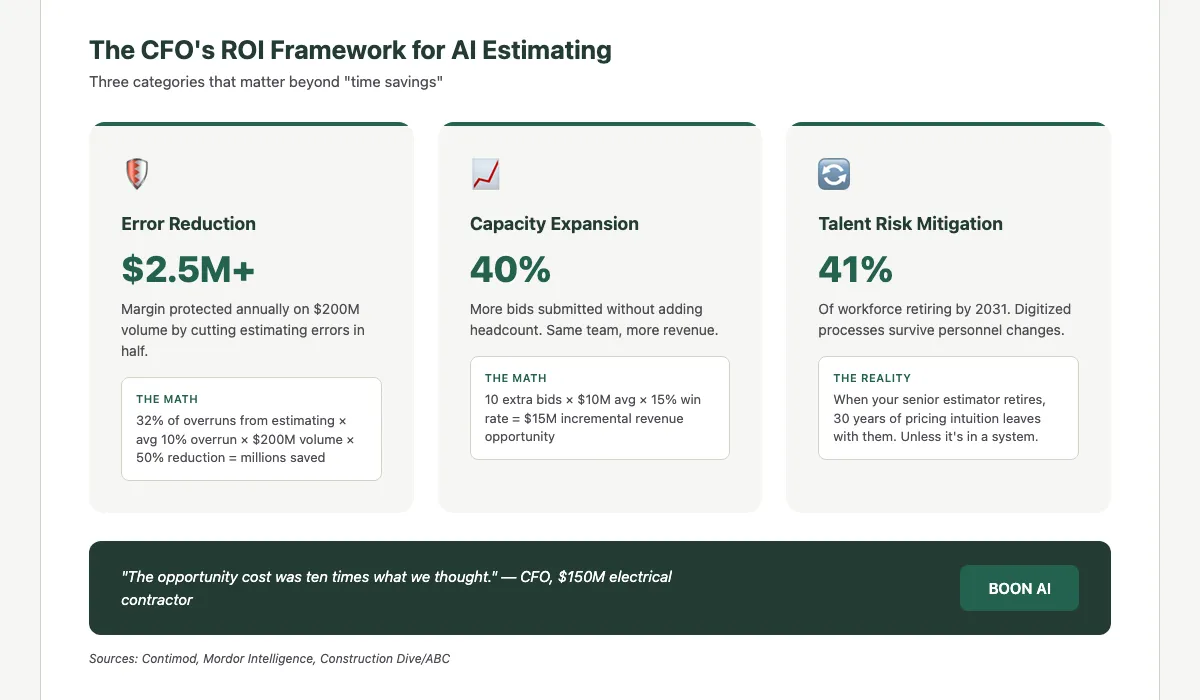
Construction firms typically win between 10-25% of the projects they bid. Firms adopting estimating technology see 15-20% improvements in win rates. If your average project is worth $10M and you’re winning 15% of bids, every additional ten bids translates to roughly $15M in potential new revenue.
The Labor Cliff Makes This Worse
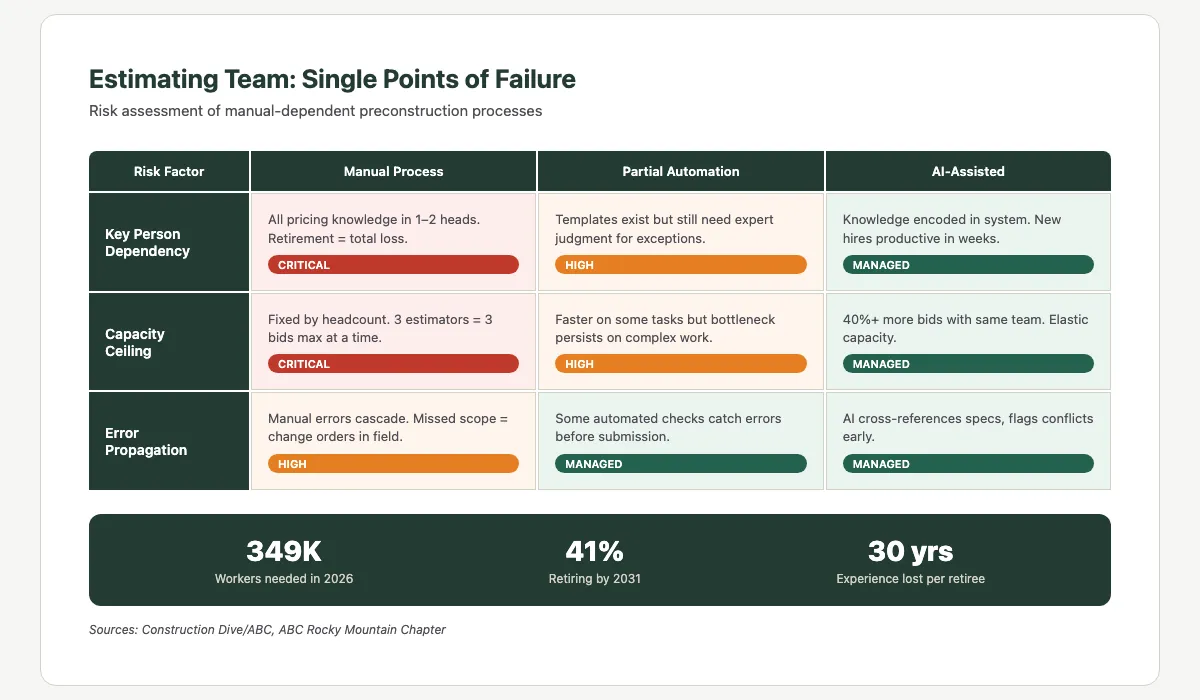
The construction industry needs 349,000 new workers in 2026. An estimated 41% of the current workforce will retire by 2031. When your senior estimator retires, they take 30 years of pricing intuition with them.
Reframing the ROI Conversation
1. Error reduction. 32% of cost overruns from estimating errors. Cutting errors in half on $200M volume = millions preserved.
2. Capacity expansion. AI-enabled platforms trim bid prep time by up to 40%.
3. Talent risk mitigation. Digitized processes survive personnel changes. Business continuity.
“The opportunity cost was ten times what we thought.”. CFO, $150M electrical contractor
What the CFO Should Ask Tomorrow
- How many bids did we decline last quarter because of estimating capacity?
- What percentage of cost overruns originated in preconstruction?
- What happens to bid volume if we lose one senior estimator to retirement?
Whether you begin with electrical takeoff software, HVAC takeoff tools, or a full AI construction takeoff platform, the key is starting.
Deepti Yenireddy is the CEO and founder of Boon AI.