A mechanical estimator spent 4 hours on a manual takeoff. AI did it in 90 seconds. Even with review and cleanup, that’s a 4x reduction.
Mechanical takeoffs (ductwork, piping, equipment) are some of the most time-consuming scopes in preconstruction. Every run has to be traced, every fitting counted, every spec cross-referenced. It’s not complex in theory. It’s brutal in volume.
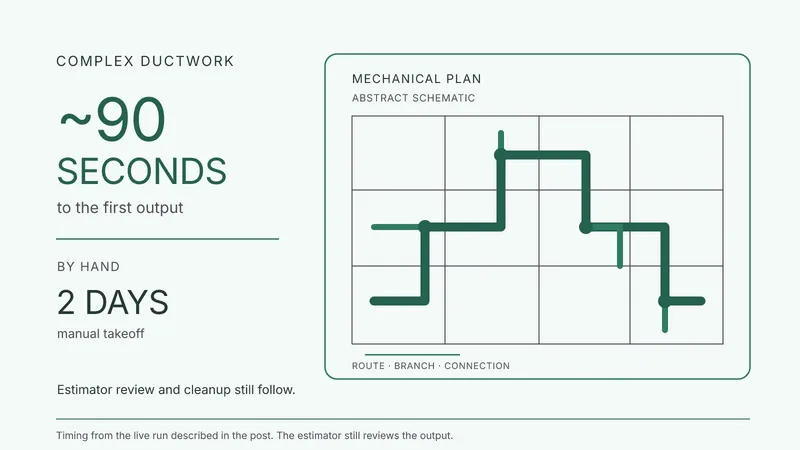
We watched it happen in real time. A seasoned mechanical estimator sat down with a set of mechanical drawings and did the takeoff the way he’s always done it. 4 hours.
Then the same drawings went through Boon AI. The AI completed the takeoff in 1 minute and 30 seconds.
Of course, no AI output ships without human review. After cleanup and verification, the total time was about 1 hour, a 4x reduction from the fully manual process.
🎥 Watch the Side-by-Side

▶️ Watch the full AI mechanical takeoff demo video
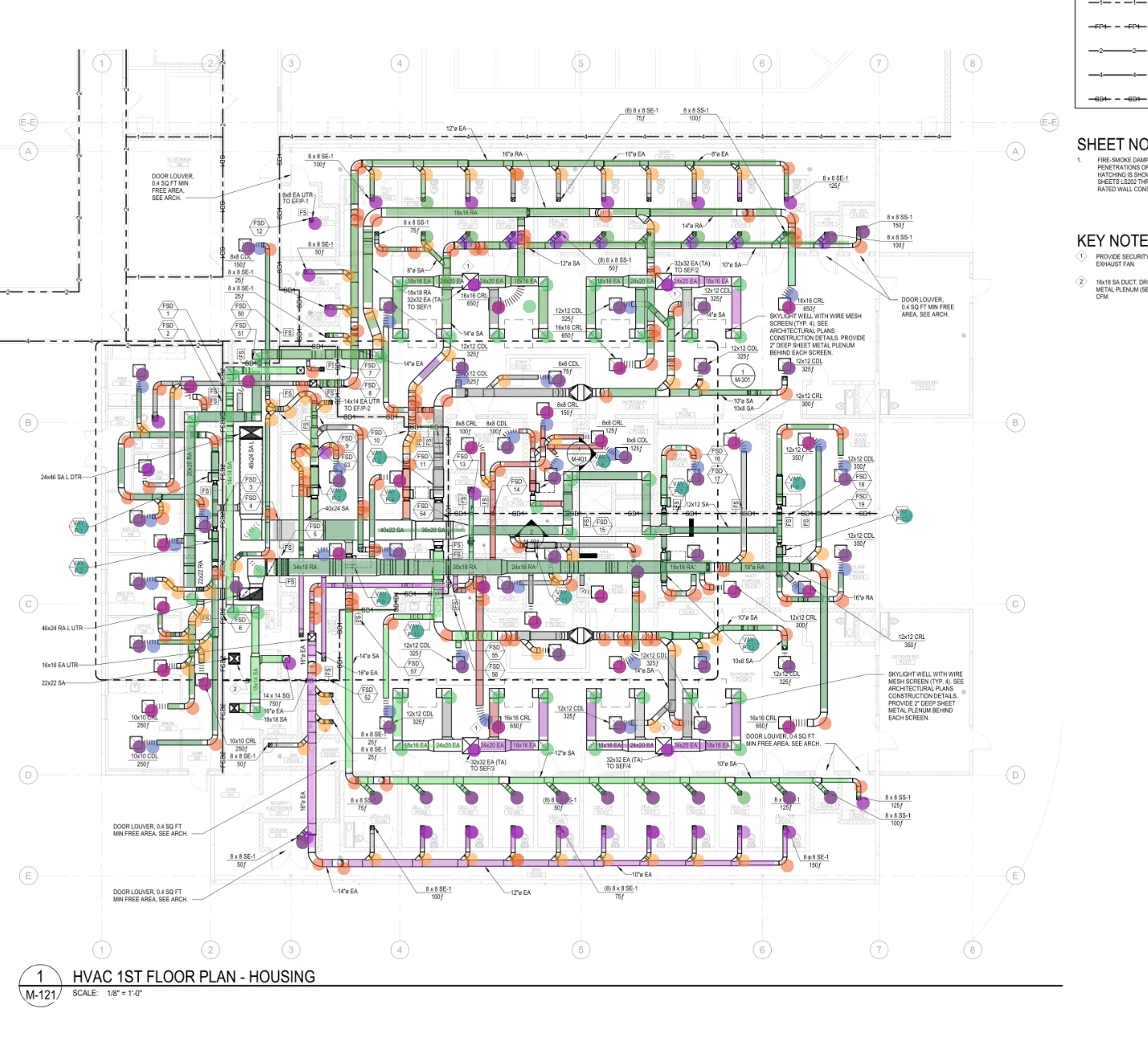
The completed AI takeoff. Every duct run, fitting, and piece of equipment detected and color-coded across the full HVAC floor plan.
What 4 Hours of Manual Mechanical Takeoff Looks Like
If you’re a mechanical estimator, you already know. But for everyone else wondering why this matters:
- Open the mechanical floor plans. Usually 15-30 sheets per building
- Trace every duct run, measuring length and noting size transitions
- Count every fitting: elbows, tees, reducers, transitions
- Trace piping runs. Hot water, chilled water, refrigerant, condensate
- Identify and count equipment: VAV boxes, FCUs, AHUs, diffusers
- Cross-reference the mechanical schedule for specs and sizing
- Tabulate everything into a format your pricing team can use
Each individual measurement isn’t hard. But a single mechanical floor plan can have hundreds of elements. And you’re doing this across every sheet, for every bid, under deadline pressure.
The 4 hours our estimator spent wasn’t because he was slow. He’s experienced. That’s just what this scope takes when you’re doing it by hand.
What AI-Assisted Mechanical Takeoff Looks Like
With Boon AI, the workflow flips:
- Upload the mechanical drawing set, standard PDFs, same files you already have
- AI detects and classifies elements, ductwork, piping, equipment, fittings
- Measurements are calculated automatically, linear footage, counts, sizing
- The estimator reviews and adjusts, correcting anything the AI missed or misclassified
- Export the takeoff, clean, organized, ready for pricing
The AI handled the raw extraction in 90 seconds. The estimator then spent about an hour reviewing, adjusting a few elements, and verifying quantities against the specs. Total: ~1 hour vs. 4 hours.
That hour of review isn’t wasted time. That’s where the estimator’s real value kicks in. Judgment calls on ambiguous details, catching scope gaps, making sure the numbers make sense. The difference is they’re starting from a 90% complete takeoff instead of a blank screen.
Why 4x Matters More Than You Think
A 4x reduction sounds good in the abstract. Here’s what it means in practice for a mechanical subcontractor:
Scenario: Mid-size mechanical sub, bid season
- 5 active bids per month
- Each bid’s mechanical set: ~4 hours manual → ~1 hour with Boon
- 3 hours saved per bid × 5 bids = ~15 hours saved per month
That’s real time back. The kind that clears a full mechanical set before lunch instead of after dark. Across a year, it’s roughly 180 hours your estimators aren’t spending on manual tracing. That’s the difference between:
- Bidding more projects, without hiring another estimator
- Actually reviewing your numbers instead of rushing to submit before deadline
- Your estimators going home at 6 PM instead of pulling all-nighters during bid week
- Catching scope gaps that turn into six-figure change orders
In construction, speed doesn’t just save time. It saves money. The contractor who turns bids faster gets to be more selective about which work they take. They price more carefully. They win better projects.
The Estimator Isn’t Going Anywhere
Let’s be clear about what happened here.
The AI didn’t “replace” the estimator. It eliminated the part of the job that no one got into this career to do. Manually tracing lines on a screen for hours.
The estimator still:
- Reviewed every element the AI detected
- Made judgment calls on ambiguous conditions
- Verified quantities against the specs and their own experience
- Caught edge cases that require human knowledge
The difference is they did all of that in 1 hour instead of doing it plus 4 hours of manual measuring. Their expertise was focused on verification and judgment. The work that actually prevents costly mistakes.
4 hours → 1 hour. Same drawings. Same accuracy. 3 hours back.
Multiply that across every bid, every week, every estimator on your team. That’s the compounding effect that changes how a mechanical contractor operates.
Try It on Your Drawings
This was one set of mechanical plans. The real question is what happens with yours.
👉 Book a demo and bring your own drawings. We’ll run them live.
No commitment. No six-month implementation. Just upload your plans and see what 90 seconds looks like.
Boon is an AI-powered preconstruction platform trusted by leading mechanical, electrical, and general contractors. Built by construction and AI experts with 150+ years of combined industry experience.