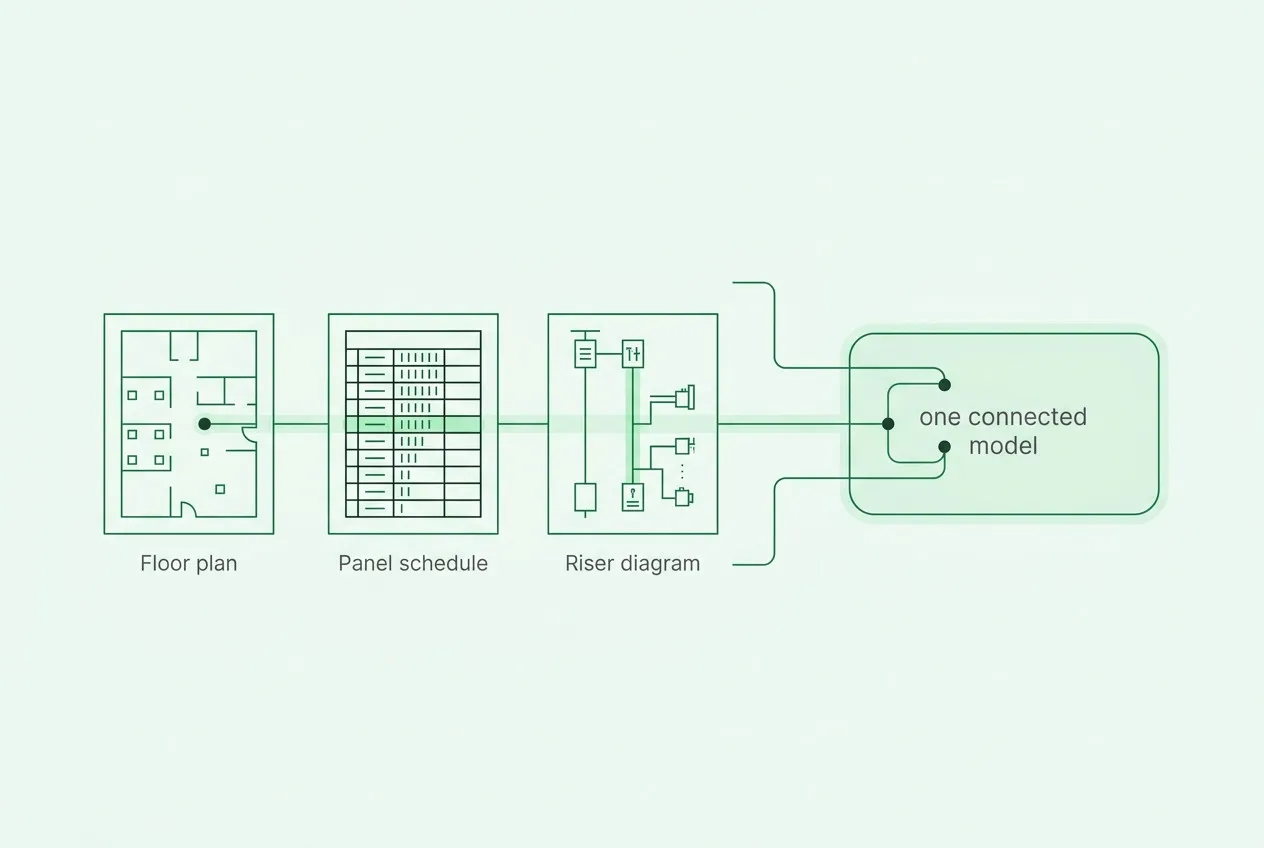
A panel schedule lives on one sheet. The equipment it feeds is drawn on another. The riser diagram that ties them together is a third. They are supposed to agree, but rarely do. That disagreement is not a data-entry chore. It is the core technical problem, and most tools never see it because they read one page at a time.
Three sheets, one model. The receptacle on the plan, the circuit in the schedule, and the feeder in the riser are the same fact recorded in three places. The job is to make them line up.
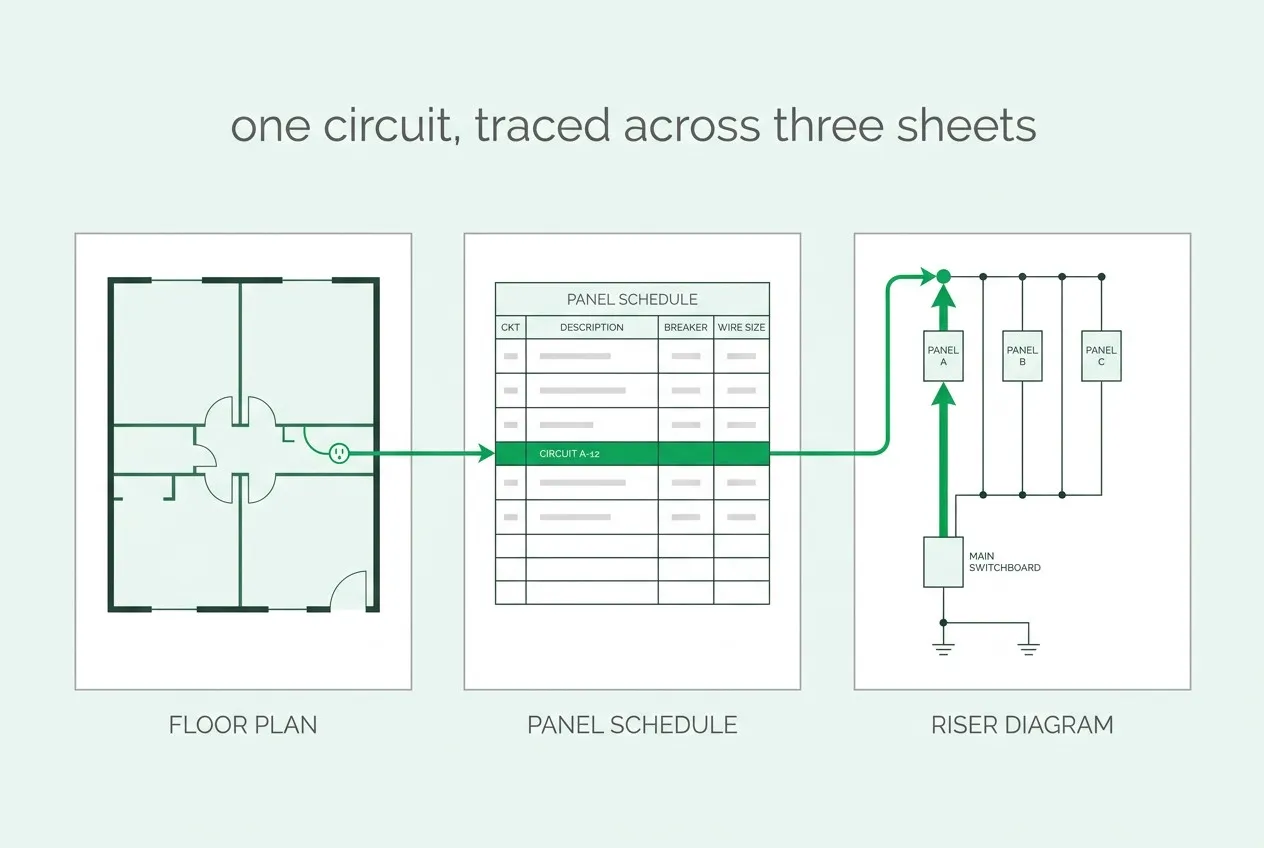
Ask an electrical estimator how they price a job and watch how often they flip between pages. They find a receptacle on the floor plan. They trace its circuit to a panel. They open the panel schedule on a different sheet to confirm the breaker and the wire size. If the panel is fed from somewhere else, they jump to the riser diagram to follow the feeder back to the service. An individual circuit touches three sheets, and the estimator is the only thing holding those three sheets in their head at once.
That is the part the software has always gotten wrong. Not the counting. The connecting.
A drawing set is not a stack of pages
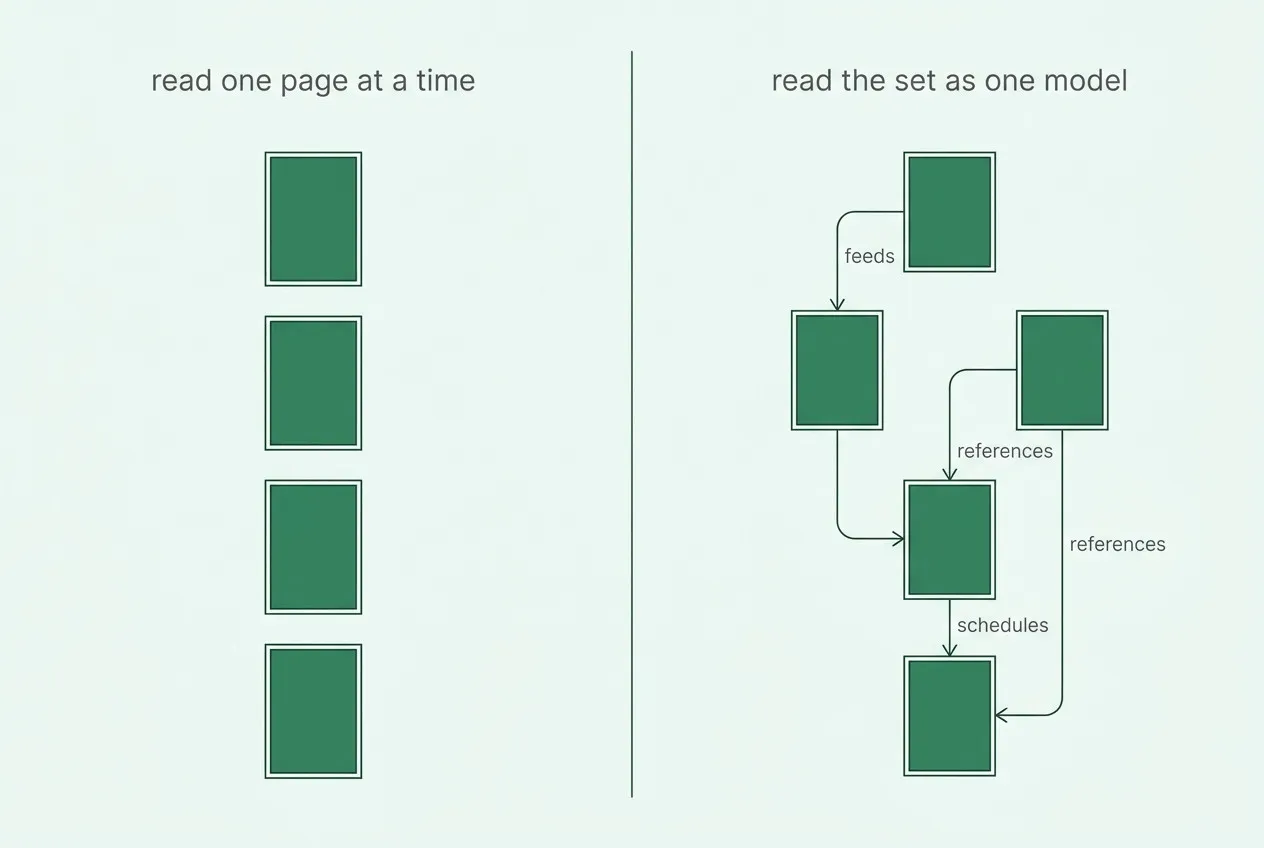
The intuitive model of a plan set is a PDF: an ordered stack of pages you read front to back. That model is convenient and wrong. A real MEP set is a graph. The floor plan references a panel by name. The panel schedule defines that panel’s circuits and points at the feeder that serves it. The riser diagram draws that feeder back to the main distribution. A keynote on one sheet governs a symbol on another. An equipment schedule sets the load that the panel schedule has to carry.
Meaning lives in the edges of that graph, not inside any single page. You cannot read a panel schedule in isolation and know whether it is right. You can only know it is right by checking it against the plan that uses it and the riser that feeds it. An estimator does this constantly and silently. It is most of the skill.
Software that treats each page as an independent image throws the graph away on the first step. It can extract a clean panel schedule and a clean floor plan and still have no idea that they describe the same panel, because nothing in a per-page pipeline carries the relationship between them. The hard part of MEP was never reading one sheet well. It was holding all of them at once.
Where the three sheets disagree
The reason this matters in dollars is that the three sheets routinely contradict each other, and every contradiction is either an RFI, a change order, or a mispriced bid.
The plan shows a panel the schedule never defines. The schedule lists a circuit the plan never draws. The riser feeds a panel at one amperage and the schedule rates it at another. A revision updates the panel schedule and never propagates to the riser, so the two sheets now describe different buildings. None of these is exotic. They are the normal state of a real set, because the sheets are drafted by different people at different times and reconciled by hand, late, under deadline.
A human estimator catches these by cross-referencing, and catching them is exactly where the hours go. The whole value of reading the set as one model is that the disagreements become visible automatically: when the same panel appears on three sheets, the model can line up what each sheet claims and surface the places they don’t match, instead of silently picking one and moving on.
What we built toward this
The honest version of where we are: this is a hard problem, and we’ve built the foundation for it rather than declared it solved. The thing that makes cross-page reasoning possible at all is reading the set through one shared understanding of a drawing. The same representation sees the plan, the schedule, and the riser, so it has somewhere to put the relationship between two pages. Read each page in isolation and that relationship has nowhere to live.
Concretely, the pieces that this rests on are the ones an engineer would expect. Schedule extraction reads panel schedules, fixture schedules, and equipment schedules off the sheets where they live, including the ones drawn as tables rather than handed to us as clean text. The case that breaks naive text extraction. Sheet classification identifies which pages are plans, which are schedules, and which are riser or one-line diagrams, so the model knows what kind of thing it is reading. And the spatial model anchors a symbol on a plan to its place in the set, which is the toehold for tracing a circuit from the plan to the panel that owns it.
The part we are still building is the full traversal at scale: doing this automatically and reliably across an arbitrary set, on every job. We read each of the three sheets today; making them a single continuous chain everywhere is the ambition we are driving toward, and I would rather say that plainly than oversell it.
What this changes for the people doing the work
The payoff is simple to say: the cross-referencing that an estimator does by hand, late at night, page by page, is the work the system is built to carry. When the model holds the floor plan, the panel schedule, and the riser together, the disagreements between them stop being something a person has to hunt for. They surface on their own.
That shows up three ways an estimator feels immediately. Fewer missed scope items, because a circuit the plan draws but the schedule never defines doesn’t slip through. Fewer late-stage RFIs and change orders, because the contradictions between sheets are caught while there is still time to bid them correctly instead of after the job is awarded. And hours back, because the part of the work that was pure cross-checking, flipping between three sheets to confirm one quantity, is exactly what reading the set as one model removes.
This is also why the approach matters beyond any single feature. A tool that reads one page at a time can get very good at reading that page and still never see that two sheets describe the same panel. The relationship was thrown away at ingestion. Holding the whole set together isn’t a setting you turn on later; it’s the thing the system was built around from the first step. That’s what lets it grow from reading each sheet well into tracing a circuit across all of them.
The counting was never the hard part. The connecting is the product.
This is part of Boon’s engineering and architecture series for the people building and backing this category. Victor Augusteo is the CTO of Boon AI.