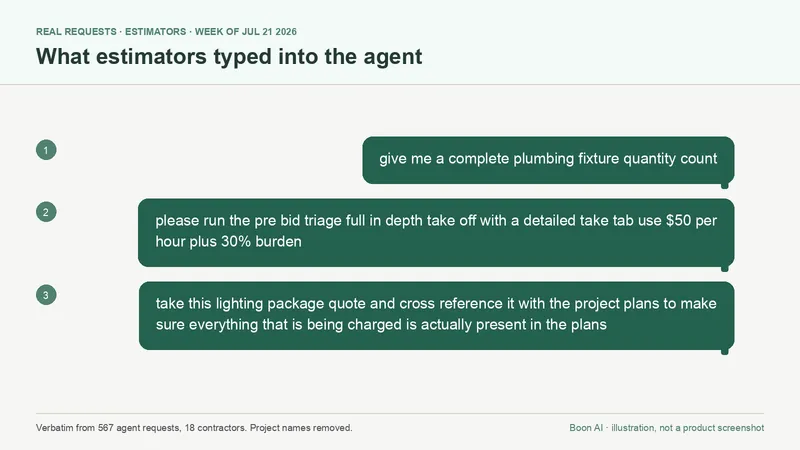
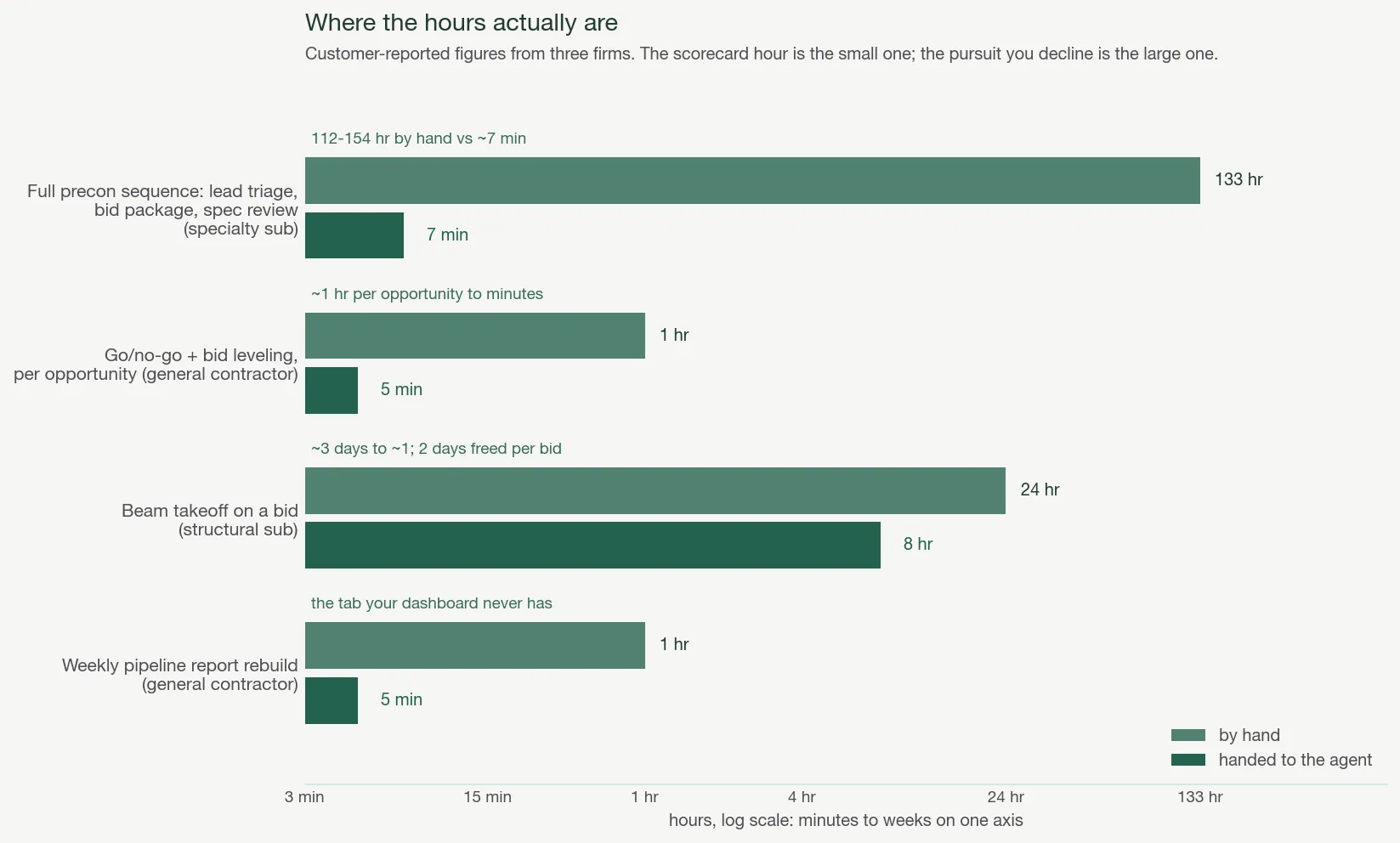
If you run precon, the two jobs your peers hand to an agent first are the go/no-go and the weekly pipeline report. A general contractor in the Southwest measured the go/no-go side: a scope checklist and bid-leveling pass that took about an hour per opportunity now comes back in minutes. One hour saved per project you evaluate. Chase 12 a month and that’s 12 hours, or about $780 a month at the $65/hr loaded rate a customer typed into the agent himself this week (“$50 per hour plus 30% burden”). An estimate off a real rate, not a model.
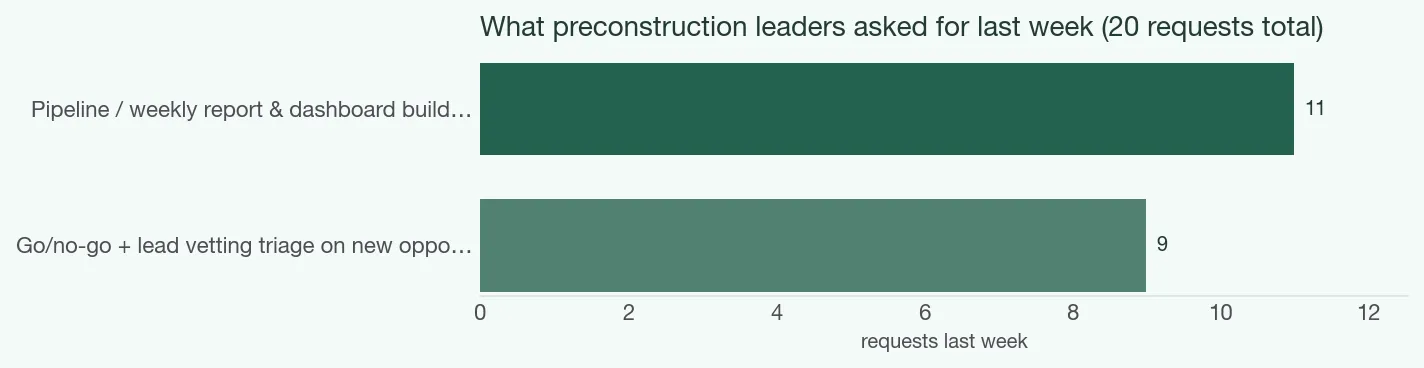
Small sample, and I’ll be straight: 20 requests last week, three contractors, two categories. Fewer, bigger tasks is what your week looks like. Short list, and both items are things you can hand over tomorrow.
Run the go/no-go on it
Nine requests, three contractors. The verb they use is “run.”
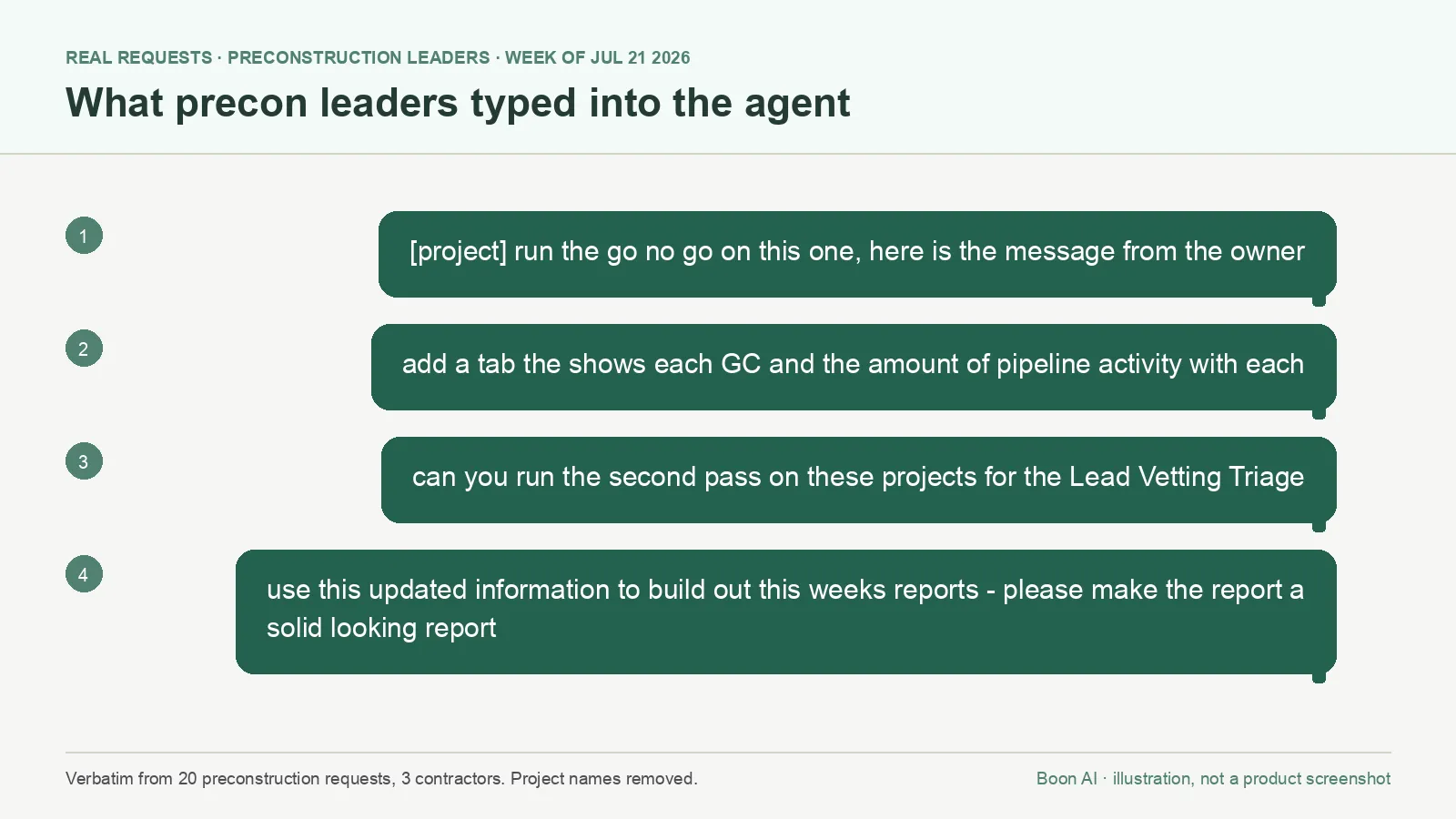
“[Project name] run the go no go on this one, here is the message from the owner.”
“Please run the lead vetting triage on [project] the documents are in the vault.”
“Can you run the second pass on these project for the Lead Vetting Triage.”
One forwarded the owner’s email straight in and expected a structured evaluation back. That’s your decision process, named, with an input handed to it. You still make the call. You just stop doing the first pass by hand.
The hours get large downstream, on work you stop doing for bids you should have passed on. One specialty contractor’s full pre-con sequence, lead triage into bid package into spec review, runs in about 7 minutes against 112 to 154 hours manually. You won’t recover all of that on every job. Kill one wrong-fit pursuit a month before an estimator opens the set and the hours you didn’t spend dwarf the hour you saved on the scorecard.
The second-pass ask is the tell that this is being used right. They’re iterating on the same opportunity, not treating the output as final.
Rebuild this week’s report
Eleven requests. Pipeline reporting as a conversation instead of a BI configuration exercise.
“Add a tab that shows each GC and the amount of pipeline activity with each.”
“Use this updated information to build out this weeks reports, please make the report a solid looking report.”
“Can you build me a dashboard that we populate for every project we drop in here.”
“Update the precon calendar.”
“Each GC and the amount of pipeline activity with each” is a relationship view of your pipeline. Exactly what you think about on a Monday, and exactly the ad-hoc cut your dashboard never has, which is why somebody on your team rebuilds it in Excel every week. Same hour per report the GC measured, so roughly $65 of loaded time per rebuild, weekly, forever, for a tab.
The dashboard ask is the ambitious one: a structure populated for every new project instead of rebuilt for each one. That’s a leader turning a one-off into a standard.
Capacity, not cost
Those dollar figures are the floor and the least interesting part. Here’s the number that moves your year.
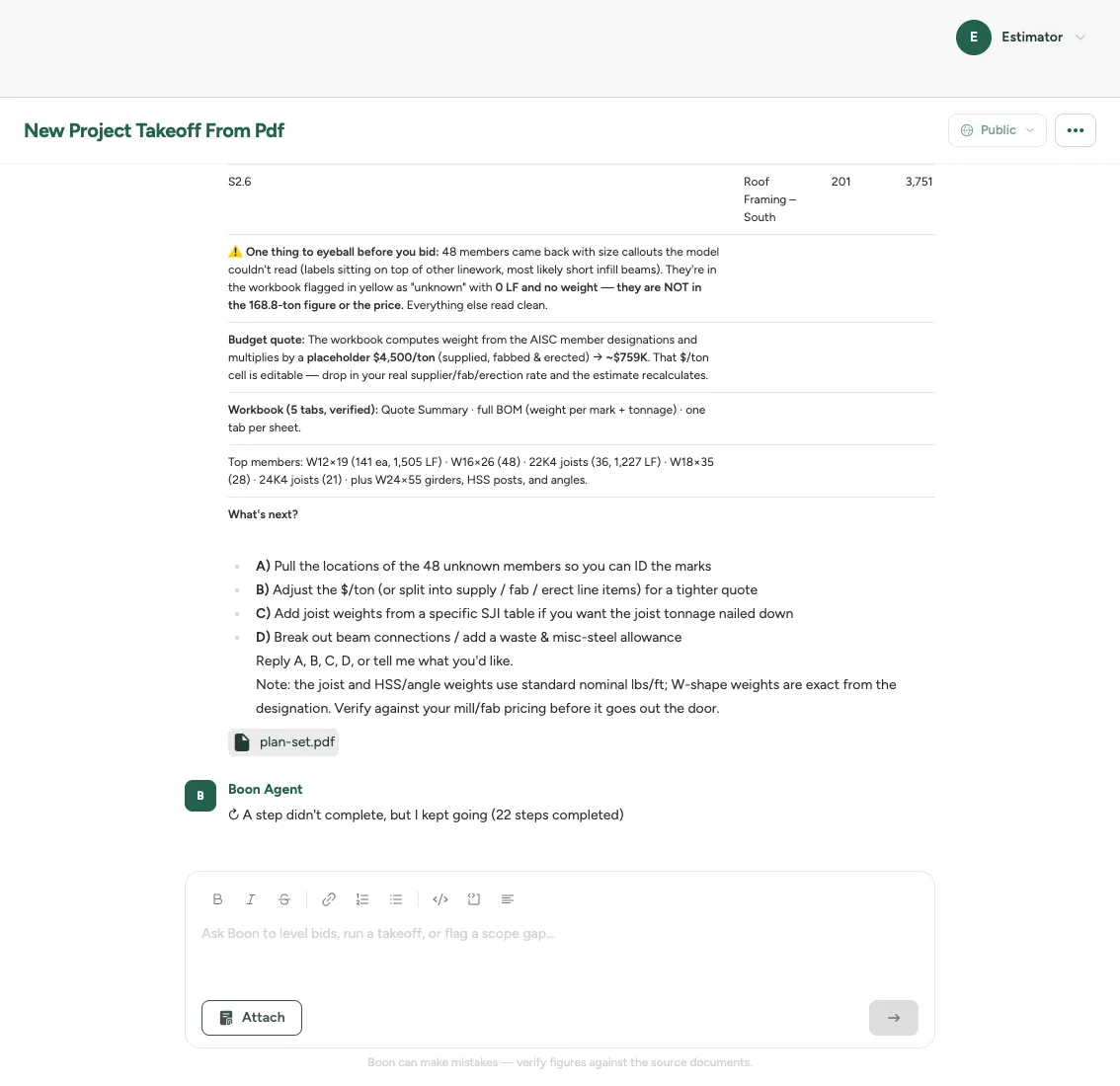
Takeoff and bid-prep is where the measured gains are largest. One electrical contractor reports 2 to 4 hours saved per takeoff and 16 to 24 hours on a 16-sheet job. A structural sub cut 25 to 30% off beam takeoffs, taking a job from about three days to about one and freeing two days per bid. Another electrical contractor measured a 90% reduction in takeoff time; one lighting takeoff went from about 2 hours per sheet to seconds.
Two days back per bid isn’t a saving. It’s the third bid you weren’t going to submit this month, same team.
What’s missing
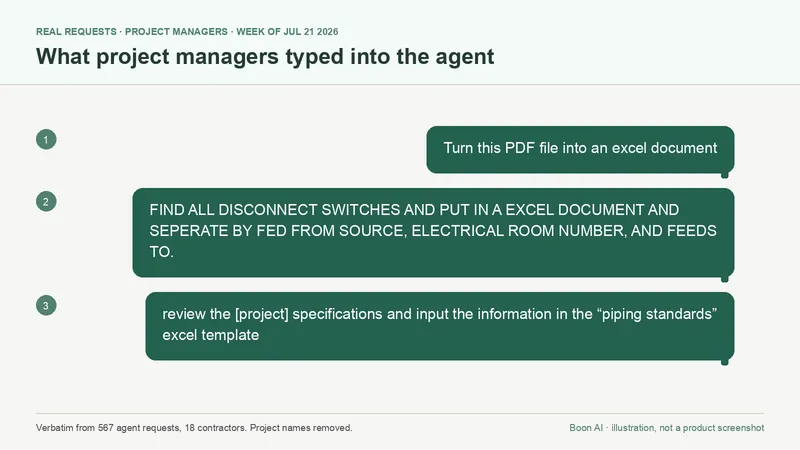
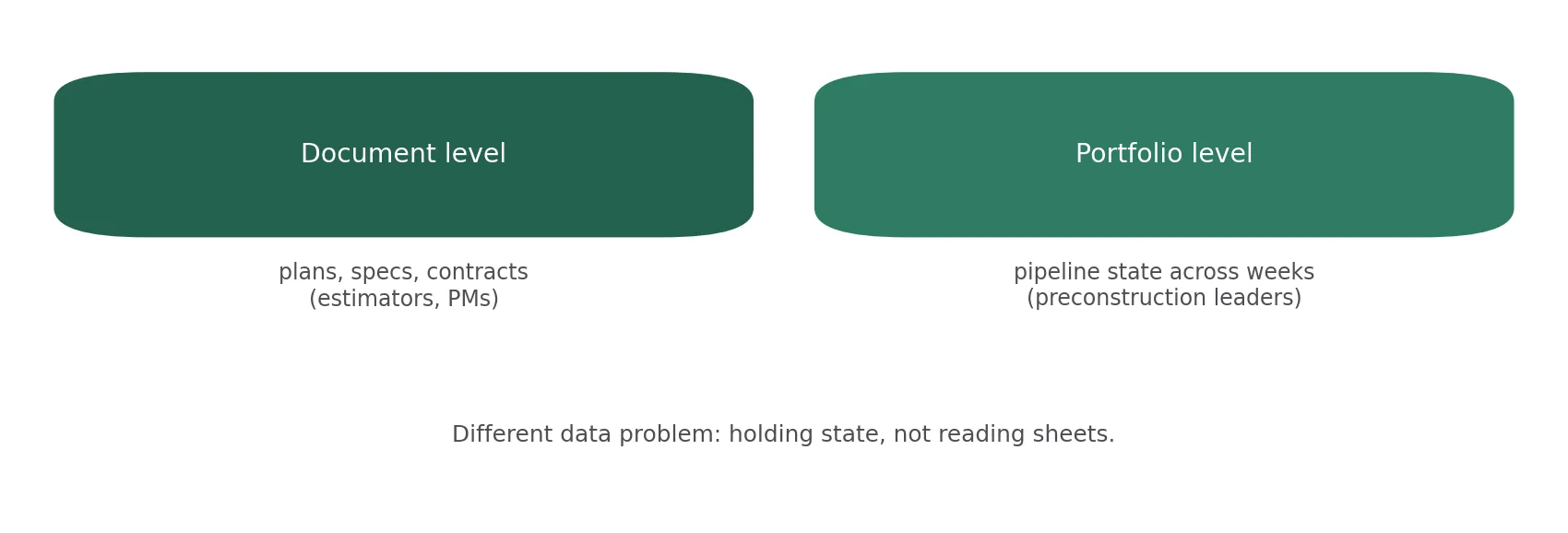
Both categories are about which jobs to chase and how the ones in flight are reporting. Neither is about the documents. Your estimators and PMs point the agent at drawings and specs. You point it at the portfolio.
Different problem, and the honest read is that we built for the estimator and the PM first. The leaders using the pipeline and vetting workflows found them without us marketing at them. The one who asked for a dashboard to populate for every project wanted us to hold the state of the pipeline across weeks, and asked earlier than we were ready for.
Forward us your next RFP email and last week’s report. Those are the two we can put real hours against today: 1 hour per go/no-go and 1 hour per report rebuild, at $65/hr loaded.