The preconstruction manager opens the plumbing specifications before sending the package for pricing. The applicable Div 22 sections sit among general provisions and drawing callouts. The question is which section-based obligations belong in the plumbing subcontractor’s scope.
In Boon Agent chat, the manager asks Boon to review the applicable Div 22 plumbing sections, connect them to relevant plan callouts, and return a trade-specific scope list grouped by section. Boon returns the requirements with source references and marks a single gap at the site-utility boundary.
The estimator checks the cited sections before sending the scope list for pricing.
The section-based view gives the estimator a focused scope to review instead of a broad project summary.
A trade list has a reader
A specification summary can be accurate and still be hard to price. The subcontractor needs to see which requirements apply to the package, where the drawing shows related work, and which conditions deserve a question before numbers come back.
The list is a communication tool, not just an internal index. Its audience may not have time to reconstruct the estimator’s reading of the whole set. If a note is vague, the quote may be based on a different boundary than the one the estimator intended.
That is why the trade matters. The same bid package can contain requirements relevant to several scopes. The preconstruction team must make a considered handoff, not copy a long list of passages without deciding who needs them.
Boon reviews the specification by trade section and returns scope items grouped around the relevant requirements. Each item stays connected to its spec section and related plan callout. That organization makes the trade boundary easier to inspect before a quote comes back.
Start with the package
The manager starts with a defined package and trade. That gives the review a boundary. Instead of asking for “everything about the project,” the request identifies the work the plumbing subcontractor is expected to price.
Boon returns a section-by-section plumbing scope list grounded in the Div 22 sections. The single site-utility-boundary gap stays visible rather than becoming an invented requirement.
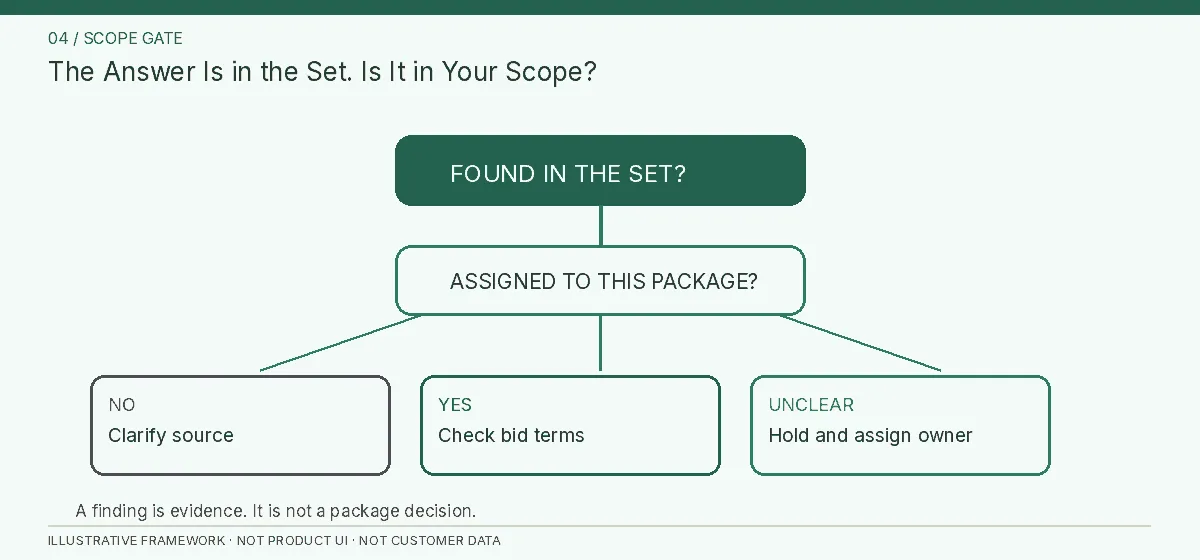
A package someone can price
The difference between a useful scope list and a document dump is the question it answers: what should this trade price, based on the bid documents available now?
The answer needs enough detail for the trade to see the intended work. It preserves references for the provisions that shape the package and leaves unrelated sections out of the scope view.
When the drawings and specification appear inconsistent, the possible mismatch stays beside both references. That makes the item easy to identify for clarification before the package is issued.
Give the recipient a fair start
A subcontractor shouldn’t have to guess what the estimator meant. The purpose of a scope list is to explain the request before the number arrives, not to repair misunderstandings after bid day.
A source-backed list keeps the trade requirements and open questions visible in one place. If the set leaves something unresolved, the relevant section and drawing callout stay with the item.
Boon also surfaces drawing/spec conflicts, levels subcontractor quotes, and drafts cited RFIs. That’s AI for the whole bid.
The best scope list is not the longest one. It tells the trade what to price and where the instruction came from.
Related: Boon Agent · Preconstruction series hub Give me a scope list, by trade, right now · Book a demo