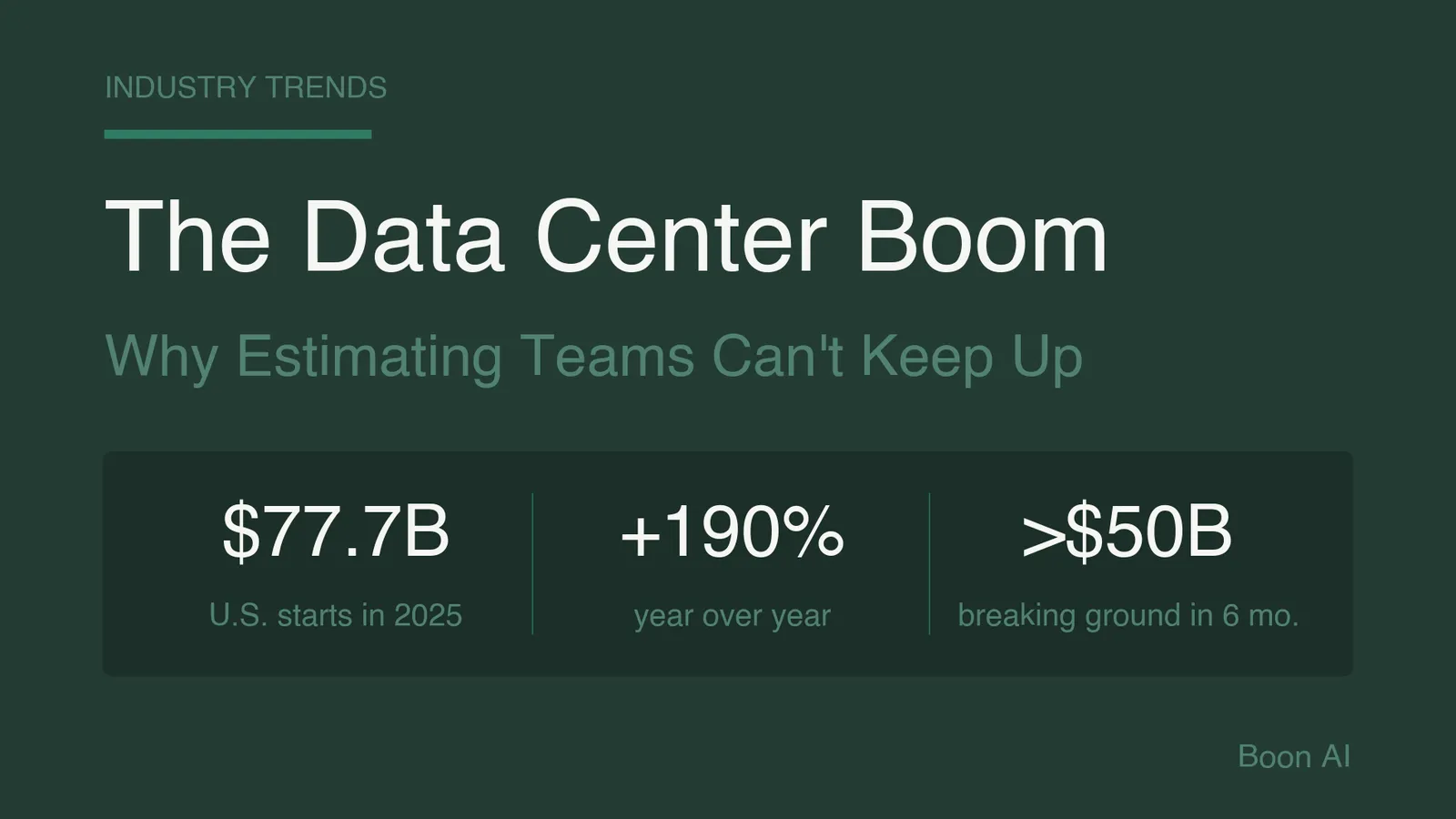
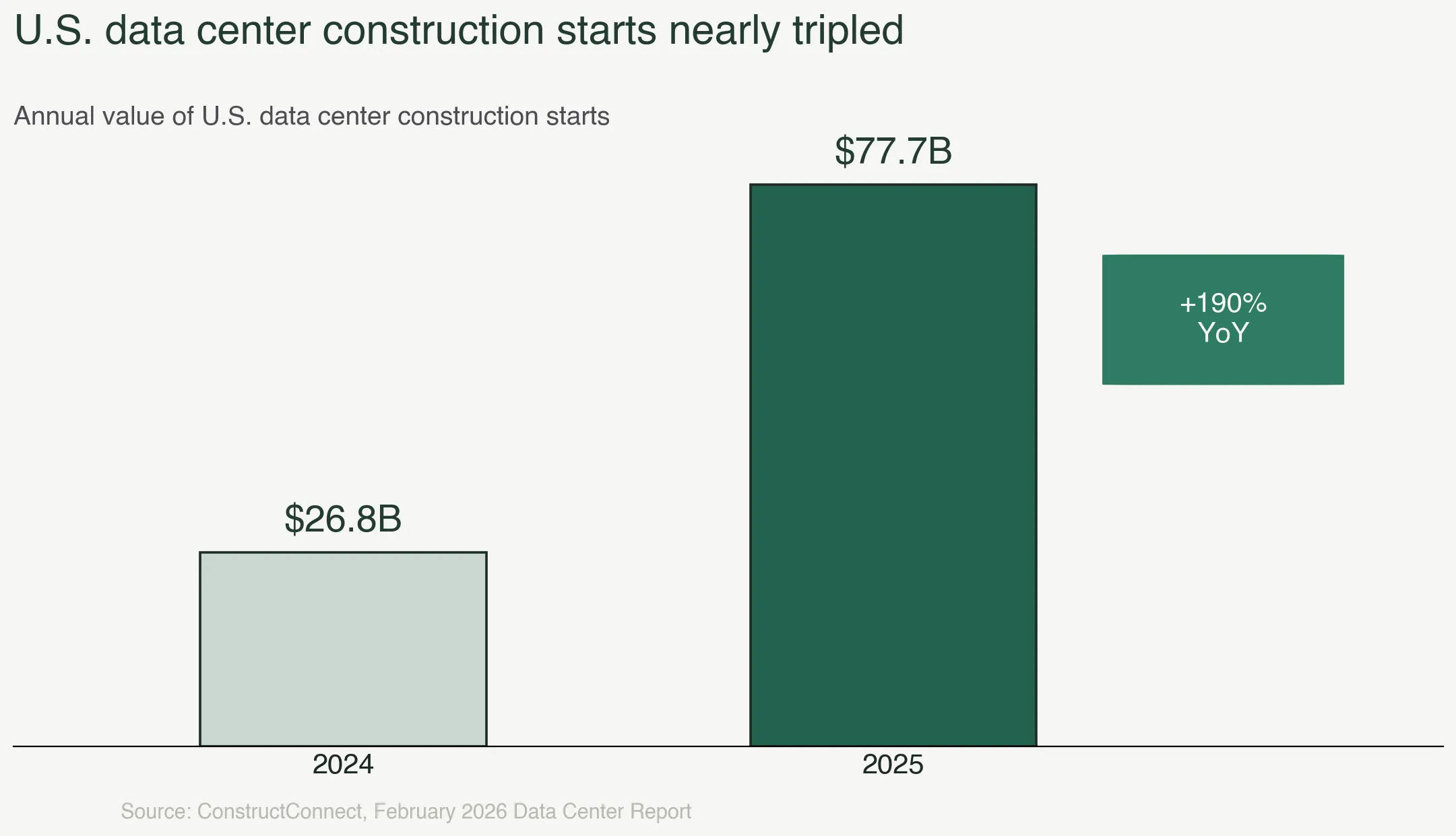
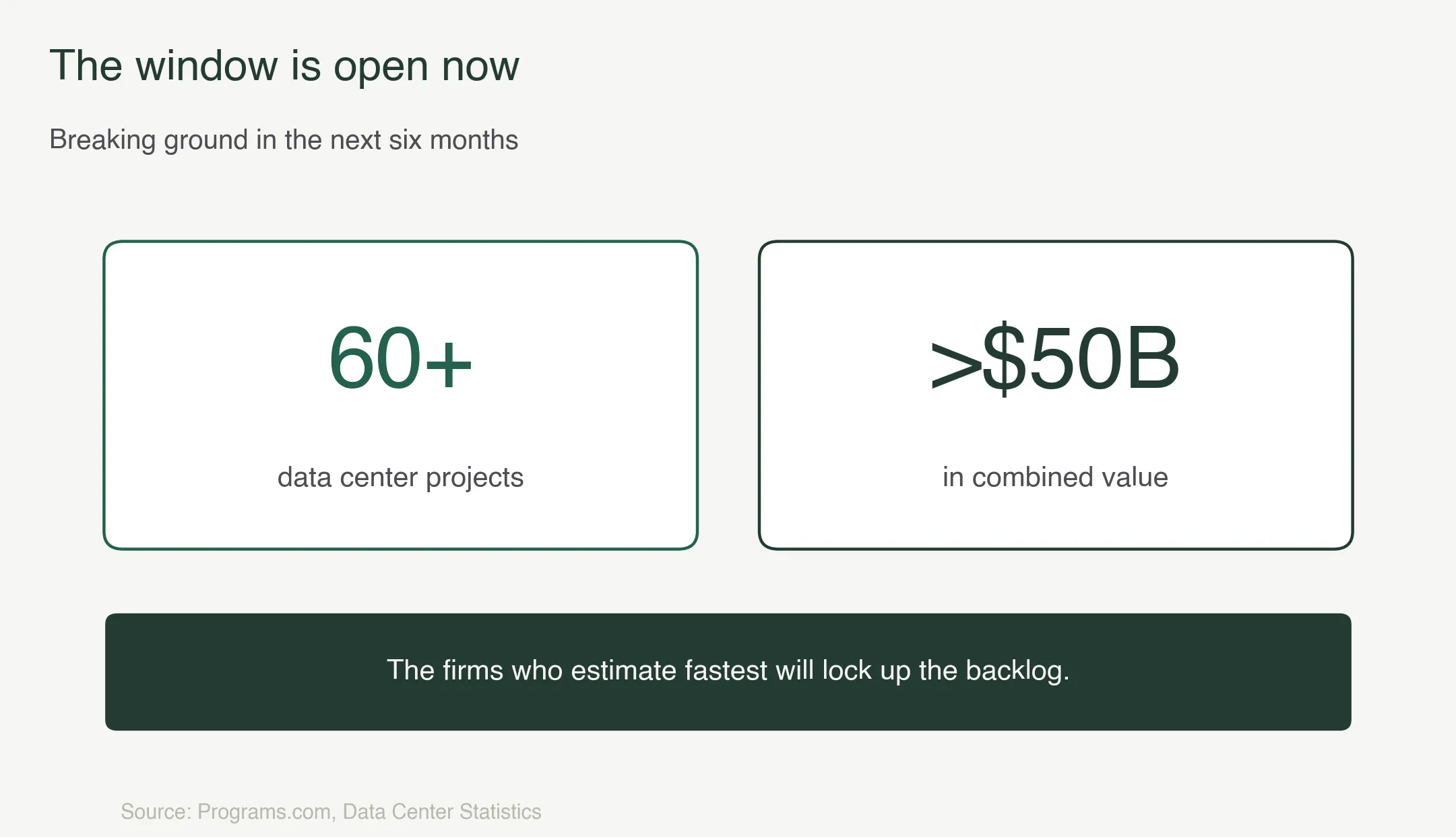
Here’s a number that should get every electrical contractor’s attention: U.S. data center construction starts hit $77.7 billion in 2025, a 190% year-over-year increase, according to ConstructConnect. Q4 alone accounted for $44.4 billion. And there are more than 60 projects worth over $50 billion expected to break ground in the next six months.
This isn’t a trend. It’s a tidal wave. And the firms who can estimate this work fastest and most accurately are going to own the next infrastructure cycle.
The ones who can’t? They’ll watch from the sidelines while their competitors lock up the biggest backlog opportunity in a generation.
What’s Driving the Surge
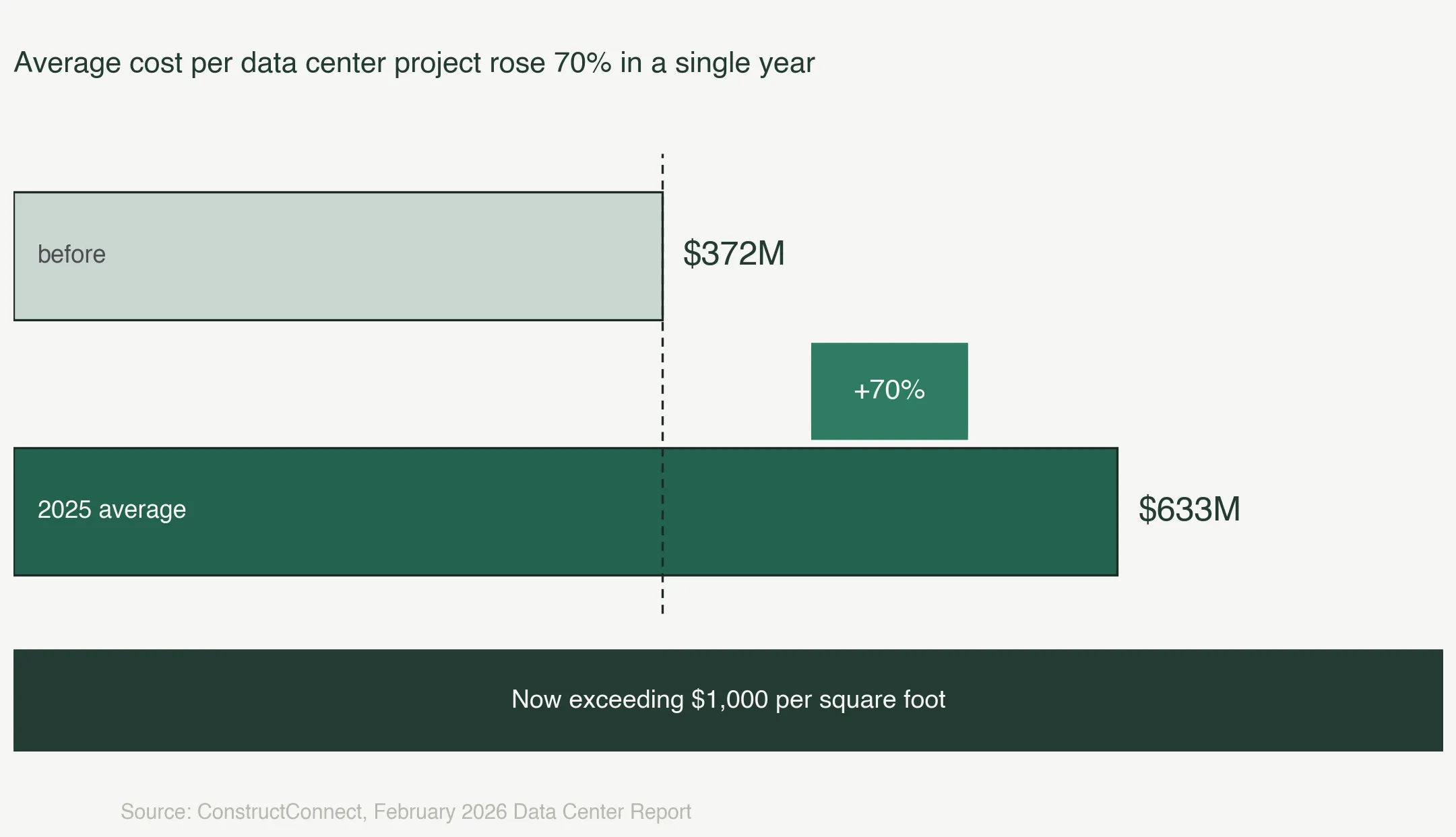
The short answer: AI infrastructure. Every major tech company is racing to build compute capacity. Microsoft, Google, Amazon, Meta, Oracle. They’re all pouring billions into data center campuses across the country. The average data center project cost rose 70% in 2025, reaching $633 million per project and over $1,000 per square foot.
By December 2025, construction spending on data centers hit an annualized rate of $45 billion, and that’s the actual put-in-place spending, not just starts. For context, that makes data centers one of the fastest-growing segments in all of commercial construction.
And here’s what matters for contractors: this demand isn’t slowing down. The AI buildout is a multi-year cycle. We’re in the early innings, not the late ones.
The Electrical Scope Problem
Data centers are, at their core, electrical projects. The mechanical and structural components matter, but the electrical scope is where the real complexity and cost concentration lives. Power distribution, redundancy systems, UPS infrastructure, generator arrays, switchgear, cable tray systems running for miles. A single hyperscale data center can have more electrical scope than a dozen conventional commercial buildings combined.
Here’s what makes this particularly painful for estimating teams:
Volume. The sheer quantity of components is staggering. A typical hyperscale facility might have thousands of receptacles, hundreds of panels, miles of conduit and cable tray. Counting all of that manually from drawings takes weeks.
Repetition with variation. Data centers are modular by design, which sounds like it should make estimating easier. It doesn’t. The modules repeat, but each one has slight variations. Different power densities, different cooling requirements, different redundancy configurations. You can’t just count one bay and multiply.
Speed. These projects move on compressed timelines. When a hyperscaler wants a facility online in 18 months, they need bids in weeks, not months. The estimating team that can turn around an accurate bid fastest gets the work.
Stakes. A missed conduit run or an undercount on switchgear in a data center isn’t a $50K problem. It’s a $500K problem. At these project values, small percentage errors translate to enormous dollar figures.
“We bid three data center projects last quarter. Each one had 200+ sheets of electrical drawings. My team of four estimators was working nights and weekends just to get the takeoffs done. We won one. The other two, we were too slow.”. Director of Preconstruction, national electrical contractor
Why Traditional Estimating Breaks Down
Most electrical estimating teams were built for a world where you’d bid 2-3 large projects a month. The data center boom is asking them to bid 2-3 per week, each one more complex than anything they’ve handled before.
The math simply doesn’t work.
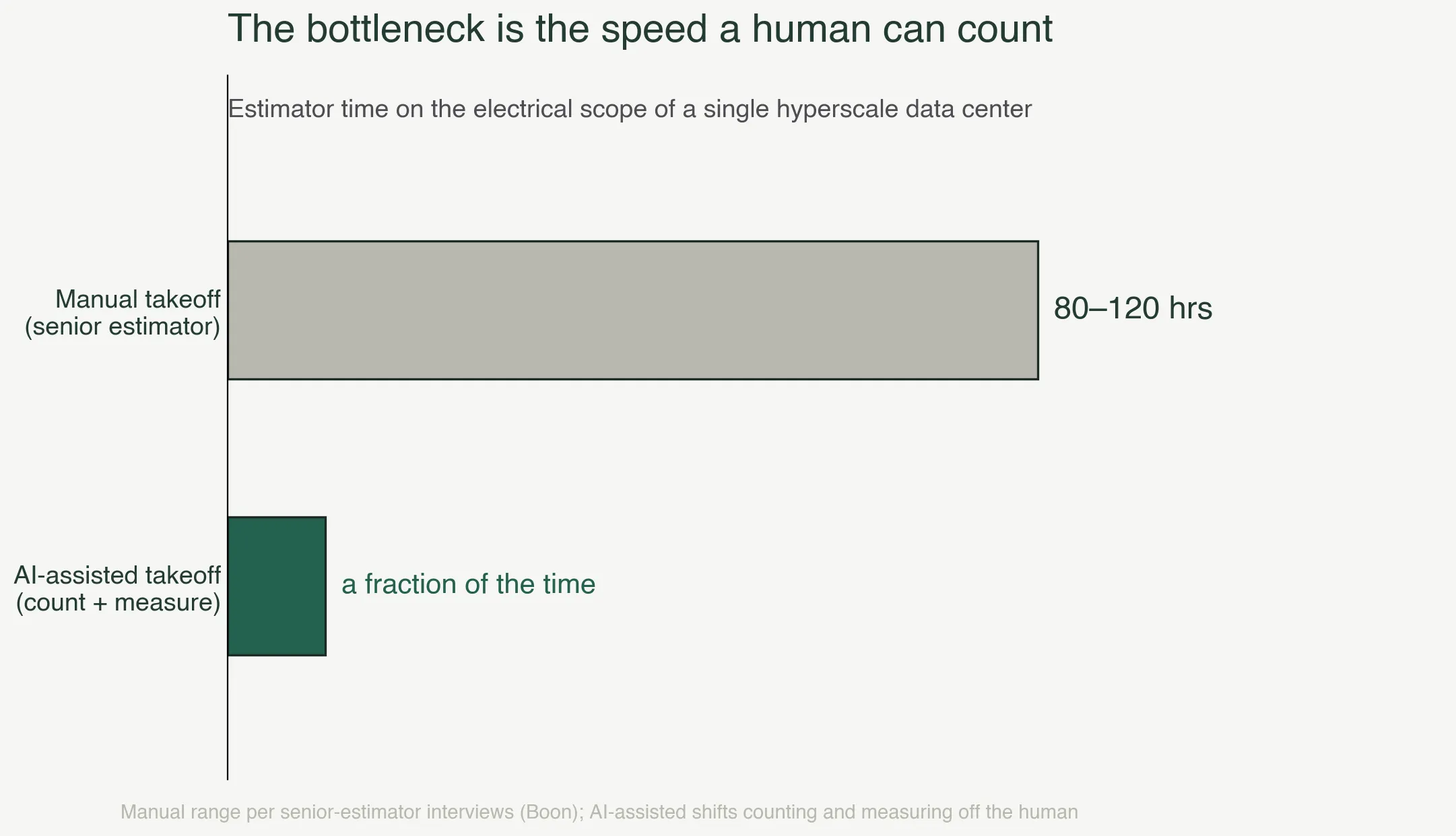
A senior electrical estimator doing a manual takeoff on a hyperscale data center might spend 80-120 hours on the electrical scope alone. If your team has four estimators, and three data center RFPs land in the same month alongside your normal commercial workload, you’re immediately underwater.
The typical response is one of three bad options: (1) rush the estimate and accept higher error rates, (2) pass on opportunities and leave money on the table, or (3) burn out your best people until they quit or make mistakes.
“The pipeline is insane right now. We’ve never seen this many opportunities. But we physically cannot estimate them all. We’re leaving probably $100M in potential backlog on the table because we can’t get to the bids in time.”. CEO, Southwest electrical contractor
This is the cruelest part of the boom: the opportunity is enormous, but the bottleneck isn’t talent or capital or relationships. It’s the speed at which a human can count things on a drawing.
The Case for Automated Takeoffs
Data center electrical work is, ironically, one of the best possible use cases for AI-driven takeoff automation . Here’s why:
High volume, repetitive components. Receptacles, junction boxes, panels, cable tray runs. These are exactly the types of elements that computer vision excels at identifying and counting. What takes a human estimator hours of tedious counting, an AI system can process in minutes. As one customer told us: “I like being able to click and then just looking at what our quantities are, simple enough.”
Standardized drawing conventions. Data center drawings, particularly from the major engineering firms that design hyperscale facilities, tend to follow consistent conventions. Symbol sets are well-defined. Sheet organization is predictable. This consistency is exactly what AI models need to perform accurately.
The payoff is massive. If automated takeoffs can reduce the estimating timeline from weeks to days on a data center project, the implications are enormous. You can bid more work. You can quality-check your numbers with the time you’ve saved. You can respond to addenda without derailing your entire schedule.
Error reduction at scale. When you’re counting 10,000 devices across 200 sheets, even a careful human will make mistakes. Fatigue, distraction, miscounts. They accumulate. Automated systems don’t get tired at hour 80.
What the Winners Are Doing Differently
The electrical contractors who are capturing the most data center work right now share a common trait: they’ve decoupled their estimating speed from their headcount.
That doesn’t mean they’ve replaced estimators with software. The best firms are using technology to handle the volume work (the counting, the measuring, the quantity extraction) so their senior people can focus on the high-value decisions: pricing strategy, risk assessment, scope negotiation, and client relationships.
Think of it this way: your best estimator’s value isn’t in counting receptacles. It’s in knowing that the number on the drawing doesn’t match reality, and adjusting accordingly. But they can’t do that judgment work if they’re buried in the counting work. As one contractor told us: “Get rid of that grunt work — that is what I am really looking forward to.”
“Once we started automating the takeoff portion, our estimators went from spending 70% of their time counting to spending 70% of their time thinking. That’s when our win rate went up.”. VP of Estimating, Top 50 electrical contractor
The Window Is Now
Data center construction is the defining opportunity of this decade for electrical contractors. The firms who can estimate this work fastest will:
- Bid more projects, capturing opportunities that slower competitors have to pass on
- Bid more accurately, because they have time to review and validate, not just rush
- Build relationships with hyperscalers, who value speed and reliability above almost everything else
- Scale without proportional headcount, the holy grail in a labor market where experienced estimators are nearly impossible to hire
The window won’t stay open forever. Hyperscalers are consolidating their contractor relationships. They want partners who can keep up with their pace. Once those relationships are locked in, breaking in from the outside gets exponentially harder.
The firms who can estimate data centers fastest will own the next infrastructure cycle. The question is whether your team has the AI takeoff tools to compete at this speed, or whether you’re still counting receptacles by hand while the biggest opportunity of your career passes you by.
Sources
- Data Center Construction Report. ConstructConnect
- Data Center Statistics. Programs.com
- Data Center Spending’s Modest Impact. Construction Owners Association
_Deepti Yenireddy is the CEO and Founder of _Boon AI , a platform helping construction firms automate preconstruction workflows and win more work.