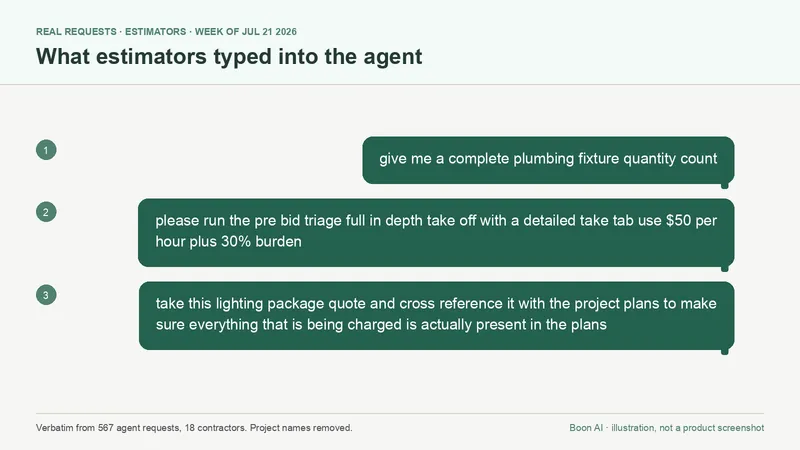
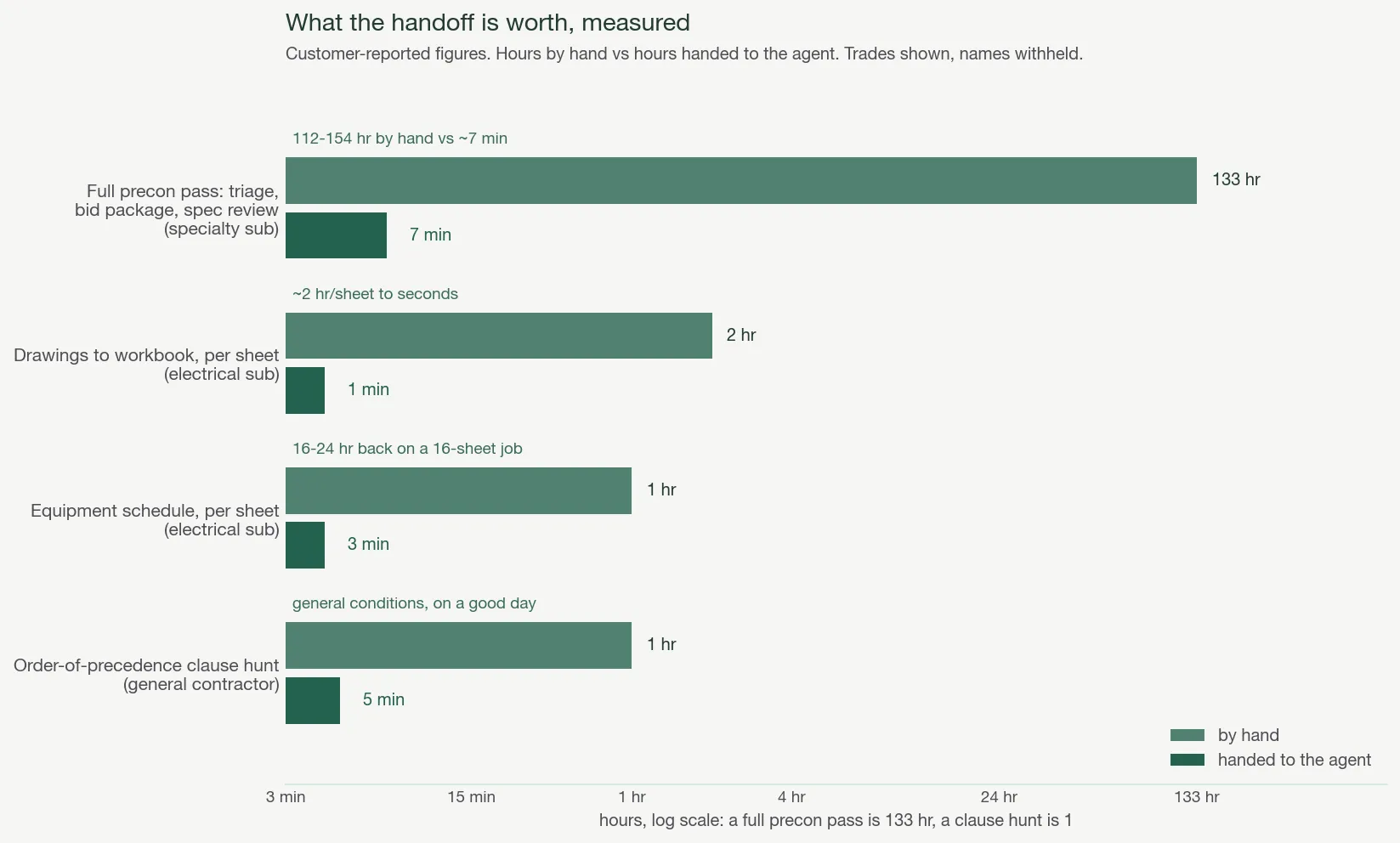
The equipment schedule due Wednesday isn’t hard. It’s long. One electrical contractor running sheets through our agent reports about an hour saved per sheet and 16 to 24 hours back on a 16-sheet job. A customer typed his own loaded rate into the agent this week (“$50 per hour plus 30% burden”), so call it $65/hr loaded: roughly $1,000 to $1,600 of your time per job, on one deliverable, before you’ve opened a contract.
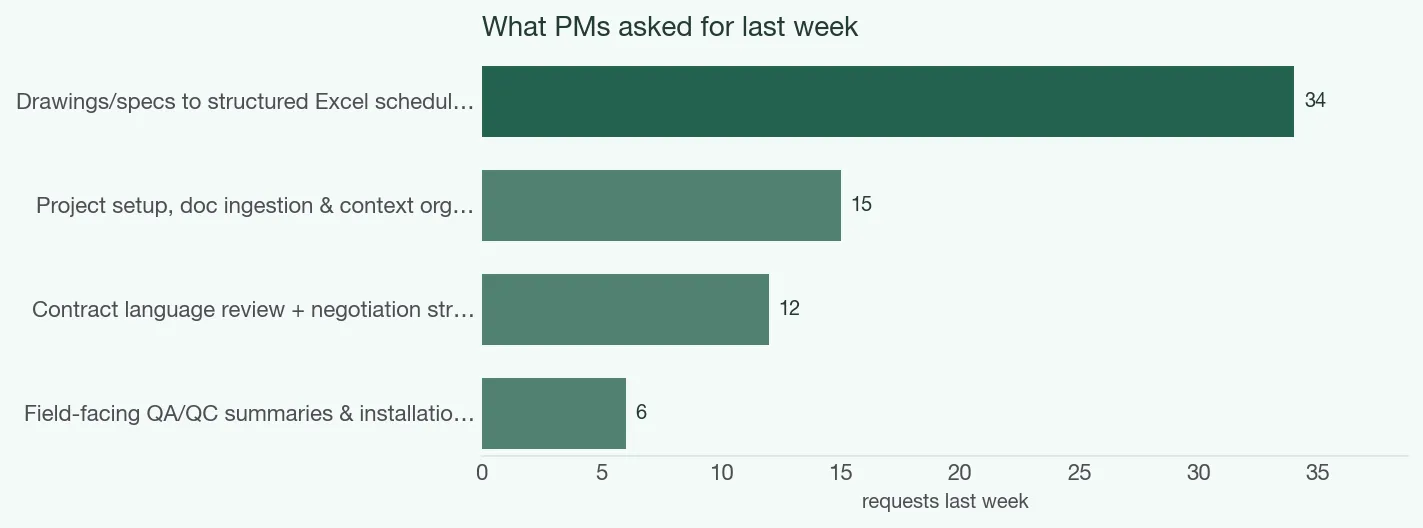
Here’s what PMs actually hand off, ranked by how often they ask.
Drawings into a workbook
Thirty-four requests last week, six contractors, all the same shape: turn these sheets into a spreadsheet somebody can use.
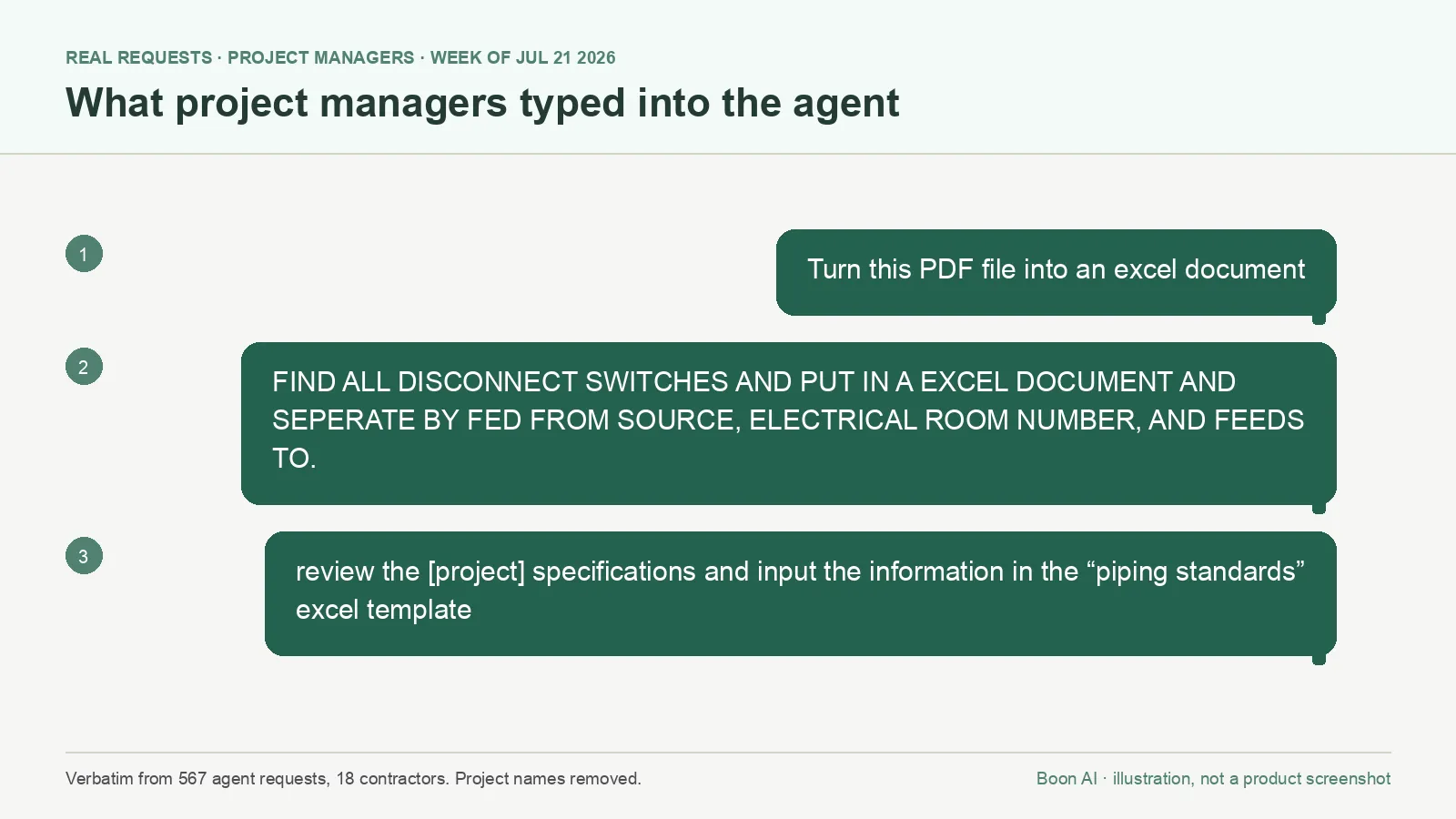
“Turn this PDF file into an excel document.”
“FIND ALL DISCONNECT SWITCHES AND PUT IN A EXCEL DOCUMENT AND SEPERATE BY FED FROM SOURCE, ELECTRICAL ROOM NUMBER, AND FEEDS TO.”
“Review the [project] specifications and input the information in the ‘piping standards’ excel template.”
The caps-lock one is a person who has done this by hand. You already know which three columns you need and which source field each comes from. You’re not asking software to invent a schema, you’re dictating yours.
The last one saves the most: you have the company template, you want the document’s contents dropped into it. The format exists. What’s missing is the four hours of typing.
At the rate above, those 34 requests are roughly 34 x 1 hour x $65/hr = about $2,200 of PM time across six firms. One lighting-heavy electrical contractor went from about 2 hours per sheet to seconds on the same kind of extraction. Estimates off one real rate, not promises.
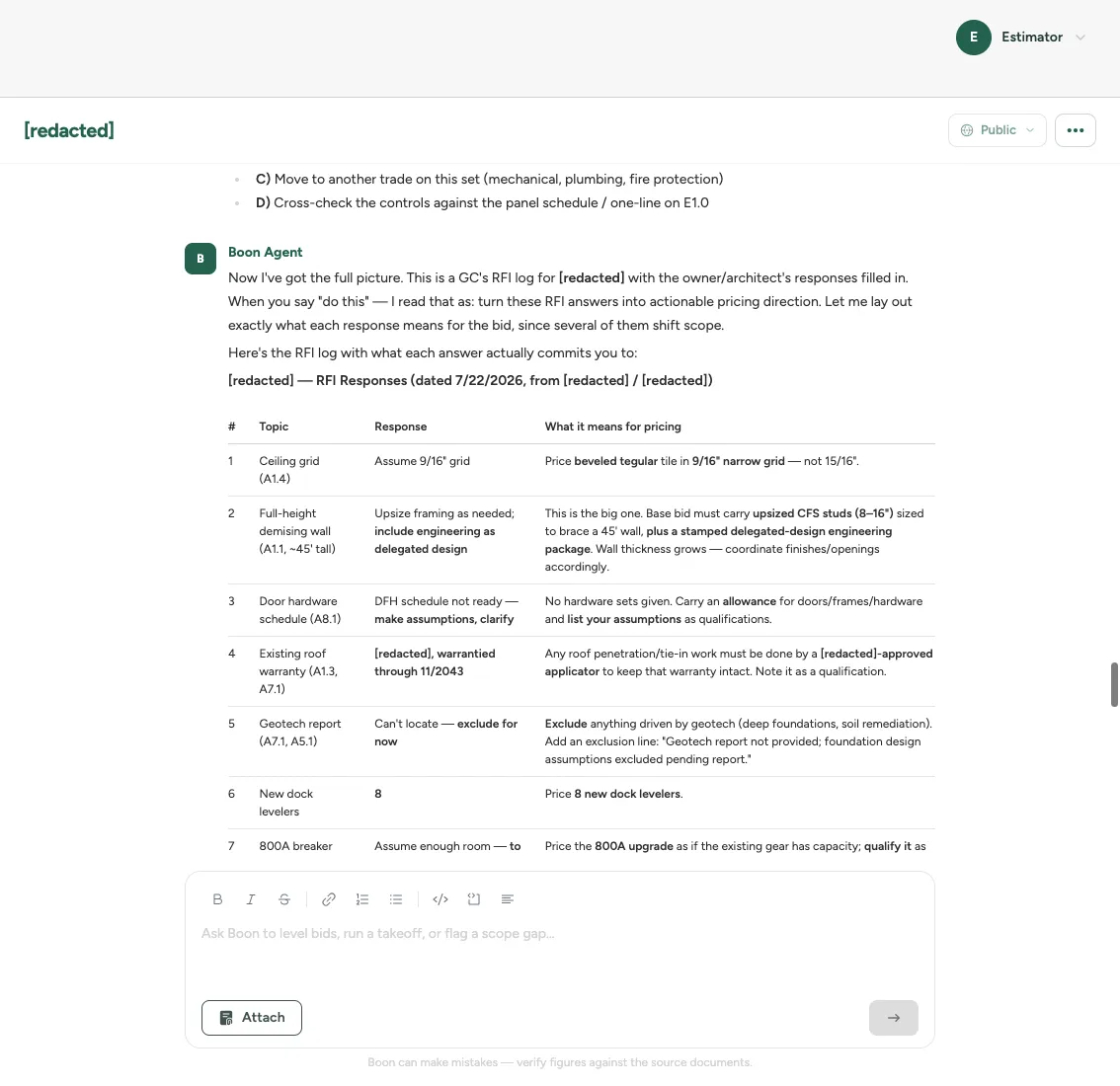
Set the project up once, then ask it for weeks
Fifteen requests, six contractors. This is what separates an agent from a search box.
“Save these spec sections for future questions for the [project] project.”
“Make sure this thread only contains information regarding [project]. I do not want to mix the projects.”
“Make job contact lists for each of jobs, put in the contract documents of each job folder.”
That second one is a PM policing context hygiene unprompted, because the value dies the moment another job’s details bleed into an answer.
The contact list is the quiet win. Those contacts already sit in the contract documents. A general contractor in the Southwest measured the closest comparable, a scope checklist and bid-leveling pass that took about an hour per project and now returns in minutes: 1 hour saved per project, about $975 across fifteen (estimate, same rate).
Walk into the call holding the clause
Twelve requests, three contractors. These aren’t production tasks. They’re arguments you’re about to have.
“Review and see what contract language there is regarding if they abandoned the job, if we still owe them payment.”
“Can you review the contract and tell me the order of precedence, the plans, specs, contract, etc takes?”
“Read the contract for job [number] and tell me what it says about acts of god as in torrential record rains.”
Someone had record rain, an owner who didn’t want to hear it, and a call in an hour. Order of precedence is a twenty-minute hunt through general conditions on a good day, an hour on a bad one, because that section is written to be unreadable. Twelve a week is 12 x 1 hour x $65/hr = about $780 (estimate, same rate). The part that decides the meeting isn’t in the arithmetic: you show up with the clause or with your memory of it.
A 40-page spec section, one page for the crew
Six requests, one contractor, so treat this as an early signal.
“Summarize this spec for a qa/qc electrical field inspector.”
“What are the high points of this spec section that I could give the installers to ensure a quality installation?”
“Put together a label and wire detail pdf using the specifications and plans, show labels sizes and colors.”
Same engine, pointed at the field instead of the office. One specialty contractor’s full precon pass, triage through bid package through spec review, runs in about 7 minutes against 112 to 154 hours manually. A spec section isn’t a field instrument. A one-page installer checklist is, and nobody has the afternoon to write one, so the spec goes out unread and the install happens from habit.
What it adds up to
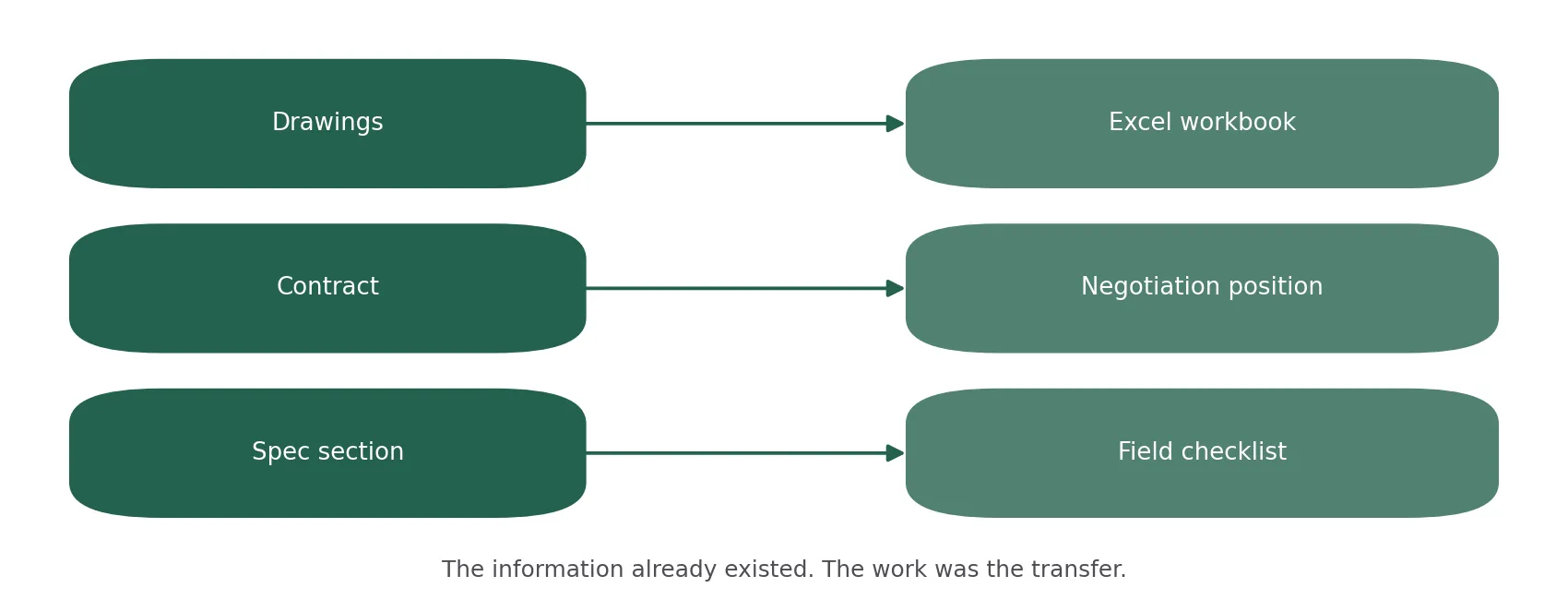
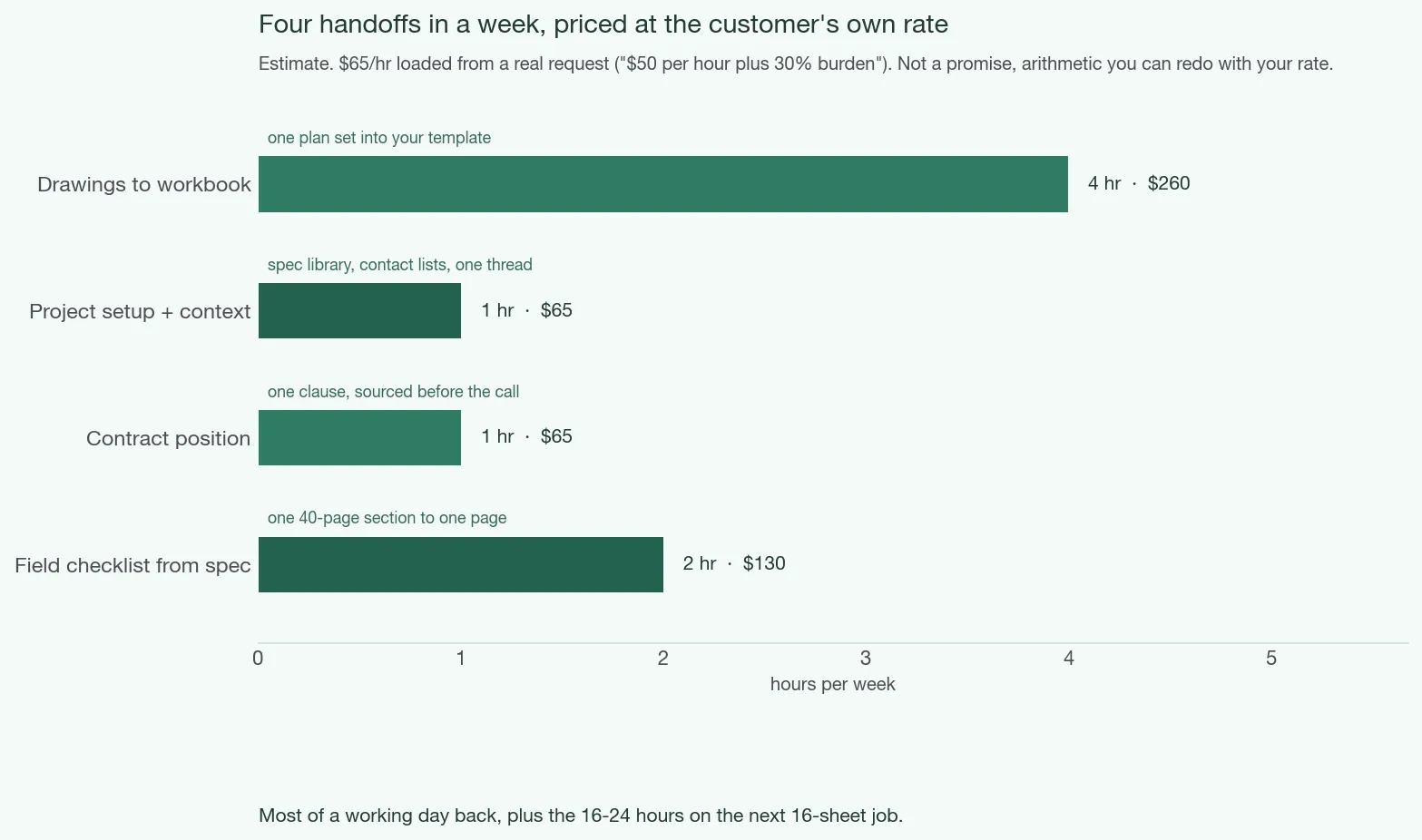
Four categories, one job: moving information you already have into the shape the next person needs. Drawings to workbook. Contract to position. Spec to checklist. Hand off four in a week and at $65/hr loaded you’ve bought back most of a working day, plus the 16 to 24 hours on the next 16-sheet job. That’s not a smaller team. It’s the fourth bid you weren’t going to get to.
Send us your worst PDF schedule and see what comes back.