On a Friday afternoon in Denver, an estimating director for a mechanical subcontractor stared at a whiteboard tracking twenty-four submitted proposals.
Three were marked as awarded. Twenty-one were crossed out in red dry-erase marker.
That is an eleven percent win rate. In commercial construction, that isn’t a disaster. It is an entirely normal month.
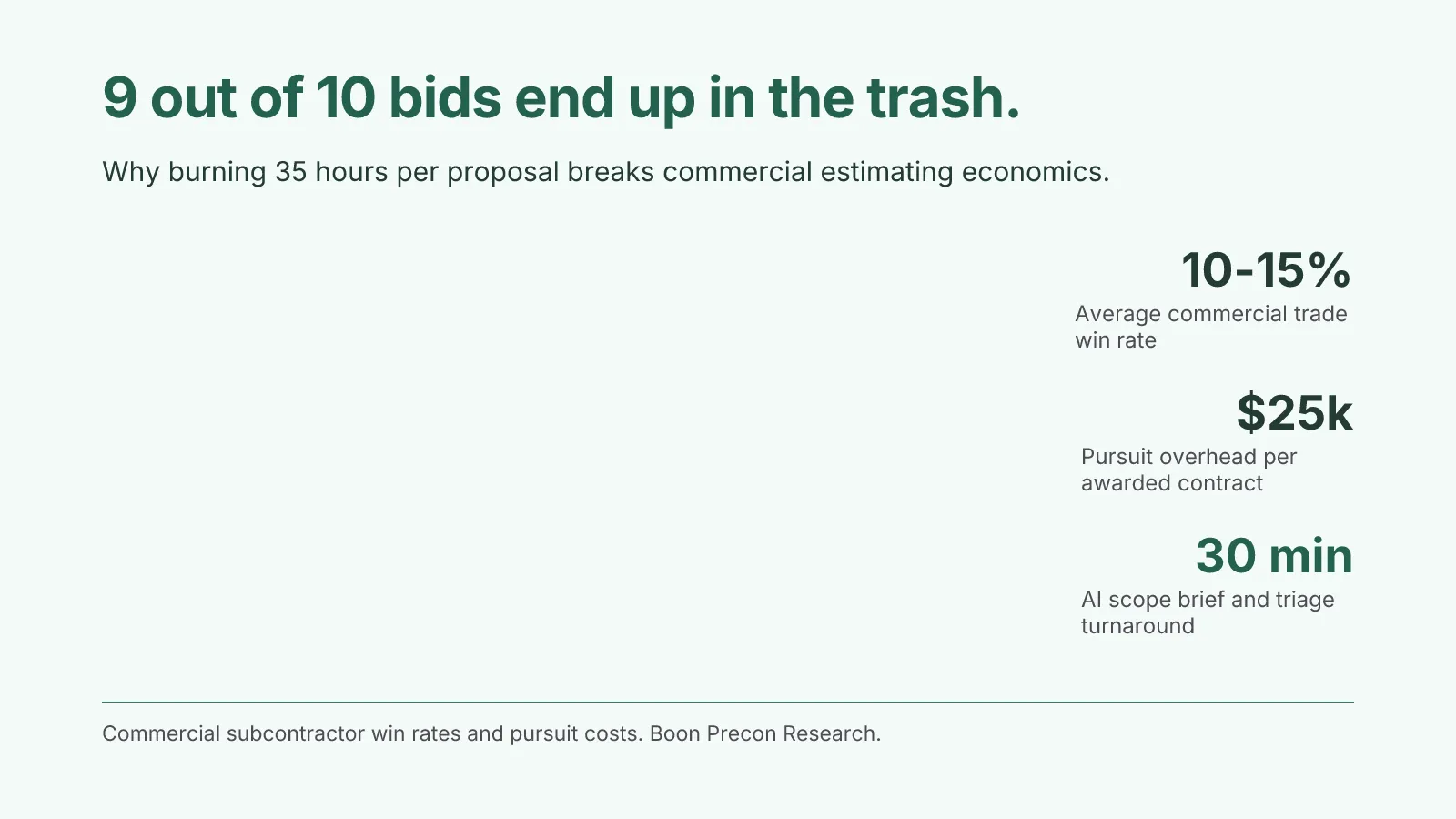
Commercial trade contractors spend their lives operating between ten and fifteen percent bid conversion. They know that nine out of every ten bids they build will end up in the trash. The client won’t award the job. The general contractor will pick a competitor who made an aggressive pricing error. Or the owner will shelve the development entirely when financing costs spike.
Yet contractors still build all ten bids as if each one were guaranteed to break ground next Monday. That practice quietly bleeds hundreds of hours of senior engineering capacity every quarter.
The true cost of pursuit waste
Consider what goes into building a single commercial bid package for a six-million-dollar plumbing or mechanical scope.
An estimator logs thirty to forty hours reading specifications, conducting takeoffs, soliciting vendor quotes, and assembling proposal exclusions. When you factor in salary, healthcare, software licenses, and departmental overhead, building that bid costs roughly twenty-five hundred dollars.
If you bid ten projects to win one, your actual pursuit cost for that single award isn’t twenty-five hundred dollars. It is twenty-five thousand dollars.
That cost doesn’t show up as an itemized line item on the project budget. It hides inside company overhead, eroding operating margin before the job even starts.
If a project’s projected profit margin is eight percent on a three-hundred-thousand-dollar contract, half of your expected net earnings just went toward paying for the nine bids you lost along the way.
Why capacity messaging sparks skepticism
When technology vendors notice this problem, their standard playbook is to tell contractors to bid twice as many jobs.
They promise that artificial intelligence will give you ten times capacity overnight. They tell chief estimators to turn on autonomous bidding tools and carpet-bomb every general contractor in the region with proposals.
Estimators reject that advice immediately. Generic AI capacity messaging triggers skepticism across all levels of a construction company, and it does so for very good reasons.
In construction, a bad bid is far worse than no bid at all. If you submit a proposal with rushed quantities or sloppy exclusions, two terrible things happen. If you lose the job, the general contractor realizes your numbers weren’t credible. If you win the job, you end up owning an unprofitable contract that can sink your firm.
Contractors don’t want to double their bid volume by spamming their market with unchecked numbers. They know that bidding more bad work just produces more expensive mistakes.
The real bottleneck is triage
The answer to the win-rate problem isn’t bidding blindly. The answer is scope triage.
When an invitation to bid arrives, an estimating team must answer three critical questions before investing forty hours of work. Does this project fit our field capacity? Are the drawings complete enough to price accurately? Can we find a competitive margin edge that gives us a realistic path to winning?
In most contracting firms today, answering those questions requires doing almost the entire takeoff first.
An estimator cannot tell if a job carries an awkward feeder run or complex duct routing until they have spent three days digging through seventy drawings. By the time they realize the project carries high risk and low win probability, they have already invested thirty hours of work.
At that point, sunk-cost psychology takes over. The team decides they might as well finalize the bid and send it out, even though their odds of winning sit near zero.
How preconstruction teams flip the ratio
To fix this dynamic, preconstruction departments need a way to understand a project’s true scope in thirty minutes rather than three days.
Boon isn’t an AI takeoff tool built to click through drawings on your screen. It is your AI teammate for preconstruction.
When a new plan set arrives, you hand the documents to Boon. Within half an hour, your AI teammate indexes the sheets, tallies major equipment counts, calculates total linear footages, and flags critical specification conflicts.
Instead of burning thirty-five hours discovering that a project is a poor fit, your chief estimator reviews a complete scope brief in fifteen minutes.
If the job carries terrible logistics, impossible liquidated damages, or poor margins, you decline the bid immediately. You save twenty-five hundred dollars of pursuit overhead and preserve your team’s mental energy for bids that fit your sweet spot.
Spending energy where it wins contracts
When your team filters out low-probability bids early, their entire workflow changes.
They stop treating bid submission as a frantic rush against the clock. They focus their deep engineering hours on the three or four bids where they have a distinct operational advantage.
Because they aren’t exhausted from grinding through ten bids a week, they have time to visit the project site. They have time to sit down with key equipment suppliers and negotiate custom fixture packaging. They have time to identify constructibility alternates that save the general contractor sixty thousand dollars while protecting their own profit margin.
That is how contractors increase their win rate from ten percent to twenty percent. You don’t win by flooding the market with automated paperwork. You win by doing thorough, creative preconstruction work on the specific projects you intend to capture.
An honest audit for next week
We are not claiming that technology will turn every commercial contractor into an eighty-percent winner. Competitive bidding will always remain tough, and owners will always make unpredictable procurement decisions.
Some contractors will keep grinding through every invitation that hits their inbox. They will continue burning thirty-five hours on bids that end up in the recycle bin, wondering why their senior estimators burn out by November.
Next Monday morning, look at the last ten proposals your preconstruction team submitted. Calculate the exact hours spent assembling each package. Then ask how many of those hours actually contributed to winning profitable work.
If eighty percent of that effort went into bids that got tossed, you don’t need to hire more estimators. You need a faster way to separate the noise from the jobs that matter.