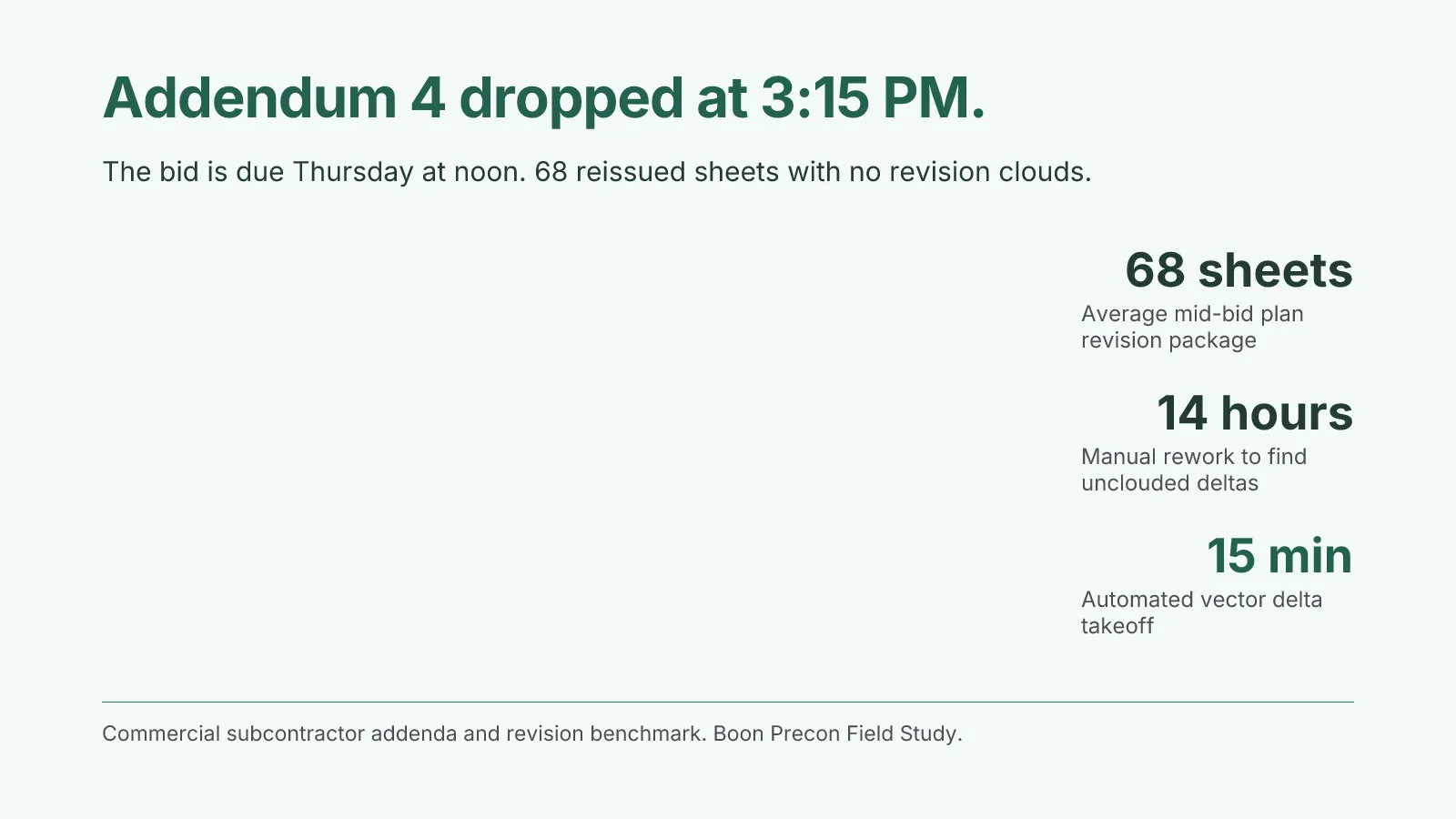
At 3:15 PM on a Tuesday, an email with a forty-megabyte zip file landed in an estimating department in Dallas.
The subject line was polite: Addendum 4 Issued for Construction. The proposal was due Thursday at noon. Inside the archive were sixty-eight revised drawing sheets and a three-page narrative bulletin that summarized the changes in eleven vague sentences.
The bulletin mentioned revised architectural layouts on Levels 2 and 3. It noted minor MEP coordination adjustments.
It didn’t mention that the consulting engineer had relocated two mechanical shafts. It didn’t mention that thirty-four junction boxes were shifted into hard ceilings. It said nothing about twenty-two variable air volume boxes being upsized.
The senior mechanical estimator had spent two full weeks building the baseline estimate. Now, forty-five hours before the submission deadline, the ground moved under his feet.
The manual delta scramble
Every commercial subcontractor and general contractor in America knows this precise panic.
When a major addendum lands two days before bid day, you face an impossible operational choice. You can have your estimators spend all night doing manual sheet overlays. Or you can start guessing.
Doing it properly by hand requires fourteen hours of tedious re-counting. The estimator opens the old plan on one monitor and the revised sheet on another. They scan back and forth, hunting for revision clouds.
Half the time, the consulting engineer forgot to cloud the change. That means the estimator has to trace every run again from scratch, checking room numbers, ceiling heights, and equipment tags.
While your team grinds through revised plan sheets, the bid day clock keeps ticking down. Real preconstruction work stops dead in its tracks.
There is no time left to negotiate buyout pricing with equipment reps. There is no time to call subcontractors and verify scope exclusions. Everything gets sacrificed to find what changed on sixty-eight pieces of paper.
Why unclouded revisions kill profit
The construction industry talks endlessly about material inflation and labor shortages, but silent plan revisions quietly destroy more trade margin than either one.
When an estimating team gets rushed on an addendum, scope changes slip through the cracks. It won’t take long to surface. It happens on almost every large commercial project.
An estimator misses a note on sheet M-204 requiring stainless steel ductwork instead of galvanized in the kitchen exhaust path. Or an electrical team misses an addendum note specifying hospital-grade receptacles instead of standard commercial devices.
You don’t discover the omission on bid day. You discover it six months later during project buyout.
By then, you own the contract at the lower number. The general contractor produces the addendum receipt showing you acknowledged the revised set. The twenty-five-thousand-dollar difference comes directly out of your company’s retained profit.
One missed sentence in an addendum can erase the entire net margin of a two-million-dollar trade package.
The failure of generic software promises
When technology vendors pitch artificial intelligence to preconstruction teams, they usually miss this problem entirely.
They build marketing decks promising ten times estimating speed. They tell contractors that generic machine learning models will auto-generate entire bids from scratch with a single click.
Experienced chief estimators hear those claims and tune them out immediately. Generic AI capacity messaging triggers skepticism across all levels of a construction company because it treats estimating as simple document generation.
Estimators know that building an estimate isn’t about spitting out numbers into a PDF. It is about understanding the delta between what was drawn yesterday and what was issued today.
If software cannot show an estimator the exact geometric differences between Revision 2 and Revision 3, speed is useless. In fact, fast guesses on an addendum are worse than useless. They are financially dangerous.
Why revision clouds aren’t enough
For decades, contractors relied on architectural revision clouds to survive late plan changes.
That system is breaking down completely. Design schedules are compressed, and architectural teams face the same staffing pressures as trade contractors. Drawings aren’t always checked before release, leaving incomplete revision tagging, missing delta triangles, and broken sheet cross-references.
Contractors cannot legally rely on the design team’s clouds anyway. Most contract specifications contain explicit language stating that the contractor is responsible for all revisions shown on the reissued drawings, regardless of whether a cloud exists.
The legal burden sits entirely on the trade contractor. If the architect drew it, you own it, clouded or unclouded.
Expecting a senior estimator to spot every unclouded two-millimeter symbol shift across sixty large-format sheets in forty-eight hours is setting them up to fail.
How an AI teammate changes the equation
Preconstruction teams don’t need a tool that requires them to re-click every fixture when an addendum drops. They need an automated teammate that surfaces the changes immediately.
Boon isn’t an AI takeoff tool. We didn’t build another digital viewer where an estimator manually clicks revision clouds.
Boon is your AI teammate for preconstruction. When Addendum 4 arrives, you upload the revised sheets alongside the previous bid milestone.
Within fifteen minutes, your AI teammate compares the vector geometry across both drawing sets. It doesn’t look for fuzzy pixel differences or rely on whether someone drew a revision cloud. It analyzes the underlying drawing entities.
It flags every relocated diffuser, every upsized pipe diameter, and every deleted fixture schedule entry.
Most importantly, it generates a verified delta takeoff. Instead of re-measuring sixty-eight sheets by hand, the estimator receives a concise breakdown: thirty-four new fixtures on Level 2, twelve deleted runs on Level 3, and four schedule changes on M-601.
Every single delta links directly to the clickable vector coordinates on the source sheet. The estimator verifies the change with their own eyes in ten seconds.
Turning bid night back into strategy
When you compress a fourteen-hour revision audit into fifteen minutes, the character of bid week changes completely.
The panic disappears from the estimating department. Your senior team stops pulling exhausting all-nighters just to check whether an architect moved a wall.
They update the cost sheet by 4:00 PM on Tuesday. Then they spend Wednesday doing what senior estimators are actually paid to do: evaluating subcontractor coverage, leveling vendor proposals, and strategizing how to win the job profitably.
They submit a bid with complete confidence, knowing exactly what changed in Addendum 4 and pricing every scope delta accurately.
We might still be wrong about parts of how design packages will look in five years. Design documents may become even more fragmented before they get better.
Next time a sixty-sheet addendum lands forty-eight hours before your bid deadline, look at your estimating team. Are they spending the next two days clicking through PDF drawings to find unclouded changes?
If they are, you don’t have a revision problem. You have a workflow problem that technology has already solved. EOF