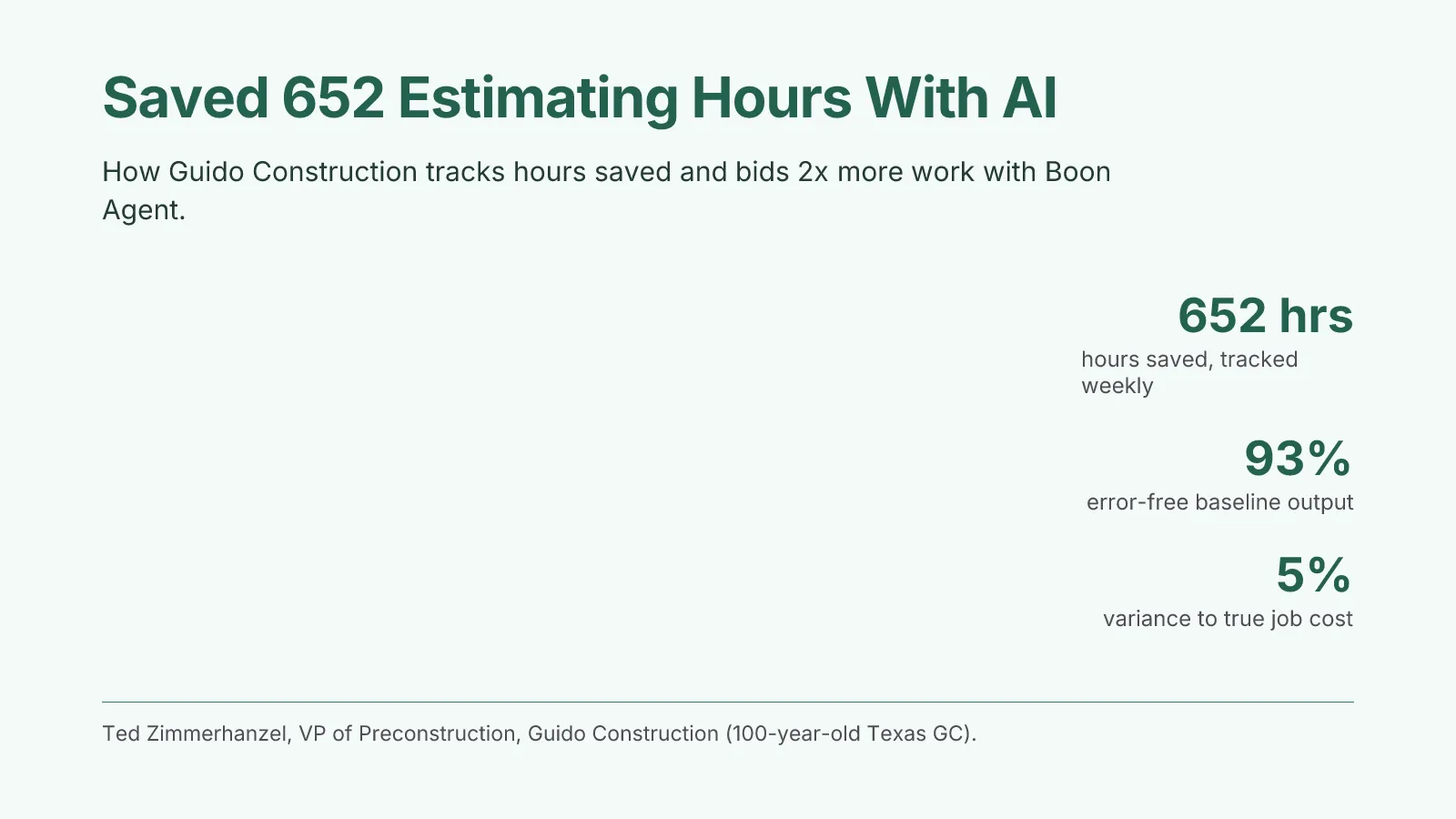
Over the last year, Guido Construction saved 652 hours across their preconstruction department. They cut baseline estimating time by sixty percent, reached a ninety-three percent error-free baseline output, and doubled their pursuit capacity to bid two completed jobs every week. They accomplished this with the exact same three-estimator team.
The catalyst was deploying Boon Agent as an AI teammate for preconstruction.
At a glance
- Company: Guido Construction. Fourth-generation commercial general contractor in San Antonio, Texas, founded in 1927.
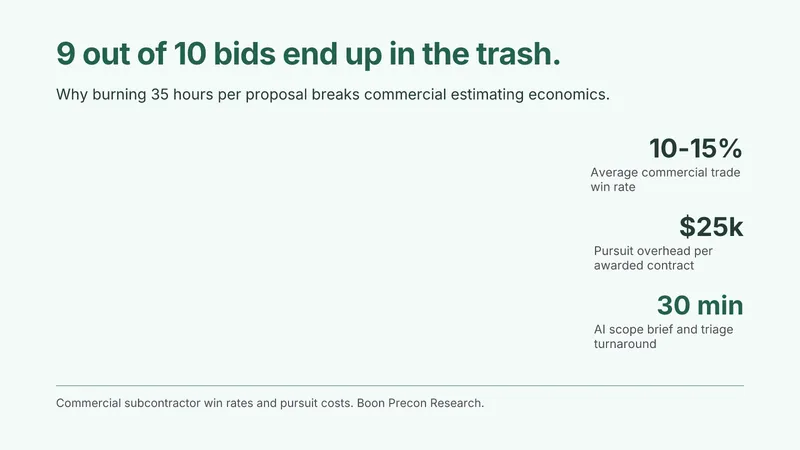
- Challenge: Drowning under five to six complex RFPs every week. The estimating team was forced to pass on attractive commercial pursuits due to manual bandwidth bottlenecks.
- What changed: Deployed Boon Agent to handle sixty to seventy percent of initial spec review, drawing reconciliation, and baseline construction takeoff.
- Results: 652 hours saved, 93% error-free initial output, bids landing within 5% of actual completed buyout cost, and pursuit volume doubled to 2 bids per week.
- Ramp-up: Initial 90-minute team training, operating independently within one week after a 10-project pilot run.
The thirty-year field perspective
Ted Zimmerhanzel has spent thirty years in commercial construction. He was in the field for eighteen years before he moved into the office to run preconstruction at Guido Construction. Guido built landmarks across San Antonio, from historic restoration projects like the Alamo to modern educational campuses and river authority infrastructure.
When five or six complex requests for proposals arrive in a single week, a contractor faces a brutal choice.
“We were having to pass on opportunities just because of the sheer volume of the commercial side,” Ted told me during our Pre-Construction First session. “You just need to figure out how to become more efficient and more accurate so you can keep the hopper full. Instead of passing on jobs, you can actually go pursue them.”
Most technology pitches promise vague transformation. Ted didn’t buy promises. He negotiated a ten-project test run. He and his estimators spent ninety minutes learning the platform, then put real plan sets through the system.
Today, Guido runs roughly ninety-five percent of their preconstruction pipeline through Boon Agent.
Where the hours actually go
The common industry belief is that estimators spend their working days applying cost judgment. They don’t.
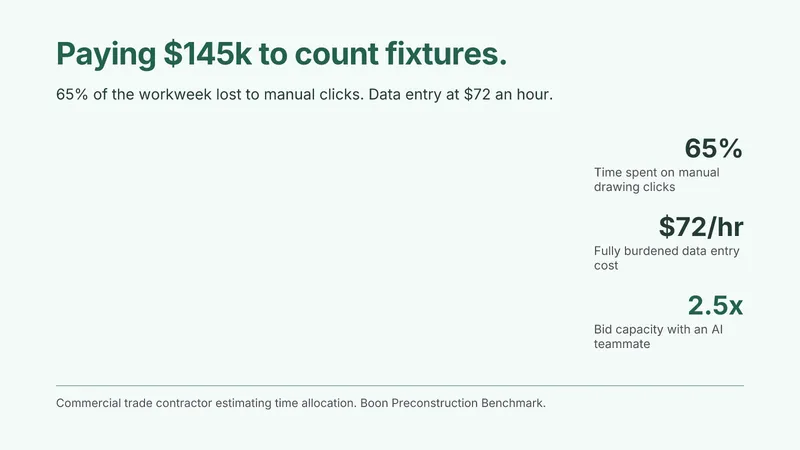
Across commercial general contractors, senior estimators spend the majority of their week acting as clerical human search engines. They scan eight-hundred-page project manuals for testing requirements. They cross-reference general conditions against division warranties. They trace whether a door callout on an architectural sheet agrees with the structural footing below it.
Only after that mountain of reading is done can an estimator do their real job. That real job is pricing risk, negotiating with trade partners, and structuring competitive bids.
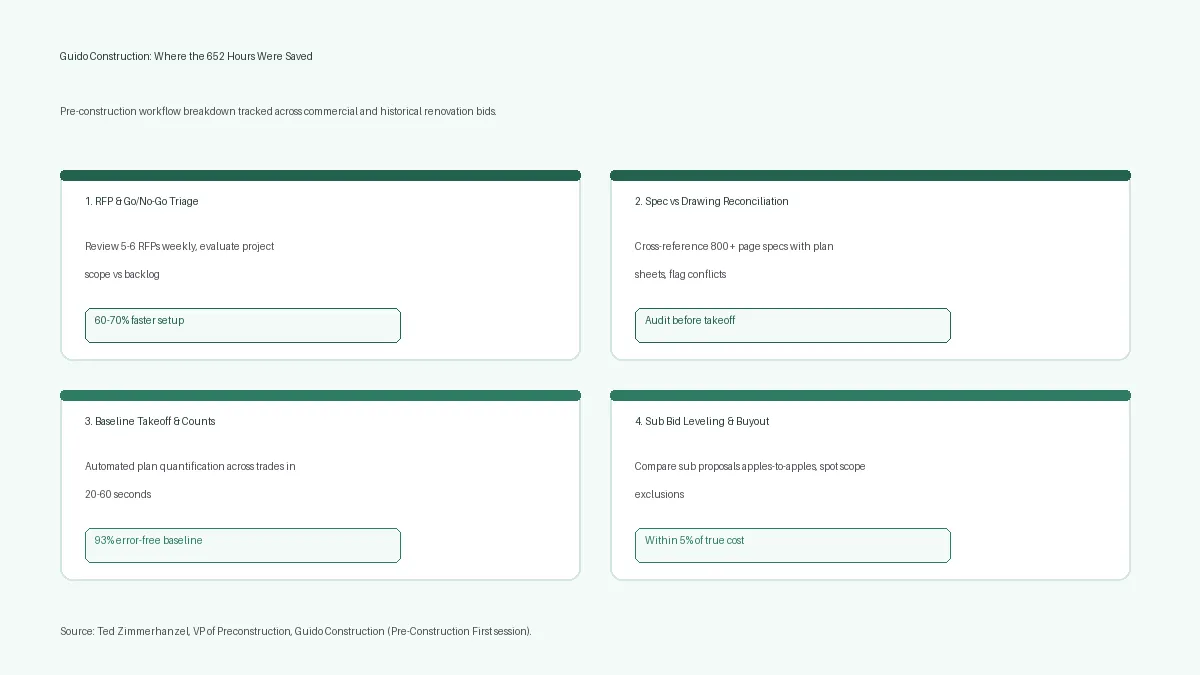
Before adopting Boon Agent, Guido faced three distinct operational bottlenecks. The first was pursuit triage. The executive leadership team had to evaluate five or six complex project proposals every week just to make go or no-go decisions. Reviewing that volume of contract paper manually ate entire days before an estimate even started.
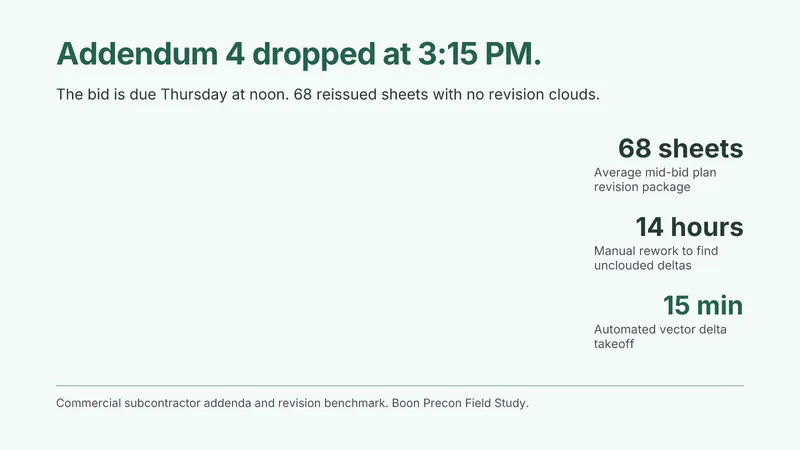
The second bottleneck was document reconciliation. Project drawings and specifications have become significantly more complex. When drawings contradict the spec book, the contradiction stays hidden until buyout or install unless caught early.
The third bottleneck was baseline takeoff quantification. Measuring and counting assemblies by hand across dozens of plan sheets consumed dozens of hours per project.
Boon Agent is not an AI takeoff tool. An AI takeoff tool is just a faster digitizer that leaves the rest of the workflow untouched. Boon Agent is built as an AI teammate for preconstruction. It reads the full project set, catches drawing-versus-specification conflicts, drafts the necessary clarification requests, and returns verified baseline quantities for estimator review.
The 652-hour scorecard
Ted didn’t take software vendor claims on faith. He set up an internal benchmarking process and ran tests weekly to measure the impact.
The number on his scorecard today is 652 hours saved across his team.
“I run tests weekly to see how much we’re saving,” Ted explained. “Boon looks after sixty to seventy percent of the initial setup work. It gets the baseline work done accurately so we can run with that, make decisions, and go win work.”
That time recovery directly altered Guido’s bidding capacity. Instead of turning down project pursuits due to estimating bandwidth, Guido now bids two jobs a week consistently. They maintain three or four more active pursuits in the pipeline while expanding into civil and horizontal work.
They accomplished this without adding estimating overhead. Ted’s department operates with three estimators and a senior construction specialist. They doubled their pursuit volume with the exact same team, proving the real economics of estimating software ROI.
When estimators aren’t buried under manual transcription, the entire dynamic of the department shifts. They spend their time building relationships with trade partners. They collaborate directly with operations leaders. They review constructability and site logistics. The quality of work life improves because the repetitive grind is gone.
The ninety-three percent baseline
The central question every chief estimator asks about artificial intelligence is accuracy. The industry has seen plenty of flashy software demos that collapse when handed a messy, scanned plan set.
Ted’s measurement of Boon Agent’s output across real commercial projects established concrete estimating accuracy benchmarks:
- Ninety-three percent error-free baseline: The initial model extraction is accepted directly by estimators without revision.
- Eight percent human refinement: The estimator applies project-specific judgment, local market factors, and trade nuances.
- One percent scope escalation: Complex discrepancies are flagged for formal clarification before bid submission.
“We’re running ninety-three percent error-free,” Ted noted. “Then we have an eight percent refinement where we say, that’s not quite what we wanted. And then a one percent where it comes back and we say, okay, that’s not what we were looking for. That is pretty remarkable.”
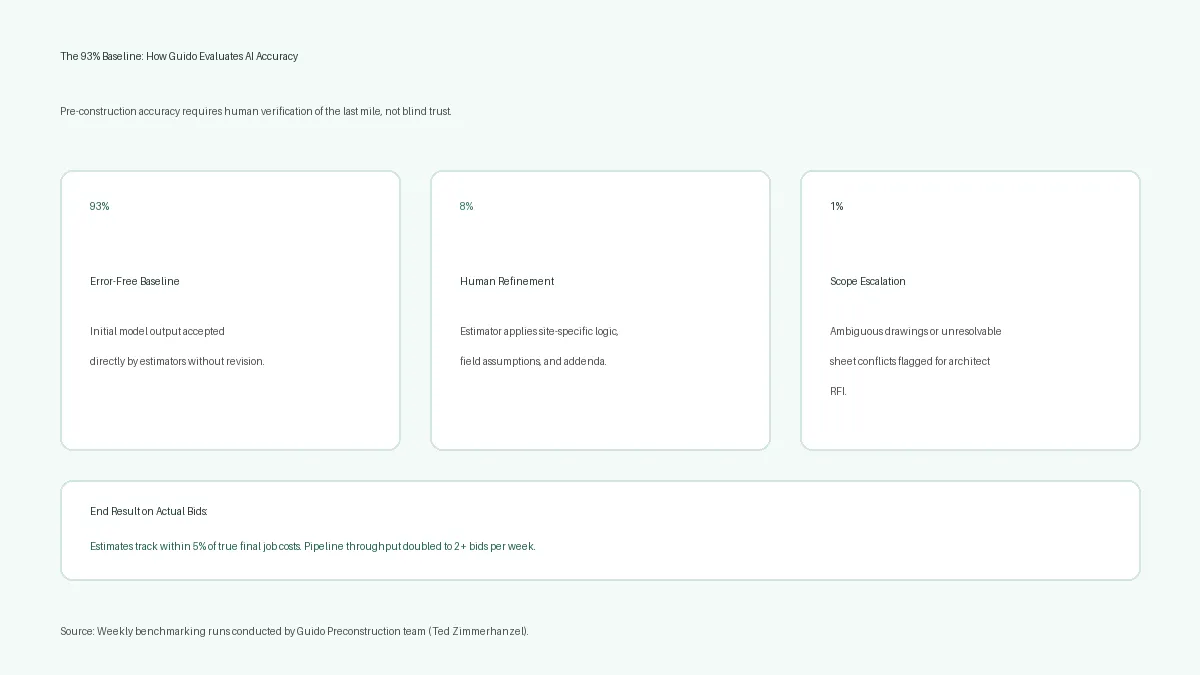
More importantly, that baseline translated into true cost accuracy. When Guido compares their preconstruction estimates against actual completed project buyout, the numbers land within five percent of true cost. This matches our findings on time to reviewed takeoff benchmarks.
This distinction matters. You shouldn’t expect artificial intelligence to hit one hundred percent accuracy on construction documents. Construction plan sets are inherently interpretive and full of conflicting drafting notes. A system that claims complete perfection is selling fantasy.
The practical goal is getting to a ninety-three percent baseline in sixty seconds rather than spending forty hours getting there by hand. That leaves the final seven percent for experienced human professionals to review and verify.
Integrating into existing systems
A new software capability is useless if it creates an isolated data silo. Estimating teams already rely on structured databases and estimating platforms.
Guido integrates Boon Agent directly into their core estimating workflow. That includes connecting with platforms like DESTINI Estimator by Beck Technology, as well as downstream project management systems. Quantities and schedule data flow directly into the spreadsheets and cost databases the team already trusts, similar to Marathon Electric’s bid intelligence playbook.
Adoption didn’t require months of disruptive consulting. Guido conducted an initial ninety-minute training session for the estimating staff. Within a week, the team was operating independently.
Boon supports the team directly inside their everyday communication channels. When an estimator encounters an unusual drawing condition or an edge case, the engineering team resolves it inside an hour via Slack or Microsoft Teams.
The technology has also expanded beyond the estimating department. Guido’s field operations personnel now use Boon Agent on active jobsites to verify specification submittals, inspect installation requirements, and generate quality logs. When preconstruction and operations share the same underlying document intelligence, field surprises drop dramatically.
What estimators should demand
If you are evaluating preconstruction technology for your firm, don’t settle for vendor marketing decks. Demand the same standards Ted Zimmerhanzel applied:
First, test the system on your messiest plan sets. Don’t evaluate software on clean demo drawings with perfect vector lines. Put an eight-hundred-page scanned public bid through the engine and inspect how it handles contradictory schedules.
Second, measure the time to a reviewed estimate. The metric isn’t how fast a tool draws colored boxes on a screen. The metric is how many hours it takes an experienced estimator to produce a defensible number they will sign their name to, reflecting outcome-based pricing in preconstruction.
Third, look for plan-and-spec cross-referencing. If a tool only counts symbols on a single sheet but can’t read the specification book, you are still doing eighty percent of the document synthesis yourself.
Artificial intelligence won’t replace commercial estimators. But estimators who use an AI teammate to eliminate sixty percent of their paperwork will consistently out-bid and out-build firms that remain chained to manual transcription.
Ready to see how your estimating team can eliminate manual paperwork and double pursuit capacity? Book a demo with Boon to run your plan sets through the platform.