By Deepti Yenireddy, CEO, Boon AI
A team signs up for Boon, buys the starter pack, and then plans the rollout the careful way. One estimator will test it on a side project. Everyone else keeps working as they always have. We’ll see how it goes, then decide.
It sounds like discipline. The data says it’s the most reliable way to make sure the tool fails. Not because the tool is weak, but because of how it gets used.
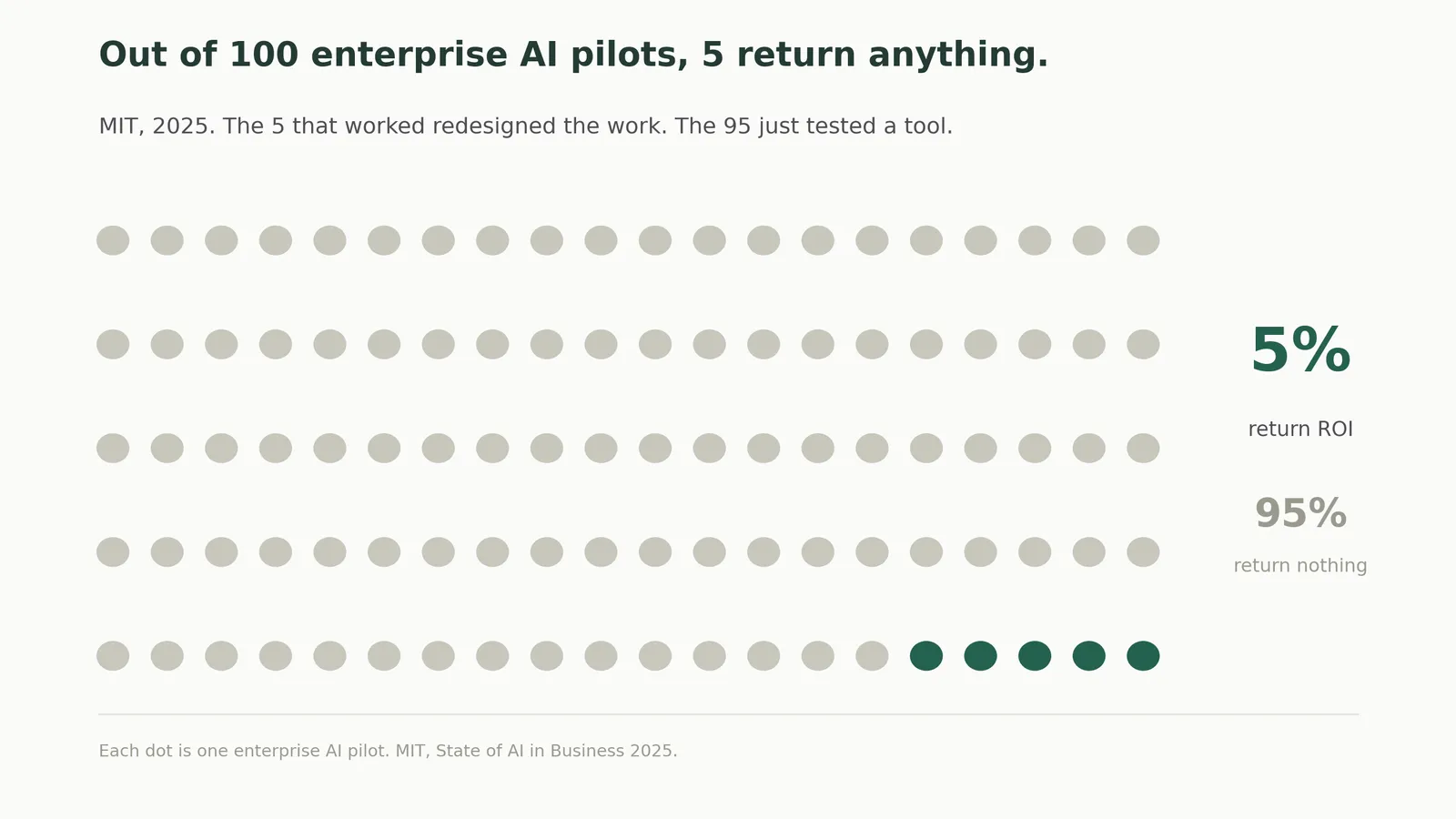
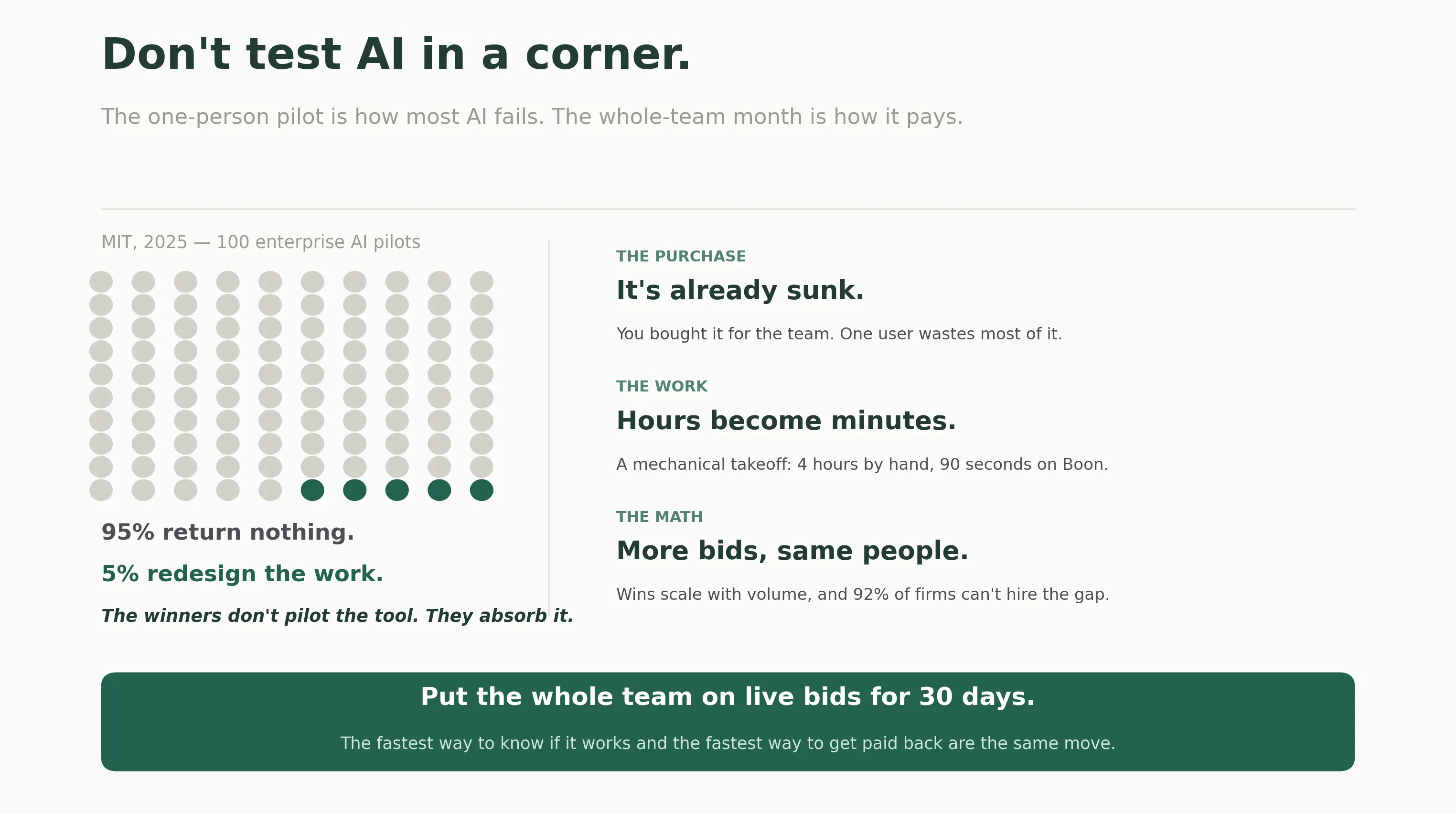
MIT’s State of AI in Business 2025 studied enterprise AI adoption and found that 95% of pilots return nothing measurable. Billions spent, no result. The 5% that worked weren’t the ones with the best model or the most careful rollout. They were the ones who stopped treating the tool as an experiment and redesigned real work around it. MIT’s own phrasing: measure absorption, not adoption. Count workflows redesigned, not logins.
That distinction is the whole game. A workflow redesigned is the team estimating differently on Monday morning. A login is one person who tried something once and moved on. A single estimator poking at Boon on a side project is a login. It is the exact shape of the 95% that go nowhere, and it fails for a reason.
Why pilots fail
The one-person test feels safe because it limits exposure. It also removes every condition the tool needs to prove itself.
One estimator on a spare project runs the tool where nothing is at stake, on work that isn’t representative, under no deadline pressure. Whatever they conclude, it doesn’t transfer. The rest of the team never changes how they work, so nothing about the firm’s actual output moves. Three months in, the honest status report is “one person is still getting the hang of it.” That isn’t evidence. It’s the sound of a pilot quietly dying. The trial never quite ends and the decision never quite gets made, and a quarter slips by with the tool parked in a corner.
MIT saw the pattern everywhere. Generic tools hit 83% adoption for easy tasks, then stall the moment real work demands context. High adoption, zero transformation. The 5% that get returns do the opposite. They put the tool on the real pipeline, in the hands of the whole team, on the bids that actually matter. The work reshapes around it. That’s what MIT means by absorption, and it’s the only thing the 95% never do.
The sunk purchase
Here’s the part the careful plan skips. The starter pack is bought. That money is spent whether one estimator touches it or six do. Going slow doesn’t lower the cost. It only lowers how much of it you ever use.
There’s a name for paying for capability and leaving it idle. Across 30 million software licenses, companies use only 49% of what they buy; the rest is shelfware. Mid-size firms are the worst at it. A tool bought for the estimating team and run by one person isn’t at 49%. It’s far below that. And the gap is pure waste of money already gone.
So the risk you were trying to manage already happened at checkout. You spent it. The only open question left is how much of what you paid for turns into work, and how fast.
What it costs
While one desk experiments, the rest of the team estimates the way it did last year. That’s the real bill, and it doesn’t show up on an invoice.
Bid win rates in commercial construction sit around 25%, and they’re fairly stable. Wins scale with volume: at one in four, roughly every four bids you can’t staff is a win you don’t get. That’s the quiet cost of a slow month. Not a line item, a bid you never submitted. Estimator capacity is what caps that volume, and manual takeoff eats most of it. On real recorded work, Boon collapses that measurement from hours to minutes.
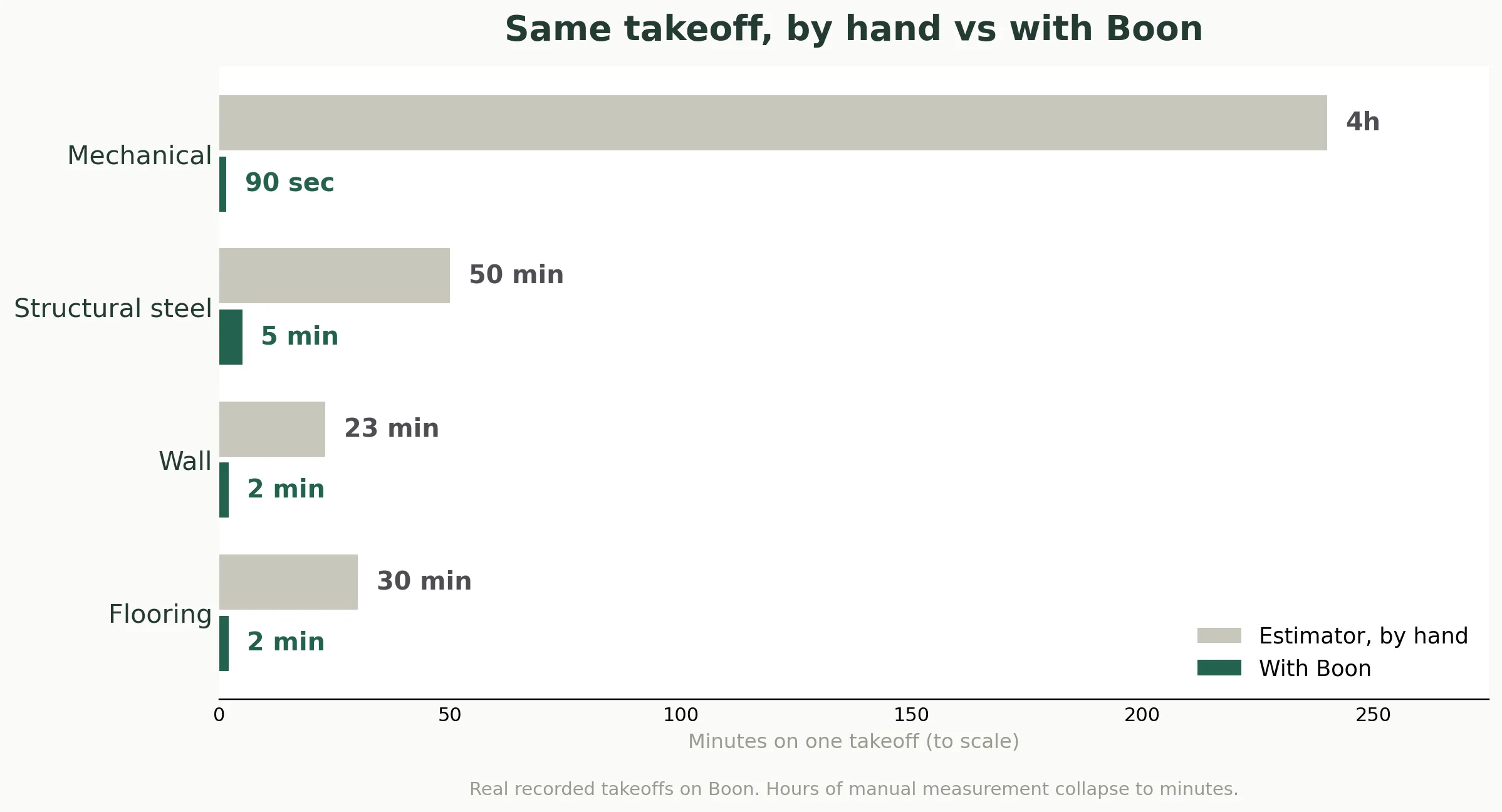
Free that time across the whole team and the firm carries 30 to 50% more bids with the same people. Free it on one desk and five-sixths of that capacity stays locked up. You can’t hire your way around it either. 92% of construction firms report trouble filling positions, and 45% have seen projects delayed by the shortage. The team you have is the team you have, and it’s not getting bigger this year. So the lever isn’t headcount. It’s how much each estimator can carry, and that’s exactly what the tool changes.
The faster answer
The reframe is simple. The careful plan and the ambitious plan are the same plan, and the careful one is actually slower.
Most of the industry proves the point by staying stuck. The majority of construction firms are still experimenting with AI rather than running it in production. Experimenting forever is the default failure. It’s also avoidable.
If you want to know whether Boon works, the quickest way to find out is to put it in front of the whole team, on live bids, for thirty days. You’ll see it across scopes, estimators, and deadlines, and you’ll have real evidence in a month. The one-person pilot takes longer to tell you less, and the data says it usually tells you nothing at all.
You already bought the capability. The firms that get a return don’t test it in a corner. They put it to work. Start the whole team on your next batch of bids, give it a month, and read the result off the work itself: sets out the door, hours saved, bids you had the capacity to chase. That’s the report worth having, and a side project can’t write it. The careful move here is the bold one. Make it.
Acknowledgements
Thanks to the Boon team for the review of this piece.
Sources
- MIT, State of AI in Business 2025 (via Forbes)
- Zylo, 2024 SaaS Management Index
- AGC of America and NCCER, 2025 Workforce Survey
- Construction.com, How to win more construction bids
- Boon AI, The Real ROI of AI in Preconstruction
Deepti Yenireddy is the CEO of Boon AI. She works with preconstruction leaders at GCs and specialty contractors to quantify the business case for AI adoption.