AutoCAD 1.0 shipped in December 1982, ten months after Autodesk was founded. Forty-four years later it is a $45 billion market-cap business with $7.2 billion in fiscal 2026 revenue, 97% of it recurring, and an AEC segment alone that brought in $3.58 billion last year. If you are an investor looking at construction software, this is the shape you are measuring everyone else against.
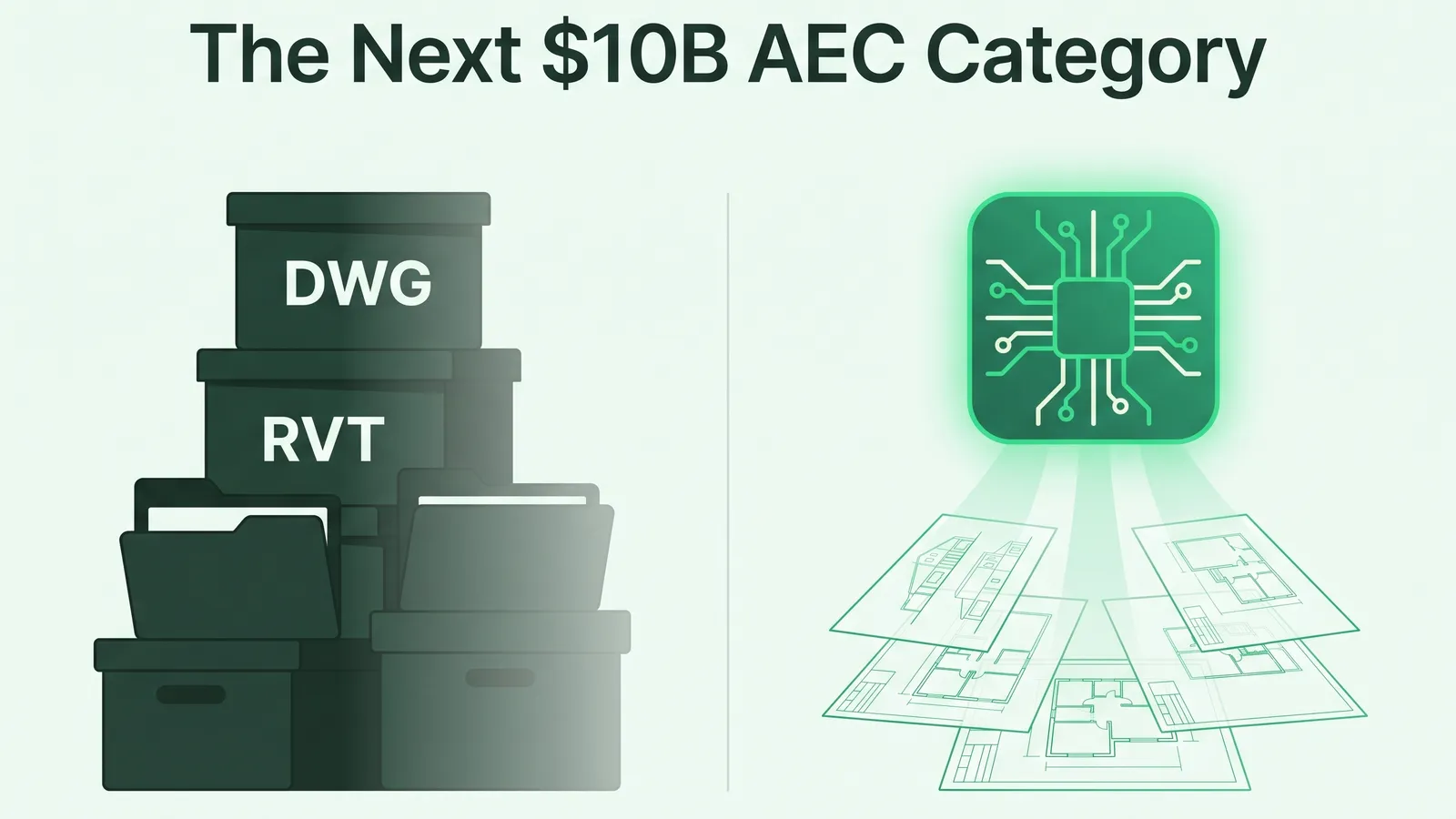
I want to be careful about the argument. It is not that Autodesk is about to collapse. Companies this big do not collapse. They persist. The question is not whether Autodesk survives the AI era. It is whether the company that defines the next $10 billion category in AEC is Autodesk, or a company that does not exist on its org chart yet.
I think it is the second one. And the reason has almost nothing to do with the incumbent being poorly run.
The old moats
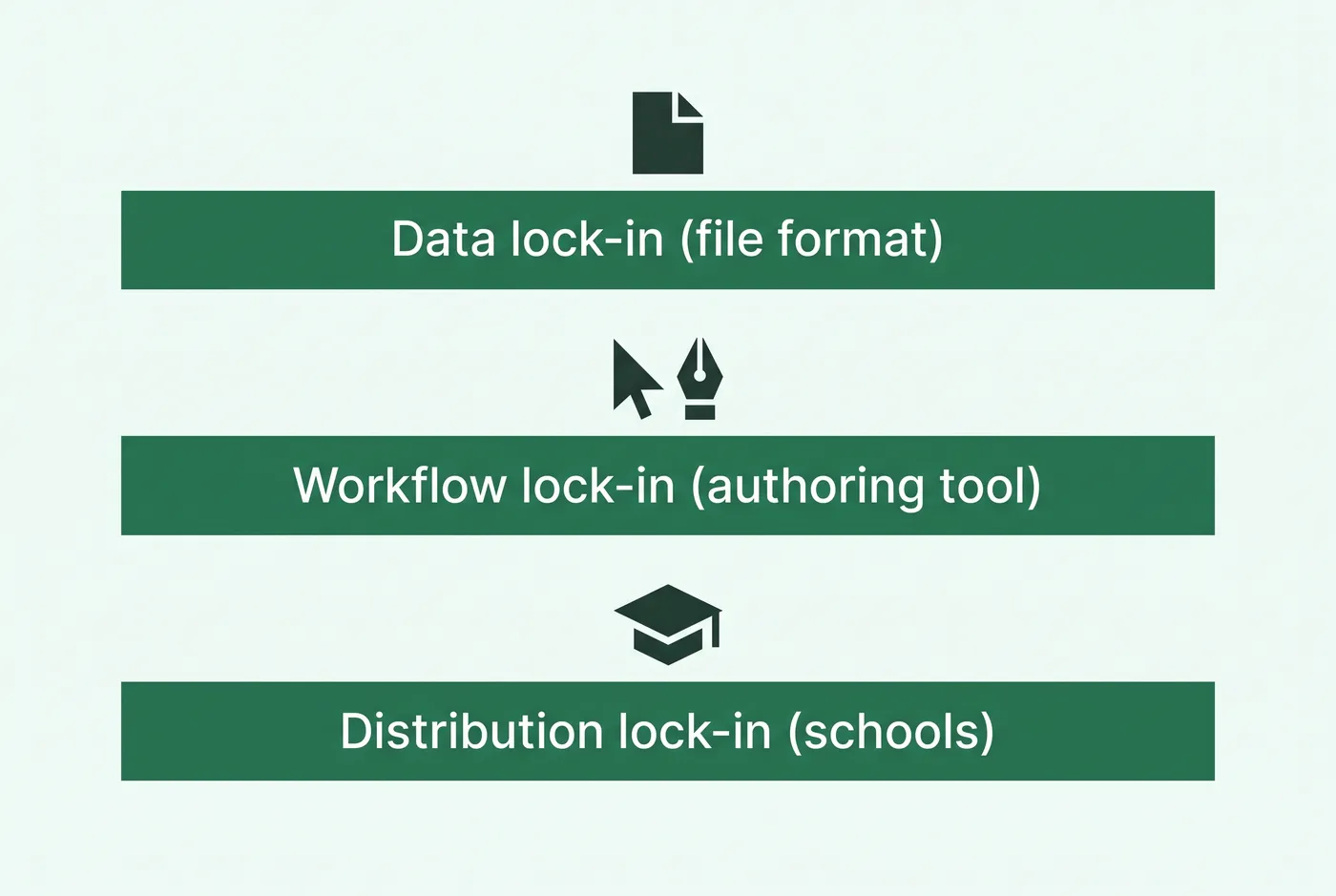
The last era in AEC software had a shape you can describe in one sentence. If you owned the file format the drawings were saved in, and you owned the tool that read that file format, and you got every architecture and engineering student to learn your tool for free, you owned the industry.
Autodesk built exactly that. DWG became the way CAD drawings were exchanged between firms. RVT became the way BIM models were stored. Both are proprietary. Both are hard to leave once a firm has a decade of project files sitting in them. The education program, launched in 2006 and expanded globally in December 2014 to make professional design software free to every student and educator on earth, made sure the next generation of architects and engineers learned those products before they had ever earned a paycheck. By the time a new architect joined a firm, the seat had already been won. That is the game.
Three moats. Stacked. Data lock-in through the file format. Workflow lock-in through the tool that reads it. Distribution lock-in through the schools that trained everyone. None of them are accidents. They were built deliberately, over decades, and they compounded in the way that great moats do.
If your business model is “sell perpetual, then subscription, seats of authoring software to a firm that already has ten thousand DWG files it cannot leave,” those three moats are unbeatable. Nobody has beaten them for forty years.
What just changed
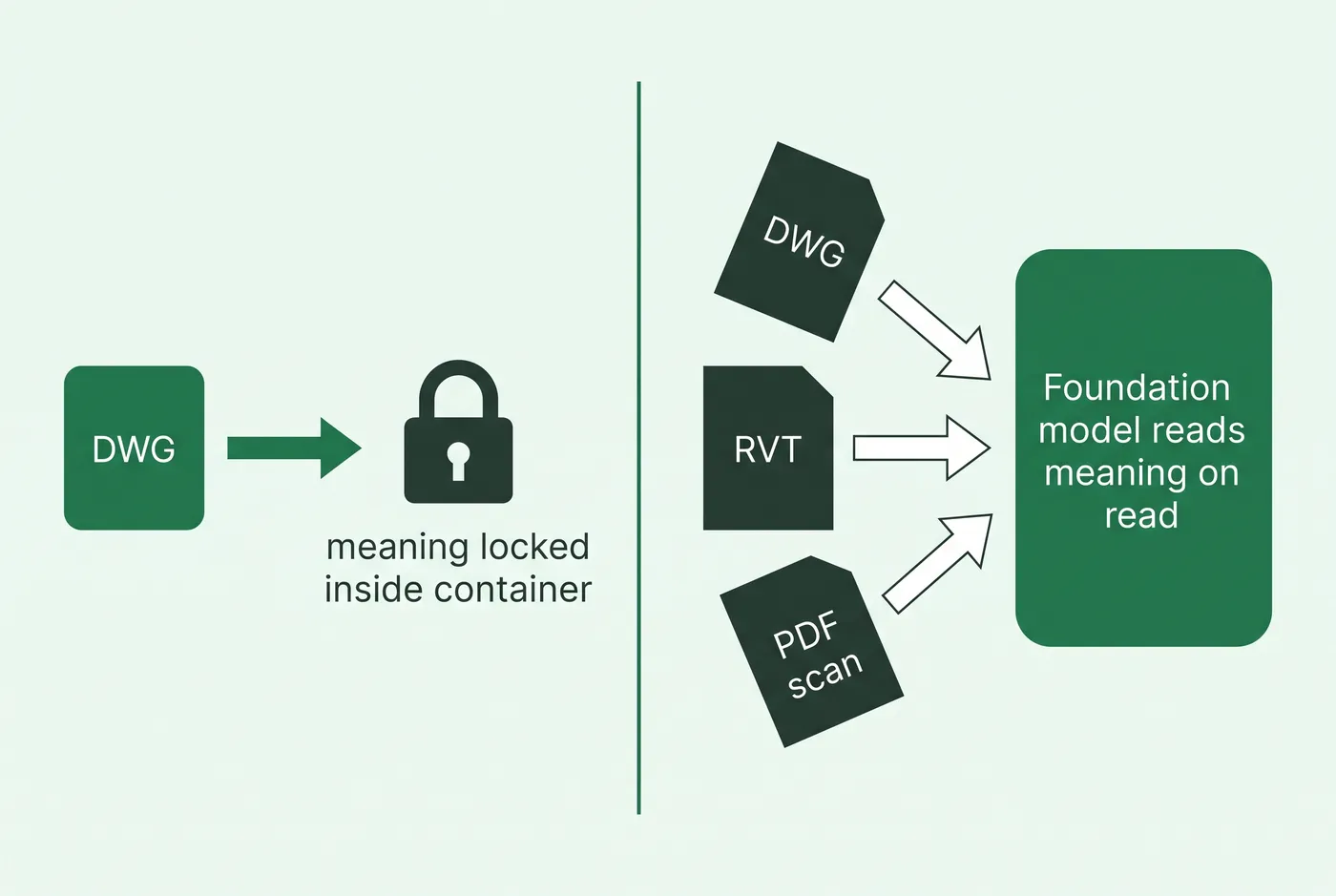
The substrate changed. The thing the moats sat on stopped being scarce.
For forty years, the reason a drawing had to live in DWG or RVT was that turning a 2D drawing into structured data was hard. It was so hard that only the tool that authored the drawing could reliably read it back. The file format was not just storage. It was the only interface that preserved meaning. That is why owning the file format mattered. You owned the meaning.
Foundation models trained on construction drawings change what that sentence means. A model that can read a plan set into structured space, that recovers geometry and topology and system relationships from any drawing regardless of who authored it, does not need the file format to hold the meaning. The meaning gets recovered on read. DWG, RVT, PDF, a scan of a 1998 as-built, a screenshot pasted into an email. It is all drawing. That is the shift.
That inverts the moat. When any drawing can be read into structured data, the file format is a container, not a language. Containers are easy to leave. And the switching-cost story that kept ten thousand DWG files locked inside AutoCAD for a decade stops being a story about the file format. It becomes a story about whether a competitor can read the drawing better than the tool that made it.
The seat model is the second thing that changed. Authoring seats are sold to the people who make the drawings. But most of the work that a construction firm does on a drawing is not authoring. It is reading. Estimators read drawings to bid jobs. Project engineers read drawings to write RFIs. Superintendents read drawings to install what is on them. Facilities managers read drawings, sometimes for decades, to maintain what got built. The incumbent priced against the smaller of those two populations, because the larger one did not have software that fit its work.

When the AI reads the drawing, the reader’s workflow gets its own tool. That is a different buyer, a different budget line, and often a bigger one. Whatever product wins that buyer is not taking share from an authoring seat. It is opening a category the seat model does not address. That is a different game.
The gap
I will say this plainly because it is the part investors actually want to know. What does the next $10 billion company in AEC have to be good at that the last era’s category leaders were not built for?
Three things. Each is the kind of commitment that is hard to bolt onto an existing $45 billion business without breaking something.
The first is a foundation model tuned to construction documents specifically. Not a horizontal vision-language model asked politely to look at a drawing. A model whose training distribution is the actual document format the industry runs on, whose architecture is built for multi-page, multi-scale spatial reasoning, and whose accuracy floor is set by an unforgiving benchmark like takeoff, where being off by 5% on fixture count loses the bid. This is a technical bet that is incompatible with being a general-purpose authoring platform. You either commit to it early, on purpose, or you do not have one.
The second is an on-prem, NDA-safe data pipeline. The drawings that would teach any construction AI what it needs to know are the sealed archives inside GCs and subs and engineering firms. Those drawings do not, and will not, move to a public cloud. Any company whose deployment story requires shipping the customer’s sealed drawings to a shared inference endpoint is going to lose the top 200 GCs before it starts. An authoring-seat cloud strategy is fine for authoring. It is not the shape of a company that runs high-accuracy inference against a customer’s sealed project data, in the customer’s office, on the customer’s silicon. That is a different deployment architecture, and it has to be there from day one.
The third is a pricing model that does not depend on seat incumbency. If a $10 billion AEC company is going to emerge from AI, most of its revenue will come from work performed autonomously, not from users logging in. The last era’s entire GTM machine, its sales comp, its financial reporting, all of it, is built on seat count. You can bolt usage pricing onto a seat business, but you cannot easily rebuild a $7 billion revenue base around it without your public shareholders noticing. The new winner will not have to. It will get to price the work from the start.
None of these three requirements is impossible for the incumbent to attempt. All three are hard to attempt fast, when the existing business is producing $2.45 billion of operating cash flow a year and the market is paying a premium multiple to keep doing exactly that.
Next
The last era’s category leader owned the file format the drawings were saved in. That was the right thing to own for forty years.
The next era’s category leader will be the company that owns the model the drawings are read by. That is a different kind of asset. It compounds. It gets better with every drawing it sees, in a way a file format never did. It does not care what software authored the file. It cares about the physical building the file describes, and it recovers that building whether the source is DWG or RVT or a 1998 blueprint scanned last Tuesday.
Whoever builds that model, at construction-grade accuracy, with a deployment story the industry can actually sign, is the next $10 billion AEC company. It might come from an existing incumbent. It might not. What matters is not who ends up owning it. The shape of the bet is different enough from the shape of the last era’s winning business that whoever gets there first is not necessarily the company that won the last one. That bet has three parts: a construction-native foundation model, an on-prem deployment story, and pricing built for autonomous work.
I have been wrong about the pace of shifts like this before. The winners of the CAD era took longer to consolidate than most people expected. The winners of the BIM era took longer than that. I would guess the AI era in AEC will take five to seven years to name its category leader, not eighteen months. That is plenty of time for the incumbents to try. It is also plenty of time for a company that does not yet appear in any research report to become the thing every research report is about.
The interesting question, for anyone investing in this space, is not whether the current market cap holds. It is who is building the model that reads the drawing, and how far ahead they are.
Deepti Yenireddy is the CEO of Boon AI.