“Two days by hand. About 90 seconds here.”
That’s the whole contrast in one sentence from the live run.
A mechanical estimator looking at a dense HVAC plan knows what the two days contain, because the work is familiar. Duct runs to trace. Fittings to count. Dimensions to read. Connections to follow across a page that was never designed to be easy on a human wrist or a human deadline.
The 90 seconds are not a magic trick. They’re a different starting point for a mechanical estimating team under deadline.
The drawing is the test
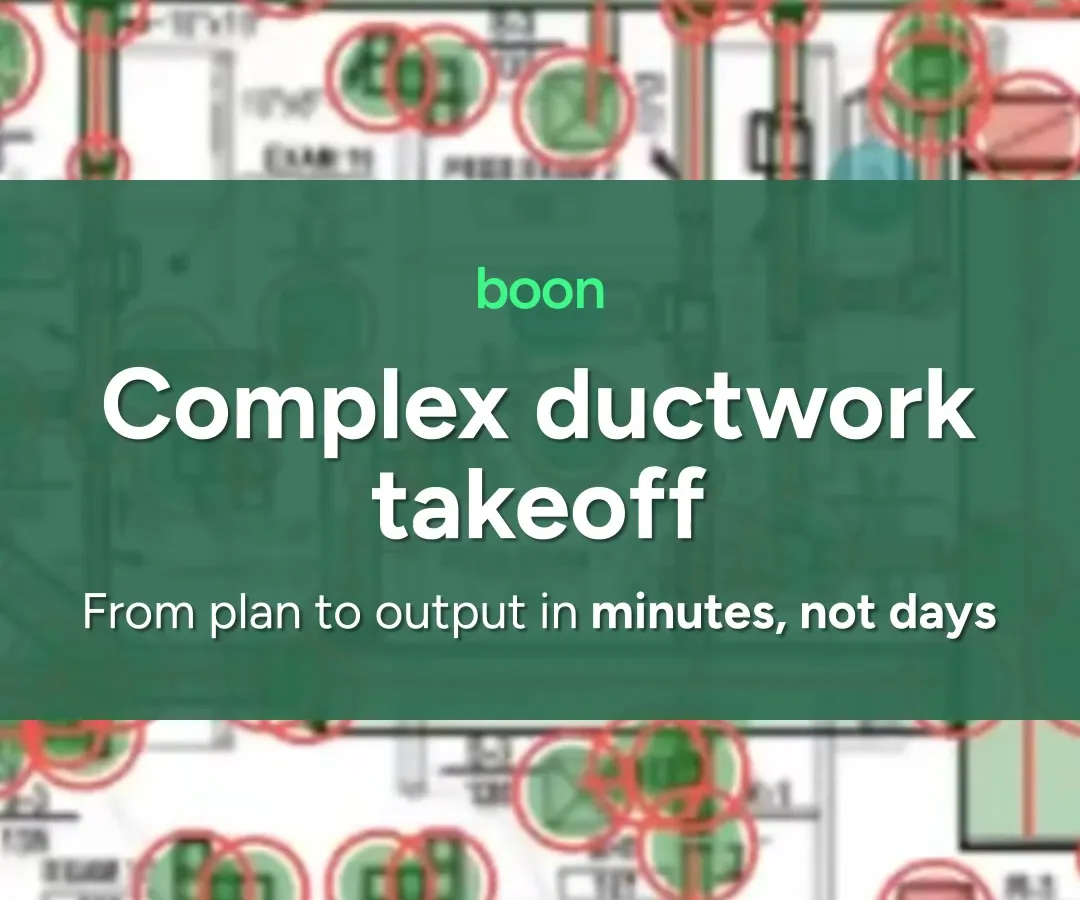
The Complex Ductwork Takeoff video starts with a live mechanical drawing. Not a toy example. Not a clean table waiting to be imported. The plan is dense with ductwork, symbols, labels, and overlapping information.
That matters because construction drawings don’t arrive as tidy datasets in a bid package. They arrive as PDFs that someone has to interpret. A duct can disappear into a crowded area of the sheet. A fitting can look like a nearby symbol. A label can sit on top of the thing it’s describing.
A useful system has to begin there, with the actual drawing. It has to look at the plan that landed in the estimator’s inbox, not at a simplified picture of one.
In the video, Boon runs that drawing through a ductwork takeoff. The output starts to appear in front of you. The plan is still the plan. The work has moved from searching and tracing toward review.
Watch the live 90-second ductwork run on YouTube.
Ninety seconds isn’t the whole takeoff
This is the distinction that gets lost in most AI demos built around a stopwatch.
Ninety seconds isn’t a promise that a bid can be submitted without a person looking at it. It’s the time it takes to get a first pass moving on this drawing. The estimator still needs to review the result, resolve ambiguous conditions, and decide what belongs in the final number.
That’s not a weakness in the workflow. It’s the point of the workflow for a reviewer who owns the number.
Manual tracing spends the estimator’s attention on the first pass. The estimator measures every run, counts every fitting, and builds the working list before there’s anything meaningful to review. When the first pass is generated quickly, the attention can move to the decisions that require context.
Does the detected scope match the bid package? Does a classification make sense? Is a connection clear on the sheet? Is there a qualification the pricing team needs to see?
Those questions don’t disappear; they show up earlier while there’s still time to answer them properly on the bid.
The estimator’s job moves upstream
The best use of a fast first pass isn’t to remove the estimator from the work. It’s to move the estimator closer to the work that matters.
An estimator shouldn’t have to spend two days proving that a line exists before they can think about what the line means. They shouldn’t have to choose between checking quantities carefully and getting the bid out on time.
With a generated starting point, the review can be more deliberate. You can correct what needs correcting. You can look at the plan and the output together. You can spend less of the day performing the same visual search and more of it deciding how the scope should be priced.
That shift is small in a single video. It’s not small when it happens across every mechanical bid on a busy desk.
It also changes the conversation about AI in estimating. The question isn’t whether the software can draw a circle around a duct. The question is whether it gives the person who owns the number a better place to begin.
Why the live run matters
A finished screenshot is easy to admire. It’s harder to learn from.
A live run shows the relationship between the drawing and the result. You can see what the system is asked to work with. You can see that the source is a real mechanical plan. You can see the output take shape instead of arriving as a polished image with the difficult part hidden.
We included the unedited contrast for that reason. Real drawings are messy. The work has to happen on the same kind of material that turns up during a bid, not only on a page selected because it makes the product look good.
The video doesn’t claim that every plan is identical. It shows one real run, on one real drawing, with the result produced in about 90 seconds. That’s enough to make the next question concrete: what would the first pass look like on yours?
The tradeoff we rejected
We could have made the video about the clock. A large number on screen. A quick cut to a finished result. A claim that the estimator’s work was over.
That would be easier to market. It would also be less honest to a team that owns the number.
The estimator is still responsible for the number. A fast system can be wrong. A dense sheet can contain an ambiguity that only someone who understands the scope will catch. A useful workflow has to leave room for correction instead of pretending that review is unnecessary.
So the tradeoff we rejected is speed at the cost of trust. The goal isn’t to make the human reviewer feel like a button-pusher. The goal is to give them a first pass they can inspect, correct, and use.
Boon is your AI teammate for preconstruction. Ductwork takeoff is one thing that teammate can do. The estimator still owns the judgment.
It’s still probably not the whole job
One 90-second run doesn’t prove that every mechanical drawing will produce the same result. It shouldn’t.
The useful test is narrower. Take a drawing your team has already priced. Run it. Compare the generated output with the work your estimator had to do by hand. Look at what was detected, what needed correction, and where the review time went.
That’s the comparison worth making for any team considering this workflow. Not a generic accuracy claim. Not a screenshot from a perfect plan. Your drawing, your scope, your review standard.
Watch the Complex Ductwork Takeoff, then bring a mechanical drawing you know well. The first 90 seconds are only the beginning. They’re the part that lets the estimator get to judgment sooner.