At 10:30 PM on a Tuesday, a senior electrical estimator with twenty-two years of field experience is sitting alone in a quiet office, clicking on floor plans.
He is not evaluating complex constructibility risks or negotiating buyout terms with equipment vendors. He isn’t comparing alternate feeder routes to save thirty thousand dollars on copper. He is counting light fixtures on Level 3 of an outpatient clinic, where seven hundred and forty fixtures sit across sixteen sheets. If he misses forty units, the bid bleeds margin before work starts. If he rushes the branch wiring schedule, the field installation team pays for that omission six months down the road.
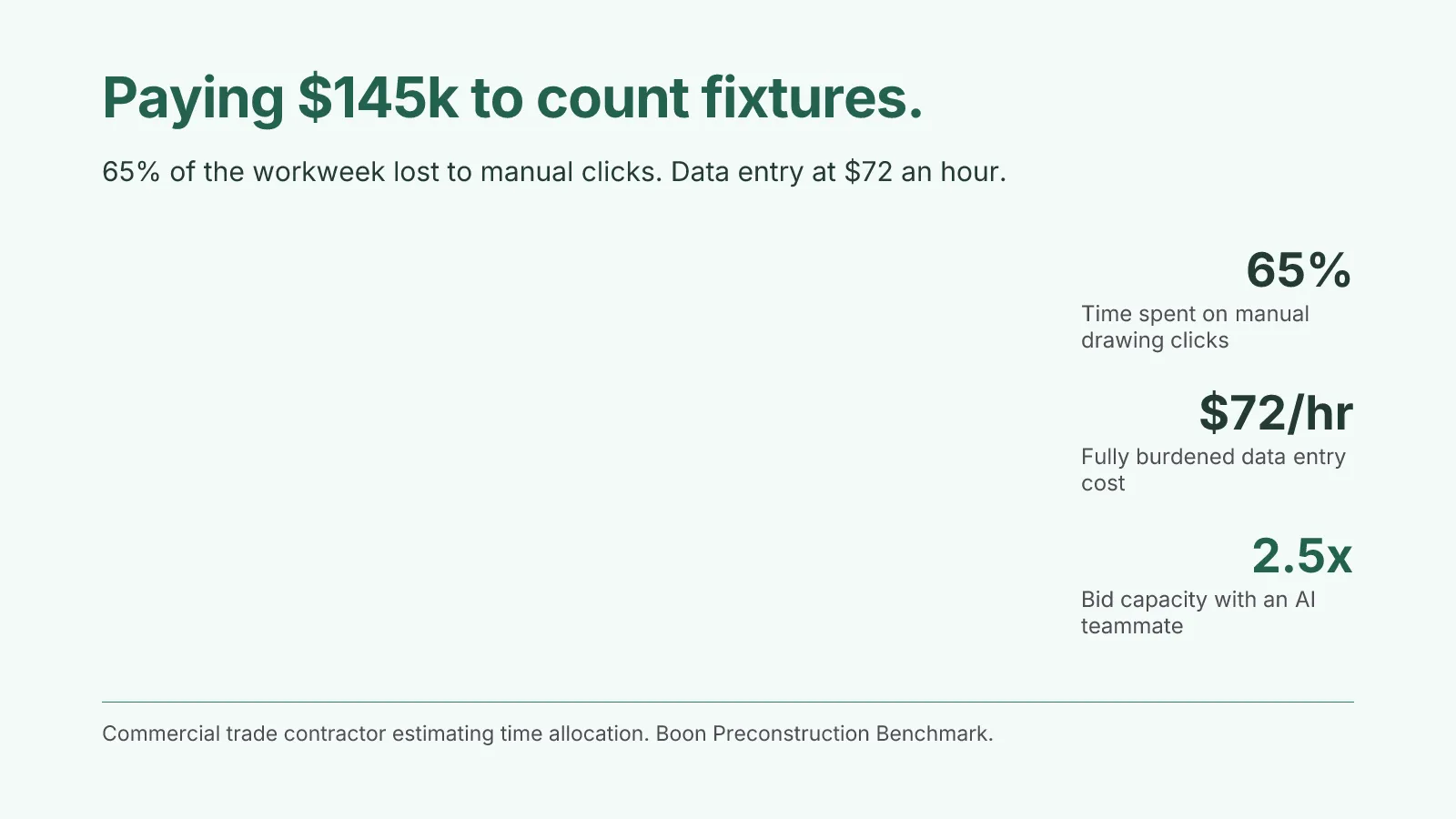
This professional earns one hundred and forty-five thousand dollars a year, which means his fully burdened cost runs seventy-two dollars an hour. His employer is essentially paying seventy-two dollars an hour for manual data entry clicks.
Everyone in preconstruction knows this scene. We just pretend it is normal.
The skepticism around capacity claims
Whenever a software company walks into a preconstruction department and promises ten times capacity, experienced estimators roll their eyes immediately. They have good reason. The skepticism is earned.
Generic AI capacity messaging triggers skepticism across every level of a commercial contracting firm. Chief estimators have heard versions of this pitch for nearly a decade. They bought digital plan tables, on-screen takeoff software, and pattern-recognition tools that repeatedly flagged exit signs as return air diffusers. Each new package promised to double department bid volume, yet none of them meaningfully shifted the team’s weekly output.
Estimators know why those promises fell apart. Estimating isn’t basic data entry; it is risk judgment performed under severe time pressure. When technology vendors shout about unlimited speed, estimators hear software that doesn’t respect the technical complexity of their trade.
A machine cannot price trade risk, read handwritten field notes about restricted site access, or anticipate that a municipal utility requires eight weeks of review for custom switchgear.
The skepticism isn’t stubborn resistance to progress. It is an earned defense mechanism against marketing promises that fail to understand how jobs actually get priced.
What estimators actually do all week
Look closely at where forty hours actually go inside a commercial trade contractor’s estimating department.
Between twenty-five and twenty-eight hours of every workweek disappear into repetitive geometric measurement. Estimators spend full days scaling conduit runs, tracing duct routes, counting plumbing fixtures, and tagging specialty devices across hundreds of plan sheets. It is exhausting work that demands total concentration, yet it draws on almost none of an estimator’s deep institutional wisdom.
The remaining twelve hours get squeezed into bid night, which is when the real commercial work must happen. That is when the team reviews vendor quotes, analyzes scope overlaps, checks addenda, and balances profit margin against competitive market positioning.
When bid night gets rushed, contractors leave substantial money on the table. They miss low supplier pricing, carry unnecessary contingency cushions, or miss a critical keynote note on sheet E-201 and absorb a forty-thousand-dollar buyout variance later.
Hiring another estimator sounds like the obvious solution, and most growing contractors attempt it. Then they audit their payroll twelve months later and realize they just hired another expensive professional to click on drawings.
The linear headcount trap
Construction executives want to expand their bid pipeline without burdening the balance sheet with permanent fixed overhead. That is the fundamental math challenge facing preconstruction leaders today.
If you have five estimators producing thirty competitive bids every month, your department’s output sits at six bids per person. If company leadership wants sixty bids, traditional management thinking says you must recruit five additional estimators.
That linear equation breaks down on two fronts. First, experienced senior estimators are exceptionally difficult to recruit. The construction industry has discussed the labor shortage for years, but preconstruction leadership feels the pinch most acutely. Finding three senior estimators who understand your regional market can take half a year of recruiter fees.
Second, every new hire introduces management drag and onboarding friction. You invest three to six months training them on company bid templates and historical cost libraries. Even when fully productive, their capacity remains strictly linear, meaning five salaries cost five times as much and ten salaries cost ten times as much.
The bottleneck isn’t an absence of talent. The bottleneck is that your best people spend sixty-five percent of their working hours doing data extraction that could be delegated.
Why tools alone didn’t solve this
For fifteen years, software vendors attempted to fix this bottleneck by moving markups from light tables onto computer screens.
That transition represented genuine progress, but it stopped at digitizing paper drawings. The estimator still had to grip a mouse, line up crosshairs, and click every single symbol across sixty pages. Instead of highlighters on bond paper, we simply gave estimators digital lines on PDF viewports.
Boon isn’t an AI takeoff tool. If all we built was another interactive canvas where a human clicks faster, we would fail the exact same test.
Boon is your AI teammate for preconstruction, and the core difference lies in delegation rather than faster manual input. An estimator doesn’t sit inside Boon clicking boxes; instead, they hand project drawing packages to the teammate, establish scope parameters, and return to high-value buyout analysis. In minutes or overnight, the teammate extracts exact quantities, links every item back to its drawing coordinates, and surfaces unresolved document discrepancies.
When the estimator reviews the package the next morning, the initial counting is already finished. The takeoff lines are complete, the sheet citations are clickable, and the estimator moves straight into verification and pricing strategy.
Keeping judgment where it belongs
The objective is never to replace the human estimator, because removing human judgment guarantees you will lose profitable work.
Winning work requires commercial judgment. It takes vendor trust. It takes buyout discipline. That is where construction contracts get won and profit margins get protected.
When an AI teammate handles repetitive measurement legwork, your senior estimator’s role transforms completely. They stop operating as seventy-two-dollar-an-hour data clerks and step into full-time preconstruction risk strategists.
Instead of rushing bid leveling at 11 PM, they have the bandwidth to call vendors, cross-check scope exclusions, and sharpen competitive margins. They can evaluate thirty projects a month instead of fifteen, not because they work longer hours, but because they stopped spending their days counting fixtures by hand.
The honest question every leader should ask
We might still be wrong about parts of how preconstruction workflows evolve over the next five years. Estimating workflows are deeply personal, and every specialized trade carries field nuances that take decades to master.
Some contractors will continue attempting to scale purely through payroll additions. They will keep paying senior engineering salaries for junior manual entry, and they will continue declining bid invitations because their staff lacks the bandwidth to open new drawing sets.
Before you commit another six-figure salary to your department budget, take an honest look at your team’s calendar this week. How many hours did your best estimators spend thinking about how to win projects, and how many hours did they spend clicking symbols on PDF drawings?
If the answer is sixty percent clicks, you don’t need another hire. You need to give your best people their hours back.