A ground-floor hydronic plan can look simple from across the room. Up close, chilled-water and hot-water runs sit side by side, and every fitting and valve breaks the drawn line into separate spans. In our piping walkthrough, I call this sheet “a bit of a headache.”
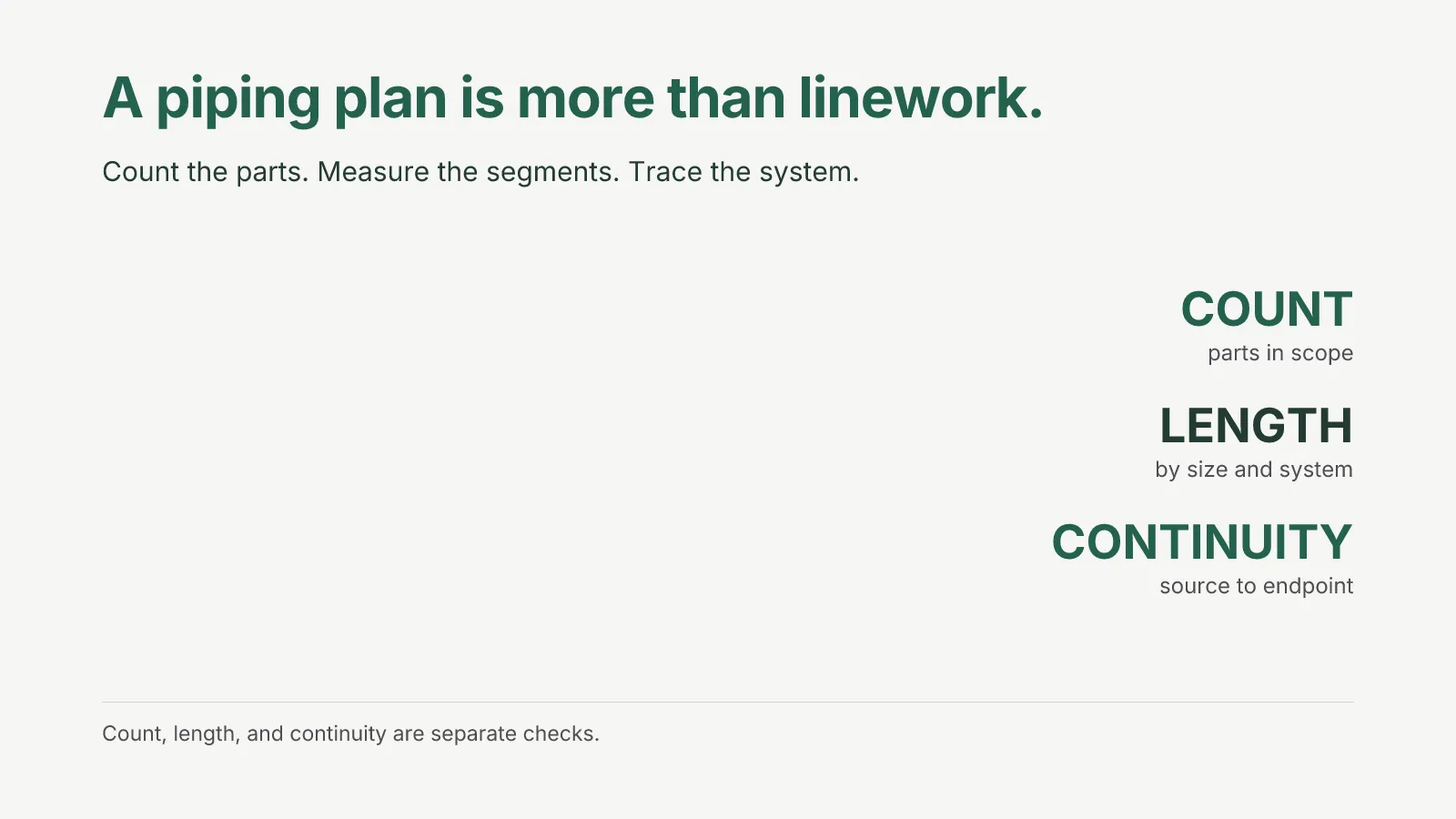
A piping takeoff review is the estimator’s check that every pipe run on a plan is counted, measured, and tied to the right system before it is priced. In an AI piping takeoff workflow, each fitting and valve splits the route into separate segments. A run can look complete on screen and still stop short of its endpoint. The review has three checks: Count, Length, and Continuity.
Boon is your AI teammate for preconstruction. Here, AI construction estimating gives the estimator a visible first pass to inspect. The estimator still owns the scope and final price.
A line can hide several runs
On a piping sheet, one apparent route may be divided at every fitting or valve. Each segment has to stop at the right place and remain tied to the right system. Similar-looking lines can make it easy to lose track of which run continues where. The task is keeping each route distinct while reading the rest of the page.
That distinction matters in the estimate. If I miss a component, the loss isn’t limited to the item count. The material, labor, and assembly needed to install it go missing too. I make that point in the walkthrough because a small break in the drawing can become a larger omission in the bid. Watch the part on missed material and labor (2:10).
A complete-looking line isn’t proof of a complete route. The mark has to be traceable back to the drawing and the system it serves.
For a related trade example, see Boon’s complex ductwork takeoff walkthrough.
What an AI piping takeoff can show
In the walkthrough, Boon’s first pass draws a line segment over each pipe run on the sheet. That gives me a clearer view of the direction and schematic shape of each pipeline. It moves some of the repeated stopping and restarting out of the work.
The claim I can stand behind is narrow: the annotations make the segments easier to inspect. I compare them with the drawing, find where a line may stop short, and correct the route when the drawing supports a different reading.
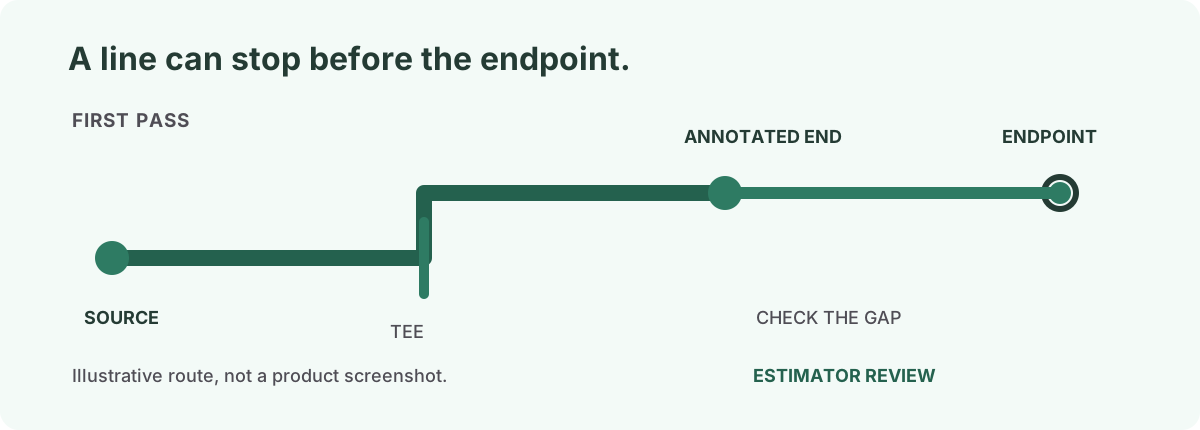
Conceptual diagram, not a product screenshot. The first pass makes a gap visible; the estimator decides whether and how to correct it.
The drawing remains the reference when a route is ambiguous.
The three checks: count, length, and continuity
Each check can fail while the other two look fine.
| Check | What it asks | What a miss looks like |
|---|---|---|
| Count | How many fittings, valves, and other components are present? | The route looks connected, but the fitting count is short. |
| Length | How much pipe is there, by size and system? | The footage looks right, but one branch is missing or sits in the wrong system. |
| Continuity | Does each run connect from its source to its intended endpoint? | A segment stops short at a fitting or valve. |
For component counts, F1 combines recall (missed items) and precision (false positives). Our plain-language explanation of F1’s two error types covers the metric generally; its published benchmarks are not piping scores. Length by size and system, and route continuity, need separate measures tied to the drawing set and scoring method.
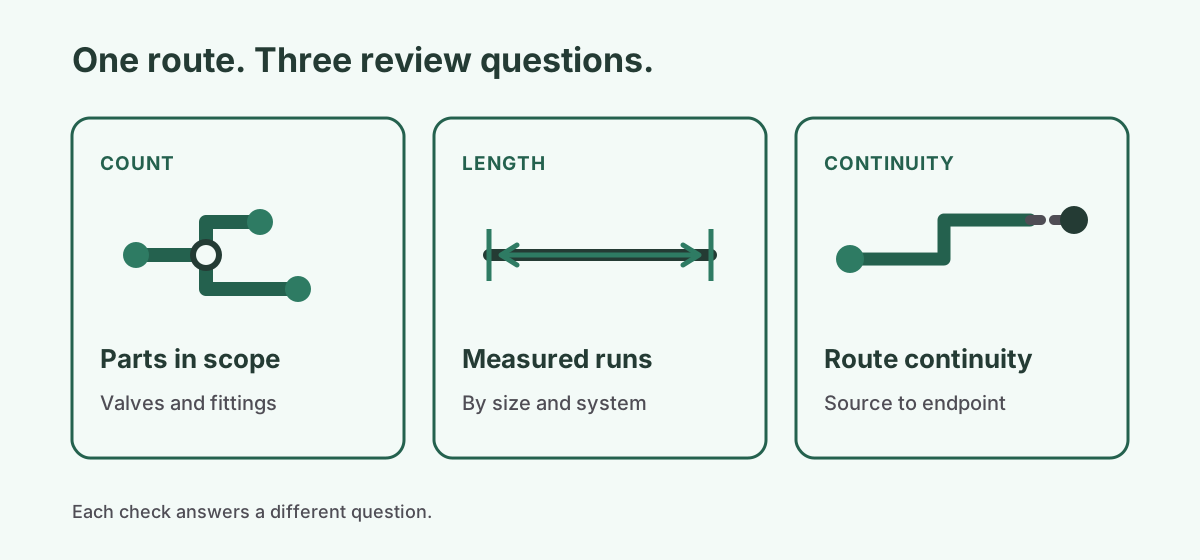
One drawing, three checks. Component count, measured length, and route continuity answer different questions.
The review screen should let me switch between the three checks. It should not hide endpoint review inside a tidy total.
Where I still use judgment
In the walkthrough, I compare the annotation with the design and see where a run may not have gone the full distance. I can then adjust that segment. That’s when a readable first pass becomes a reviewed takeoff. Watch how to check what the first pass missed (3:09).
The rest of the review should stay with the estimator. I check tie-ins, constructability, materials, assemblies, and unit rates. I decide what the drawing means when a route is unclear and what is included. Those decisions affect what gets priced and what the crew has to install.
A mark on a line helps me find the work. The reviewer still needs to inspect each segment, see where it starts and stops, and change it when the drawing says something else. For a related example of review after the first pass, see the 22-minute review pass.
The risk: a clean annotation hides missed branches
A colored annotation can look more certain than it is. I can still miss a short branch if I trust the picture instead of checking the route. That risk belongs in the product conversation, not hidden in fine print.
The tradeoff is deliberate: I prefer a visible, editable first pass to a blended score presented as proof that the takeoff is complete. It may reduce repetitive work, but it also creates a new obligation. I check the places where the drawing is dense, the systems look alike, or the line appears to stop early.
The video is one piping workflow. It doesn’t establish a measured time saving across customer sets or prove that every drawing standard behaves the same way. I won’t turn a rough manual estimate into a before-and-after claim. We need evidence from a representative set for that.
What to ask an AI takeoff vendor
Ask to see a representative piping sheet, not only a clean demo. Then ask the vendor to show:
- One marked segment, with its system and both endpoints.
- What happens when a segment stops short.
- Your own estimator correcting the route in the tool and explaining the change.
- Count, length, and continuity scored separately, with the denominator and how a miss was counted.
One single-line pass won’t generalize to every drawing set. The honest bar is whether you can trace each counted part, measured run, and continuity decision back to the drawing, and whether your estimator can challenge it. If you can’t inspect the route, the number isn’t ready to price.
Book a demo to review a representative piping sheet with Boon.