Every estimating shop has the same quiet decision to make several times a week. A GC sends over a budget request. The drawings are rough, the odds of it becoming a real project are maybe fifty-fifty, and the only person who can turn it around is a senior estimator already buried in live bids.
So the answer, most weeks, is no.
“Without something like this, we’d probably turn most of them away. It pulls resources away from estimating on real jobs.”
Scott Kelly, Chief Estimator, Veracity Electric
That was Veracity’s reality before Boon. Three or four budget requests a week, most of them declined, not because the work wasn’t worth doing but because the math on a senior estimator’s hours never penciled out. This is the story of what changed when the math did.
The hours were never the problem. The trade-off was.
Veracity is an electrical contractor running on a sharp, conventional preconstruction stack: AccuBid for estimating, a senior team that knows how to count. Scott Kelly has done this long enough to know exactly what an hour of his time is worth, and exactly what it costs to spend it on the wrong thing.
The wrong thing, for a precon team, is speculative budget work. A budget request isn’t a bid. It’s a fast, rough number a GC wants so they can shape a project that may or may not happen. The estimator who chases it spends four, five, six hours on a number that has a coin-flip chance of ever turning into revenue. Those are hours stolen directly from the bids the firm has already committed to win.
So a firm like Veracity rations. They take the budget requests they can afford and turn the rest away. Every “no” is a small relationship cost with a GC. Enough of them, and you’re not on the shortlist when the real project lands.
The bottleneck was never whether Veracity could produce a good budget. It was whether they could afford to.
The first one came back in under an hour
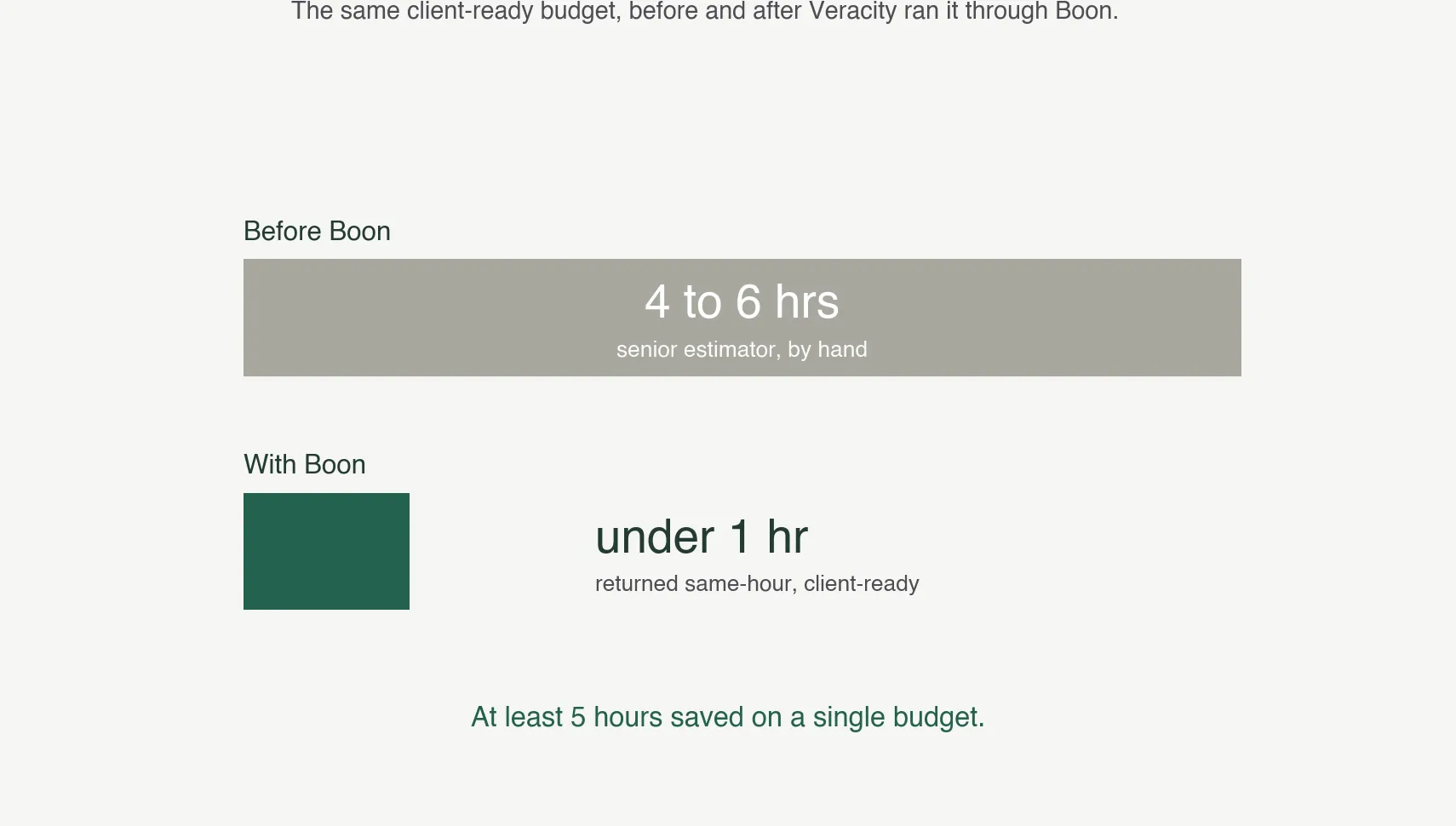
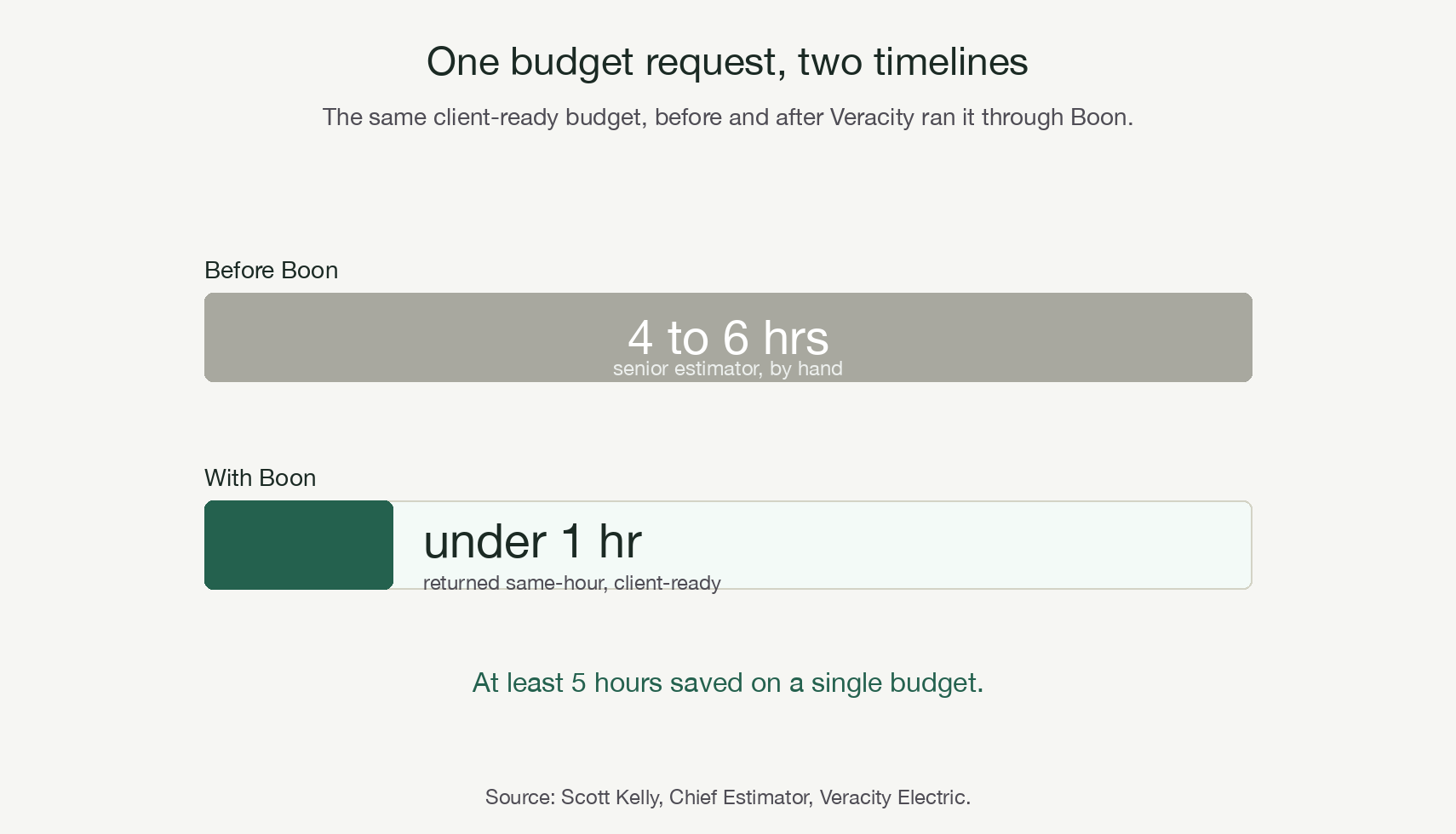
The change showed up on a real budget request, not a sandbox. A GC sent a set over. Scott ran it through Boon’s agent (Veracity calls theirs “Merlin”) and sent a complete, client-ready budget back the same hour.
“They sent that to us and we sent it back to them in less than an hour. And most of that time was me just deciding to run it through. The time it saved us: we would have spent four, five, six hours looking over that. So it saved at least five hours.”
Scott Kelly, Chief Estimator, Veracity Electric
Five hours is the number, but the speed is the story. The budget didn’t just come back faster. It came back fast enough to change what Veracity could say yes to.
And it wasn’t a rough cut. It went straight to the client: scope, exclusions, the whole sheet.
“That was a good budget that we actually sent right out to the client. Every I was dotted and every T was crossed. I don’t know that you could put something any better together to send them.”
Scott Kelly, Chief Estimator, Veracity Electric
The detail Scott keeps coming back to is the exclusions. His estimating manager, Jesse, looked at the returned sheet and flagged that there was no fire alarm in it. Scott pointed him to the exclusions section. It was already accounted for, explicitly carved out. That’s the difference between a number and a document a client can act on.
The math the firm actually cares about
Five hours on one budget is a nice number. What it unlocks is the real one.
Veracity sees three to four of these budget requests a week, the kind they used to turn away. At five-plus hours each, that’s the better part of a senior estimator’s week, every week, spent on speculative work the firm previously couldn’t justify touching.
With Boon, the trade-off inverts. The budget that cost most of a day now costs under an hour. The requests that got declined now get answered. And the firm shows up to GCs as the contractor who turns things around same-day instead of the one who passes.
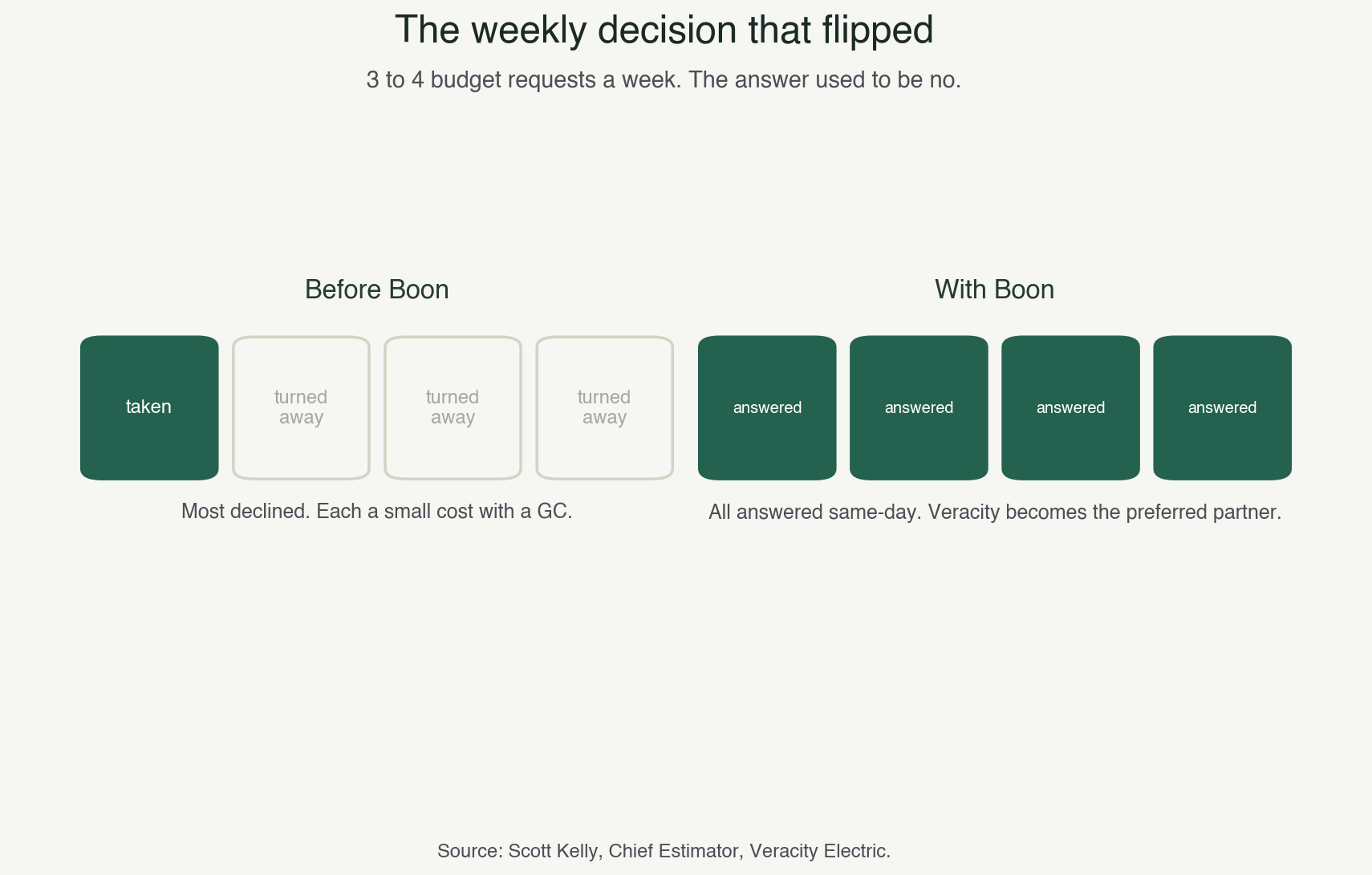
“We’re able to put budgets out like that, we now become a partner versus just another subcontractor. That’s a preferred partner for some of these GCs.”
Scott Kelly, Chief Estimator, Veracity Electric
That sentence is the whole business case. Speed on budget work isn’t an efficiency metric for Veracity. It’s a positioning move. The firm that answers the speculative request is the firm that’s top-of-mind when the speculative request becomes a funded project.
The second front: triage that gives a full day back
Budgets are where the value landed first. The bigger pool is upstream of the takeoff entirely: the triage work that eats an estimator’s day before a single quantity gets counted.
Pulling scope of work out of the specs. Reading the means and methods. Surfacing the RFIs a set of drawings is going to generate. This is the unglamorous front-half of every bid, and it’s a day each.
“Being able to have it dive into the specifications and drawings and extract the scope of work, the means and methods, the time that saves is literally almost a day. Even if it takes Merlin an hour to do that, that’s priceless. Come back an hour later and it’s done.”
Scott Kelly, Chief Estimator, Veracity Electric
The leverage there isn’t just the hour-for-a-day swap. It’s who can do the work. Scott’s point is that triage no longer requires the senior estimator at all.
“Rachael, or any project assistant, can upload it into Merlin and say, do the full triage: get me the scope of work, give me the RFIs, categorize them most-important to least, put it on a spreadsheet. You do five or six of those in a day, you just set an estimator up to add a whole other job to his schedule over a couple of weeks.”
Scott Kelly, Chief Estimator, Veracity Electric
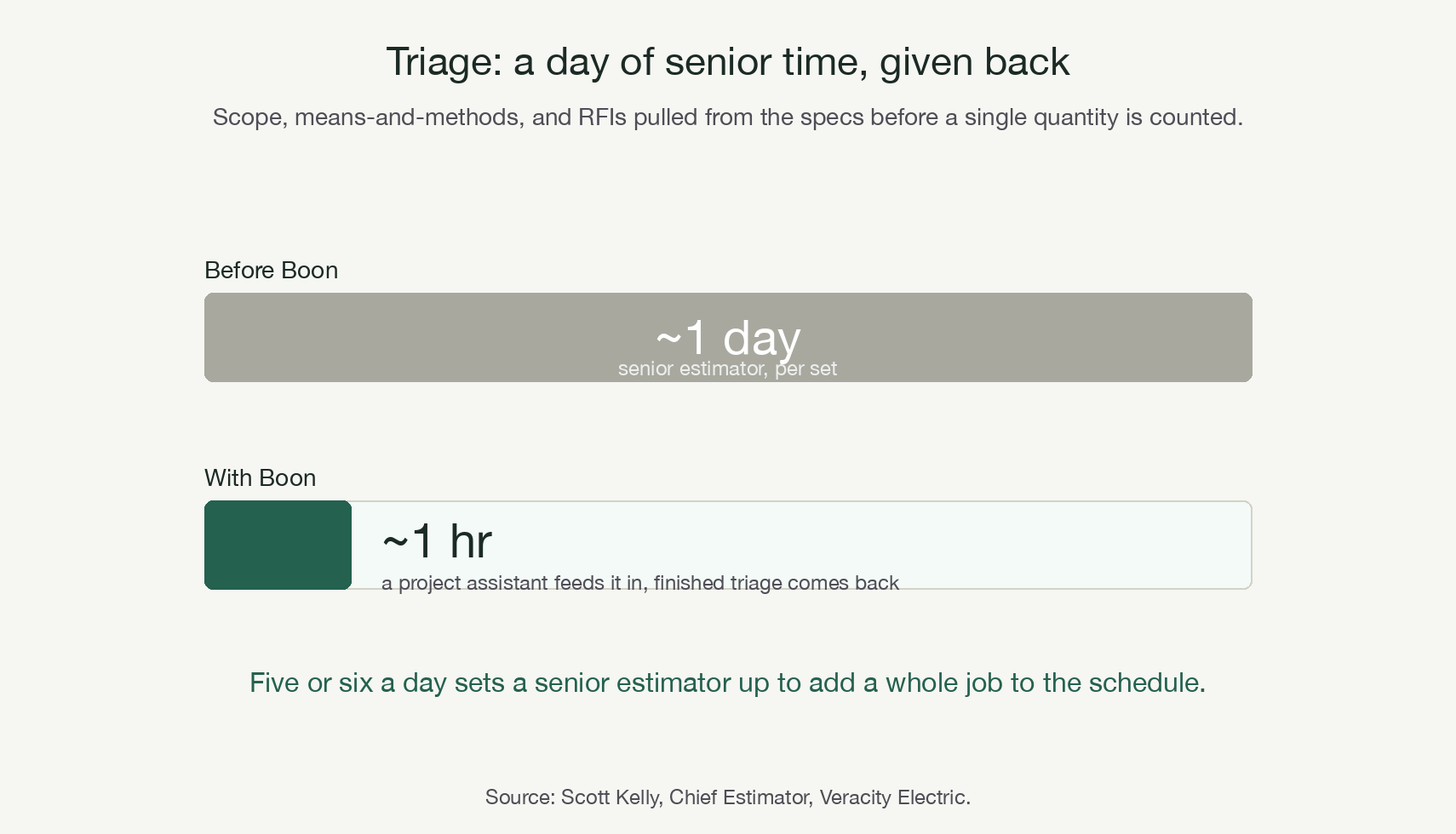
That’s the capability-expansion move. A project assistant feeds the agent. The senior estimator inherits a finished triage and a cleared calendar. The firm runs more bids on the same team.
What’s running at Veracity today
Everything below is in active use at Veracity, on real budgets and real projects, not features shown in a demo:
- Budget estimates returned to GCs same-hour, client-ready with scope and exclusions
- Full project triage: scope-of-work and means-and-methods extraction from specs and drawings
- Automated RFI generation, prioritized and exported to a spreadsheet
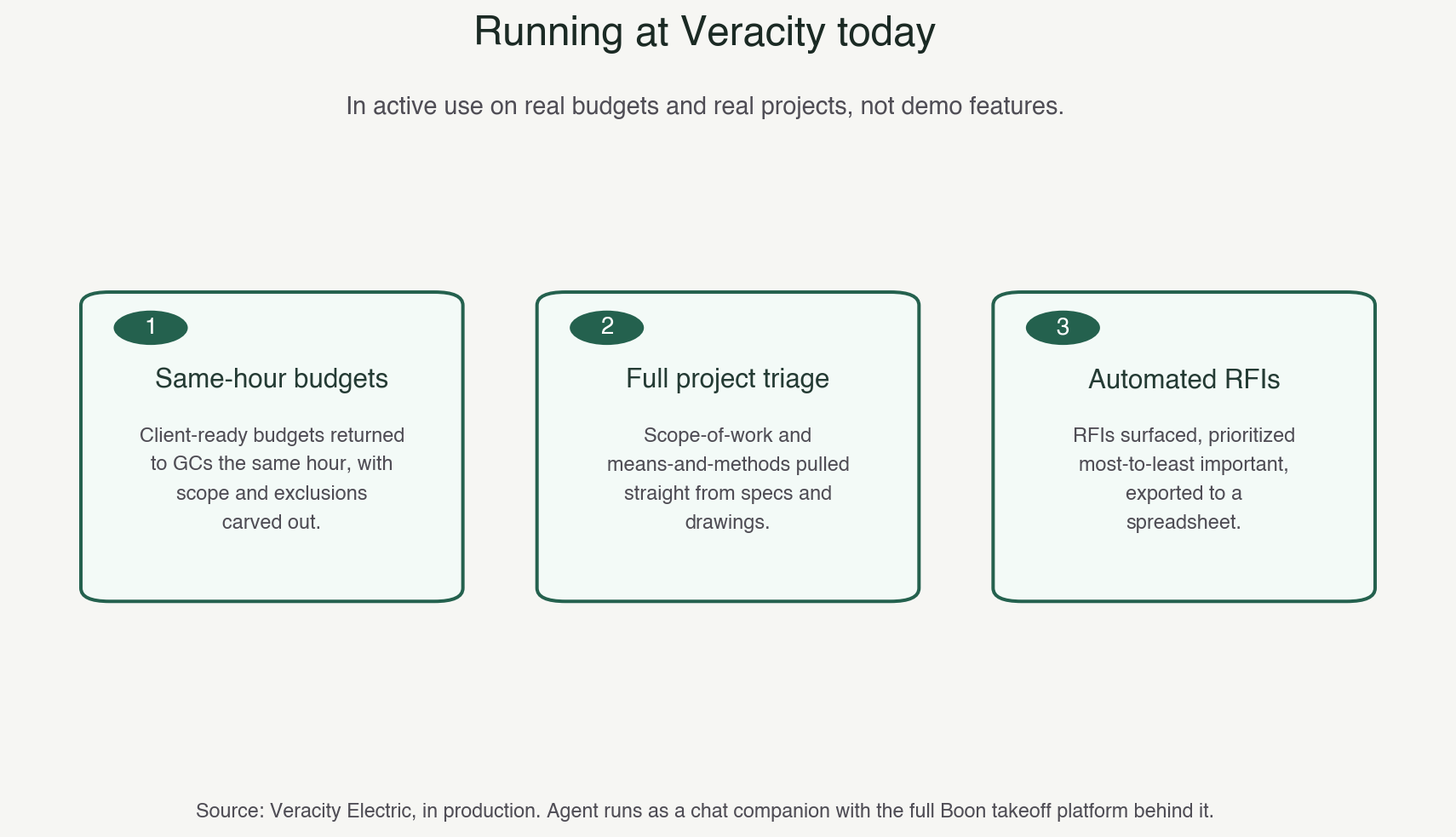
The agent runs as a chat companion, with the full takeoff platform behind it. Veracity started on Slack and is moving to Google Chat to live inside their existing Google environment. Same intelligence, the chat surface is just where the team already works.
What’s next
The takeoff side is the next unlock. Scott and his team have proven the agent on budgets and triage; the structured takeoff workflow (lighting, devices, home runs) is the muscle they’re building now, with the plan to roll it across the estimating team once Scott and Rachael have it down cold.
Scott’s read on where this goes is the one that matters, because he’s the one weighing it against years of doing it the old way:
“It’s very, very powerful. The results it produces are going to be just as good and better in some areas. I’m out there trying to sell you guys to other contractors.”
Scott Kelly, Chief Estimator, Veracity Electric
A firm that used to turn budget work away now answers it in an hour and uses it to win the relationship. That’s not a faster version of the old workflow. It’s a different position in the market, on the same team, with the same drawings the rest of the trade is still passing on.