The Boon agent working this exact use case, in product. Customer details anonymized.
Try this in Boon in about two minutes
You send: the full campus set, with one message: “Take off all twelve buildings.”
Boon returns: parallel takeoffs on every building at once, so your estimator works at review speed instead of build speed and keeps the judgment calls (like the Building 7 catches).
Where: inside the Teams or Slack your team already uses, no new tool to learn.
Take off your next multi-building bid free at getboon.ai/boon-agent
A campus expansion is the kind of bid that decides how a precon department spends its month. Twelve buildings, similar but not identical, two weeks to submit. The historical answer at most firms is to pull two extra estimators onto the job, which means two other bids get shorted or skipped, because there is no such thing as spare estimator capacity during bid season. The campus does not just cost the hours it takes. It costs the hours it steals from everything else on the board.
One GC we work with bid a campus expansion like that last month and ran it with one estimator instead of three.
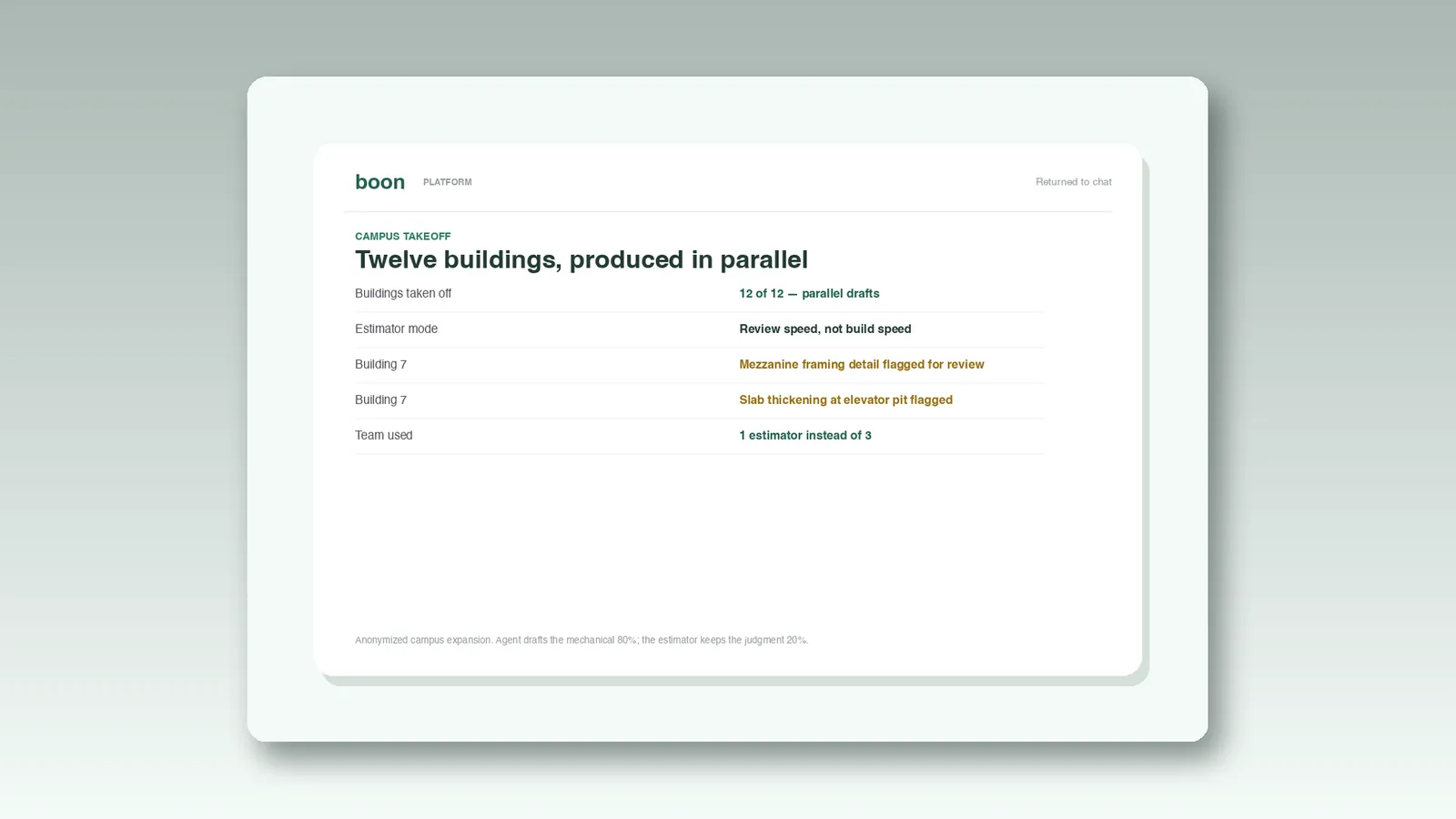
Here is how. The agent produced takeoffs on all twelve buildings in parallel while the estimator reviewed the outputs building by building. The estimator was not waiting on a queue of one takeoff finishing before the next started. All twelve drafts existed, and the estimator worked through them at review speed instead of build speed.
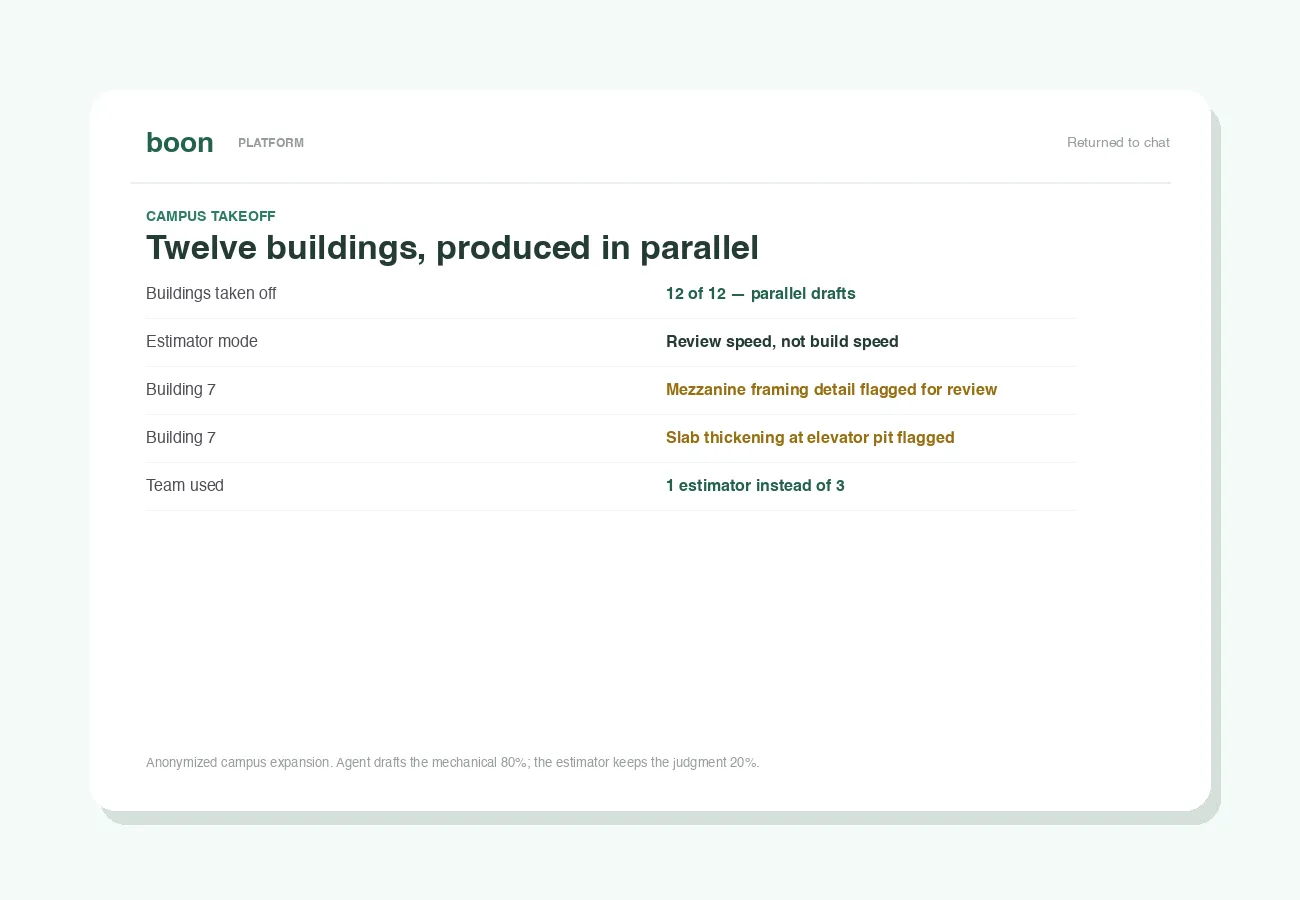
The returned deliverable, shown in product. Anonymized.
Where the human stayed in the loop
This is the part I want to be precise about, because it is the part that matters. The estimator caught two scope items the agent missed on Building 7: a mezzanine framing detail and a slab thickening at the elevator pit. Both took under an hour to correct.
That is the whole model working as designed. The agent did the mechanical 80%, twelve takeoffs’ worth of counting and quantifying that would otherwise have consumed the two extra estimators. The senior estimator did the judgment 20%, which on this job meant catching a mezzanine framing detail and a slab thickening that a draft takeoff got wrong. Those are exactly the kind of items that require a person who has built enough numbers to know where the drawings lie. The agent produced the draft. The estimator made it right.
The two-week deadline held. One estimator, twelve buildings, submitted on time, at the firm’s usual quality bar, because the quality bar is the estimator’s review and that review still happened on every building.
The capacity math
Two extra estimators, two weeks, roughly 50 hours a week each, is on the order of 200 estimator-hours that did not have to be reallocated from other bids. At senior estimator loaded rates that is meaningful time, and I am labeling it as an internal industry estimate rather than a figure this customer reported.
But the reallocation number understates the real point. The interesting cost is not the hours the two estimators would have worked on the campus. It is the bids those two estimators would have been pulled off of. During a two-week campus crunch, pulling two seniors onto one job means the other pursuits on the board get shorted, delayed, or dropped. The opportunity cost of the campus is measured in the other jobs the firm could not chase while its estimators were buried in it.
Running the campus with one estimator means the other two stayed on their own bids. That is the number that decides how many jobs a firm can pursue in a quarter. Bid capacity per estimator, not the hourly cost of any one takeoff, is the constraint that governs a precon department’s output, and this is a story about moving that constraint.
Why parallel changes the shape of the work
The reason this works is not that the agent is faster at one takeoff, though it is. It is that twelve takeoffs can exist at once. When the work is sequential, one estimator on twelve buildings is a two-week march through twelve consecutive builds, and the deadline forces you to add people. When the drafts all exist in parallel, one estimator becomes a reviewer moving through twelve buildings at review speed, and the deadline is suddenly reachable with the team you have.
That is the shift from build to review, applied to a whole campus. The estimator’s scarce hours go to the judgment calls, the mezzanine detail and the slab thickening, instead of to the counting that a draft can carry. The scarce resource, senior judgment, gets spent on the part that actually needs it.
The teammate frame
The estimator on this campus was not replaced. They were the reason the bid was any good. They caught what the drafts missed, they owned the number, and they submitted it. What they were freed from was the counting on eleven buildings that did not need their judgment, so they had the hours to give real attention to the two items on Building 7 that did.
More bids per estimator per week, not fewer estimators. That is the frame. A campus that used to require three seniors and cost two other bids now runs with one senior and leaves the other two free to keep the pipeline moving. The firm chases more work with the same team, which is the only kind of growth that does not require winning the estimator-hiring war first.
If you want to see parallel takeoffs run on your own multi-building set, our AI estimator works inside the Teams and Slack your team already uses. Start here: https://www.getboon.ai/boon-agent
Acknowledgements
Thanks to the Boon preconstruction and product teams for reviewing the workflow described here.