The Boon agent working this exact use case, in product. Customer details anonymized.
Try this in Boon in about two minutes
You send: one message the moment a bid goes out: “Bid submitted at 11:54, 5.6M at 10% markup, log it.”
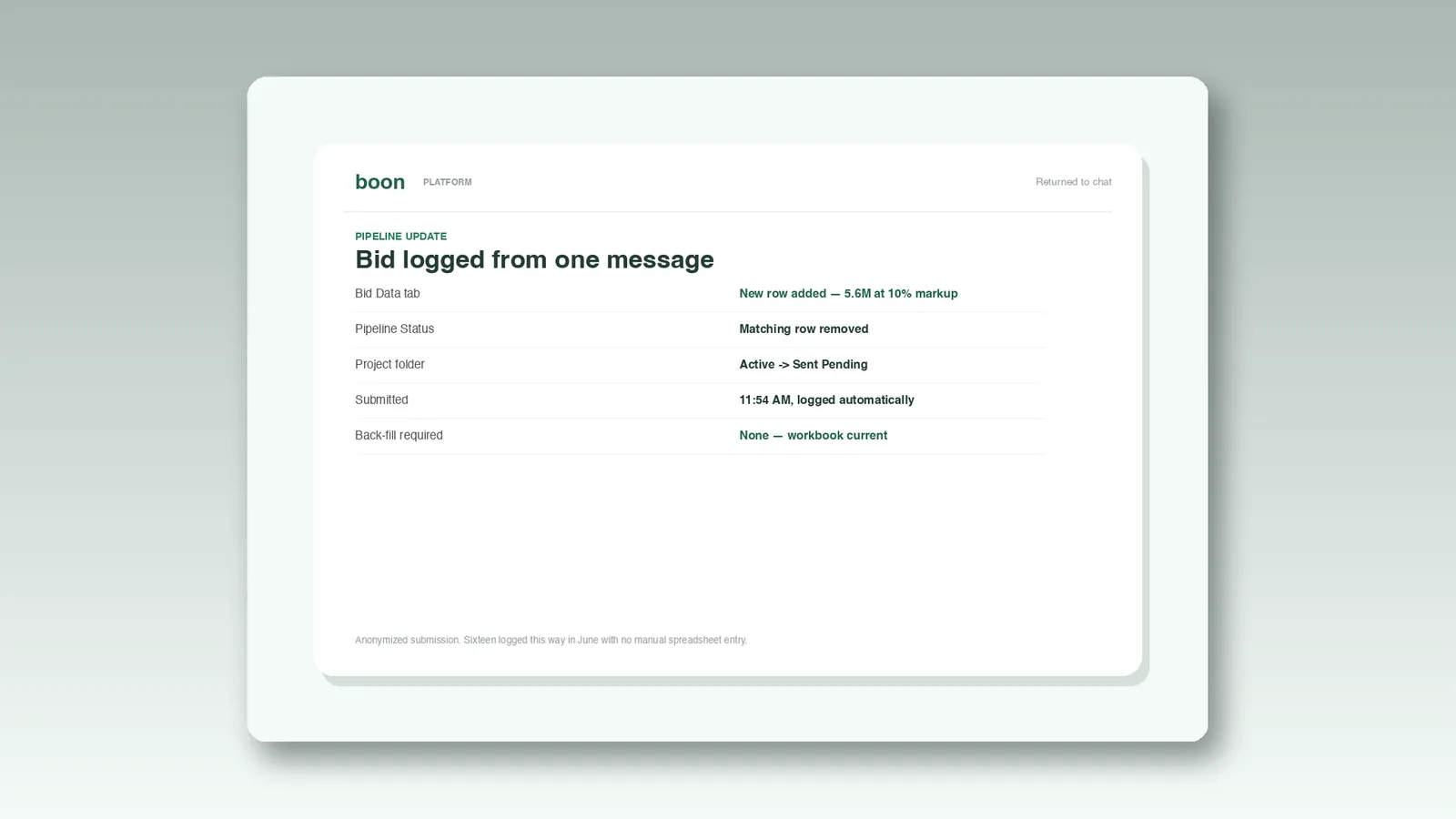
Boon returns: your Bid Data tab updated, the row removed from Pipeline Status, the project folder moved to Sent Pending, and a confirmation, no spreadsheet typing.
Where: inside the Teams or Slack your team already uses, no new tool to learn.
Log your next bid free at getboon.ai/boon-agent
Ask any estimator at a civil GC what happens after they submit a bid, and you get some version of the same sigh. The bid goes out at 11:54 on a Tuesday. Then, at some point that week, or that weekend, or three weeks later when leadership asks for a pipeline update, somebody has to go back and record it. Update the Bid Data tab. Pull the row out of Pipeline Status. Move the project folder from Active to Sent Pending. It is nobody’s favorite part of the job, so it is the part that slips.
One civil general contractor we work with logged 16 bid submissions through our AI estimator over a few weeks in June. Nobody on their team typed any of that into a spreadsheet. The agent did all of it.
Here is what the workflow actually looks like from the estimator’s chair. The estimator finishes a bid and sends one message in Teams: “Bid submitted to the GC at 11:54 today, 5.6M at 10% markup, upload to Bid Data.” That is the whole ask. It is the message they were going to send a colleague anyway. The difference is that the agent reads it, updates the Bid Data tab with the new row, removes the matching row from Pipeline Status, moves the project folder from Active to Sent Pending, and replies to confirm all of it is done.
Sixteen times. Same pattern, different projects. And at the end of the month, the workbook and the folder tree were clean and current, with no back-fill required.
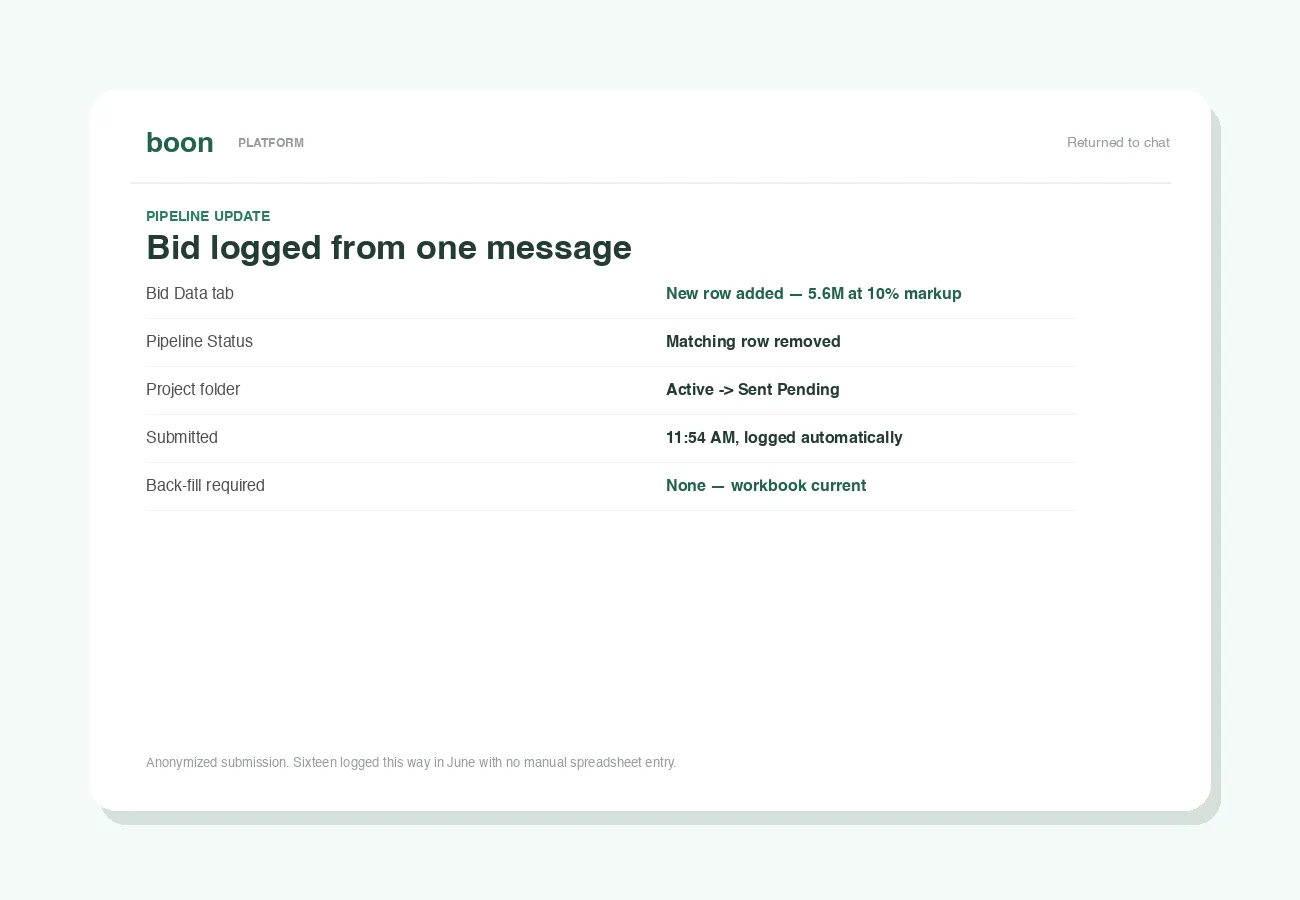
The returned deliverable, shown in product. Anonymized.
The problem was never the spreadsheet
Every firm I talk to has a system for tracking bids. A workbook, a shared drive, sometimes a real CRM that somebody bought and half the team logs into. The system is rarely the problem. The problem is the gap between doing the work and recording the work.
An estimator’s day is bids. Reading the set, running the takeoff, leveling the quotes, sending the number. The recording is a second job bolted onto the first one, and it is the job that competes with actual bidding for the same finite hours. So it gets deferred. It gets batched into a Sunday-night reconciliation session by the precon lead. It gets done from memory, which means it gets done wrong often enough that leadership stops trusting the pipeline number anyway.
The usual fixes make it worse. Buy a CRM, and now there is another tab to open and another login to remember, and adoption dies in month two because the estimator still lives in Teams and Excel. Hire an ops person to do the data entry, and you have added headcount to solve a data-entry problem. Write a spreadsheet macro, and it breaks the first time somebody phrases a project name differently.
None of those touch the real issue, which is that the recording lives outside the workflow. The estimator has to leave what they are doing to go feed a system that gives them nothing back.
What changed for this GC
The recording moved inside the message. The estimator never leaves Teams. They send the sentence they would have sent anyway, and the pipeline updates itself as a side effect of the work being done. The CRM stopped being a destination the estimator has to visit and became a thing that happens automatically when the estimator says a bid went out.
That is a small-sounding shift with a large downstream effect. When the pipeline updates in real time, leadership stops chasing weekly status. The number on the board is the number, not a best-effort reconstruction from three days ago. The precon lead gets their Sunday night back. And the estimators spend the ~20 minutes per bid they used to spend on admin, the Bid Data update plus the Pipeline Status remove plus the folder move plus the confirmation, on the next bid instead.
Twenty minutes per bid is an internal industry estimate, not a figure this customer reported, and I want to be honest about that. The number that actually matters is not the minutes. It is that the pipeline is trustworthy by default, because it is never more than one message stale.
Why this is a teammate, not a tool
A macro executes a rule. A tool waits for you to open it. What this GC’s estimators have is closer to an ops teammate who happens to read every bid-submission message and keep the books current without being asked twice.
The agent handles the mechanical part, the transcription and the file moves and the row edits, and hands the judgment part back to the people who are paid for judgment. No estimator got hired to move folders from Active to Sent Pending. They got hired to decide what to bid and at what number. Every minute the recording steals from that decision is a minute spent on the wrong thing.
The frame I keep coming back to with precon leaders is this: your CRM should live inside your workflow, not next to it. The moment it becomes another tab to update, you have already lost the adoption fight, and your pipeline number is already drifting from reality. Put the recording where the work happens, and the pipeline stays honest on its own.
If you want to see the actual anonymized workbook and how the bid-log flow runs, our AI estimator works inside the Teams and Slack your team already uses. Start here: https://www.getboon.ai/boon-agent
Acknowledgements
Thanks to the Boon preconstruction and product teams for reviewing the workflow described here.