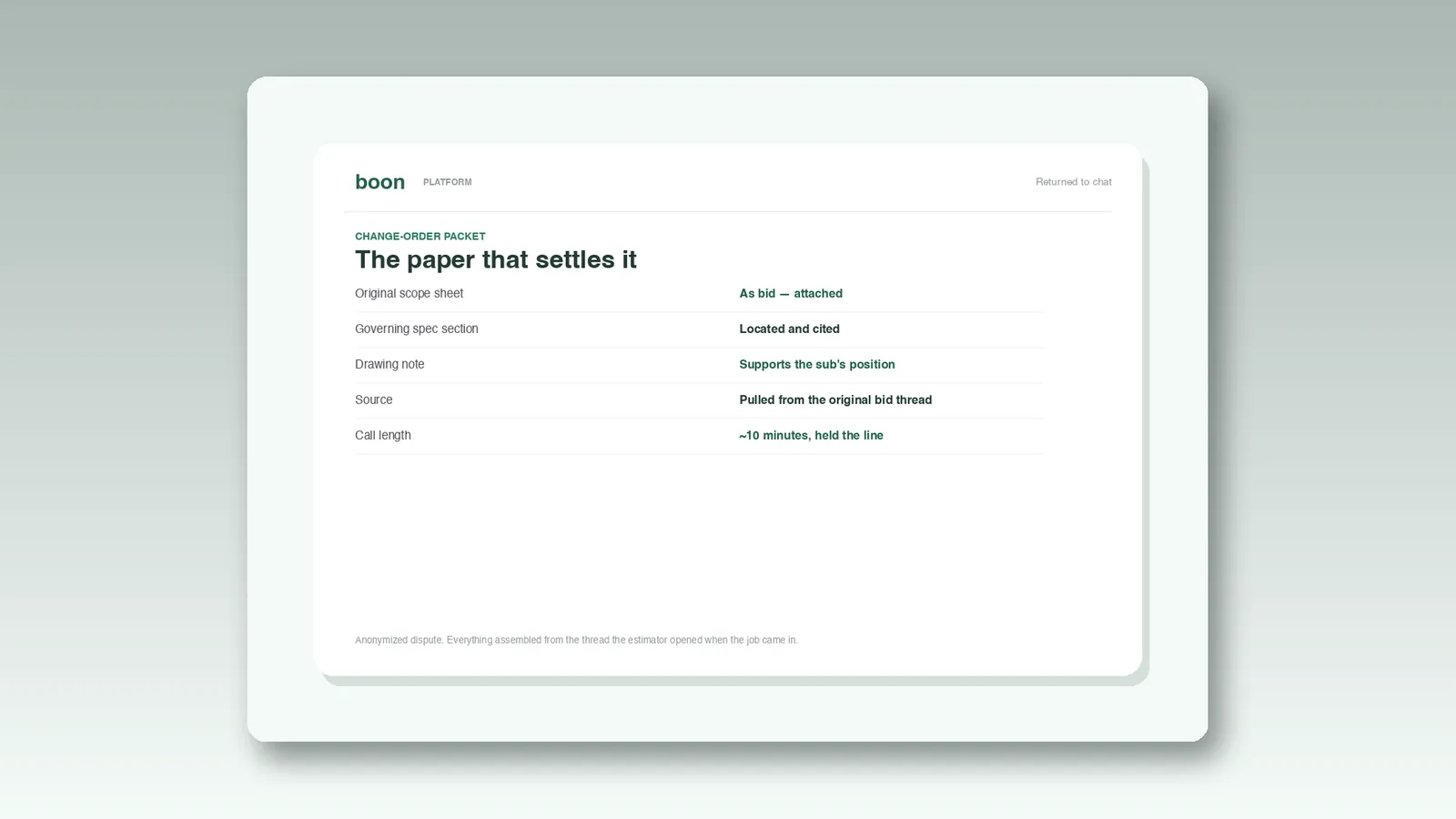
The Boon agent working this exact use case, in product. Customer details anonymized.
Try this in Boon in about two minutes
You send: one message when the change-order dispute lands: “Pull the scope sheet, spec section, and drawing note for this ductwork run.”
Boon returns: the original as-bid scope sheet, the governing spec section, and the supporting drawing note, all from the original thread, so you walk into the call with the paper to hold your margin.
Where: inside the Teams or Slack your team already uses, no new tool to learn.
Assemble your next change-order packet free at getboon.ai/boon-agent
The change-order conversation is where a mechanical sub either holds its margin or gives it away. The GC says the added ductwork was always in scope. The PM says it wasn’t. And then both sides go looking for the document that settles it, which on most jobs means a week of email, a dig through two revisions of the drawings, and a call that gets rescheduled twice while the PM tries to reconstruct what the estimator actually bid three months ago.
The problem is not that the sub is wrong. Usually the sub is right. The problem is that being right takes a week to prove, and the GC knows it, and the whole negotiation happens under the pressure of a PM who cannot lay his hands on the one drawing note that backs his read.
Last month a PM at a mechanical sub we work with walked into that call with the original scope sheet, the spec section governing the disputed line, and the drawing note that supported his position, all pulled from the same thread the estimator had opened when the job first came in. The call was ten minutes. He held the line, and he had the paper to hold it with.
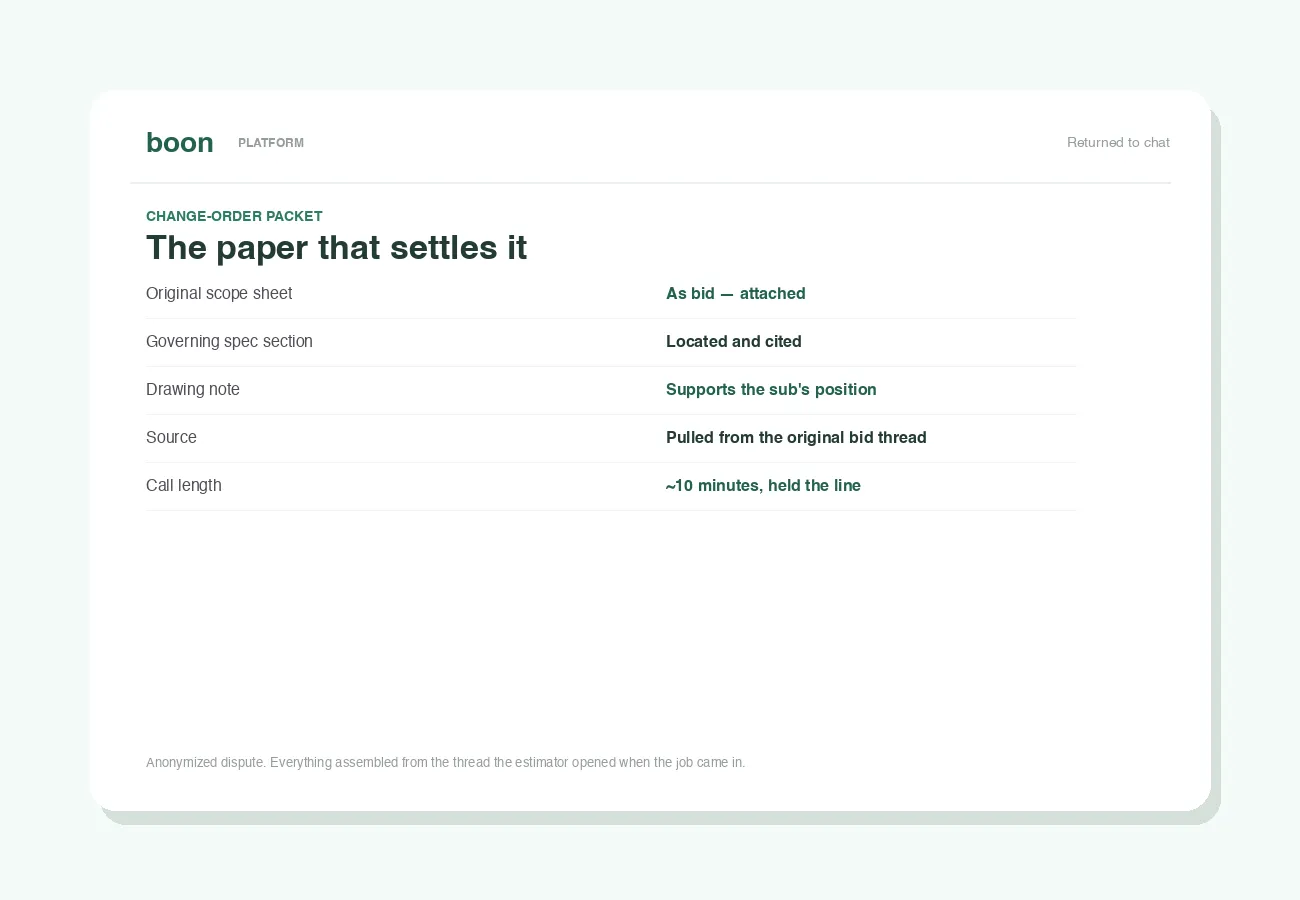
The returned deliverable, shown in product. Anonymized.
Where the week actually goes
Nobody schedules a week for a change-order dispute. It accretes. The GC’s email lands on a Tuesday. The PM was on a site walk, so he reads it Wednesday. He half-remembers the scope was tight on that run of ductwork, but the estimator who priced it is now three jobs deep, so the PM pings him, and the estimator says he’ll look when he gets a minute. Friday the estimator opens the wrong revision of the drawings, because the set got reissued twice since bid, and now they’re arguing about which drawing even governs.
What the PM walked in with
The estimator on this job had opened a thread with our AI estimator back at bid time, the ordinary way: run the mechanical scope, cite the governing spec on each line. That thread never closed. It sat there with the original scope sheet, the spec citations, and the drawing references all in one place.
So when the change order came in, the PM went back to that same thread and asked a plain question. What did we bid on this run, what spec governed it, and does the current drawing note match. The agent read the revision that governed at bid time against the current issued set, pulled the diff on that detail, and handed back the three things the PM needed: the original scope line, the spec section, and the drawing note that supported the sub’s read.
The diff was the mechanism, not the point. The point was that the PM walked into the call already holding the documented position instead of promising to go find it. It was reconstructed the moment he asked.
Documented scope beats memory, every time
A change-order negotiation is a contest between two versions of what was agreed. If both sides are working from memory, the side with more leverage wins, and on a sub-to-GC relationship that is rarely the sub. If one side walks in with the original scope sheet, the governing spec, and the supporting drawing note in hand, the contest is over before it starts. There is nothing to argue about. The paper says what the paper says.
That is the shift. The PM used to spend the week trying to get to a documented position and often ran out of runway before he got there. Now the documented position is a question away, because the thread that priced the job never went cold.
The number under the ten minutes
A single mid-size change-order dispute runs 20 to 60 hours of PM and estimator time, sometimes with counsel pulled in, before it resolves. Those are industry ranges for the loaded time a dispute consumes, not a figure this sub reported, and I’m labeling them as such. A mid-size mechanical sub sees dozens of these a year. When each one collapses from a week to ten minutes, the PM capacity that used to disappear into reconstruction goes back into running the jobs.
The larger number is the one that does not show up on a timesheet. It is the scope the sub used to eat because proving it wasn’t worth the week. When the documented position is instantly available, the sub stops conceding changes it should have held, and margin that used to leak out one dispute at a time stays where it belongs.
The teammate frame
No mechanical PM got into this trade to spend a week reconstructing what the estimator bid in the spring. He got into it to run the work and to defend the number the shop is owed. The reconstruction is the tax on getting to the conversation, and it often costs more than the change itself.
Our AI estimator carries that reconstruction, reading the revision diff and the spec and pulling the original scope line, and hands the PM a documented position. The PM makes the call in the room. The judgment about how hard to push and how to keep the GC relationship intact stays with the person who owns the account. What changes is that he walks in holding the paper instead of promising to go find it.
If you want to see a change-order packet pulled from your own bid thread, our AI estimator works inside the Teams and Slack your team already uses. Start here: https://www.getboon.ai/boon-agent
Acknowledgements
Thanks to the Boon preconstruction and product teams for reviewing the workflow described here.