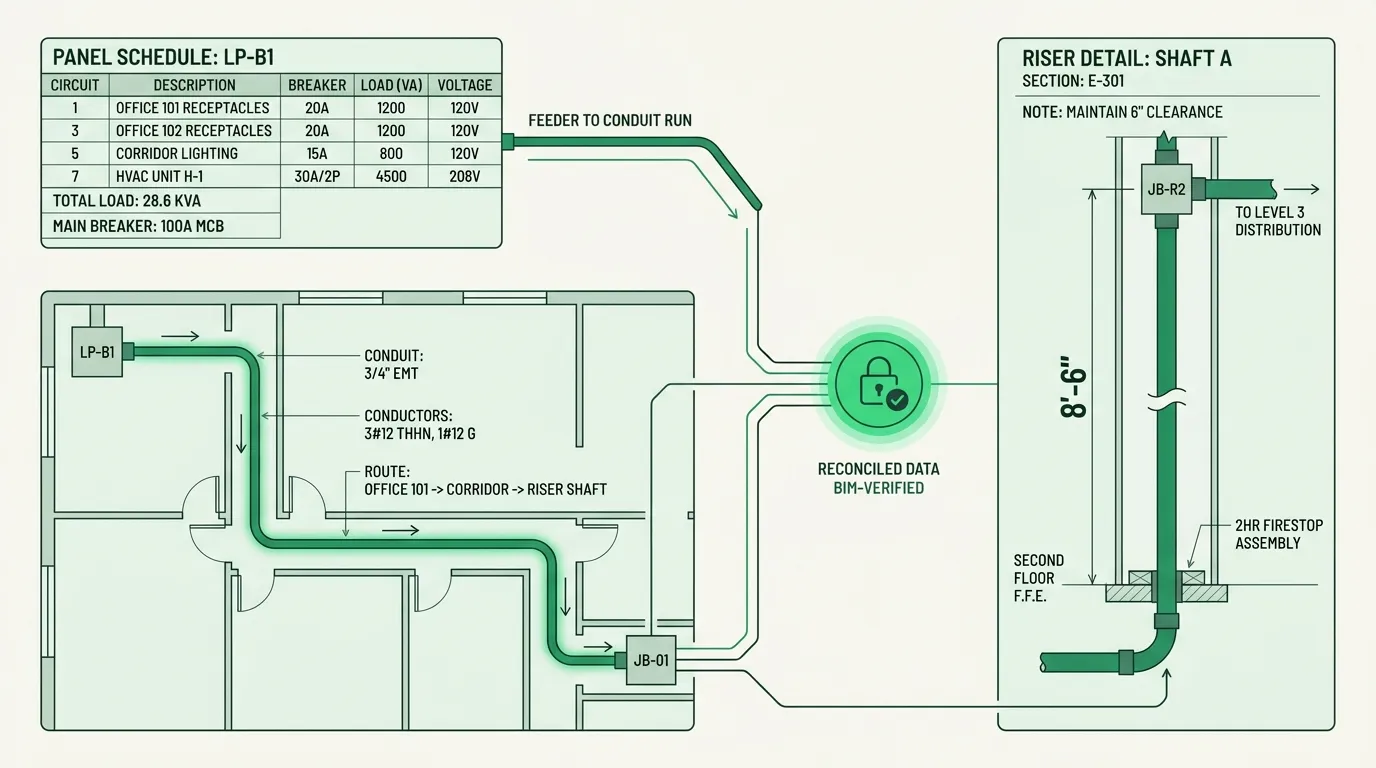
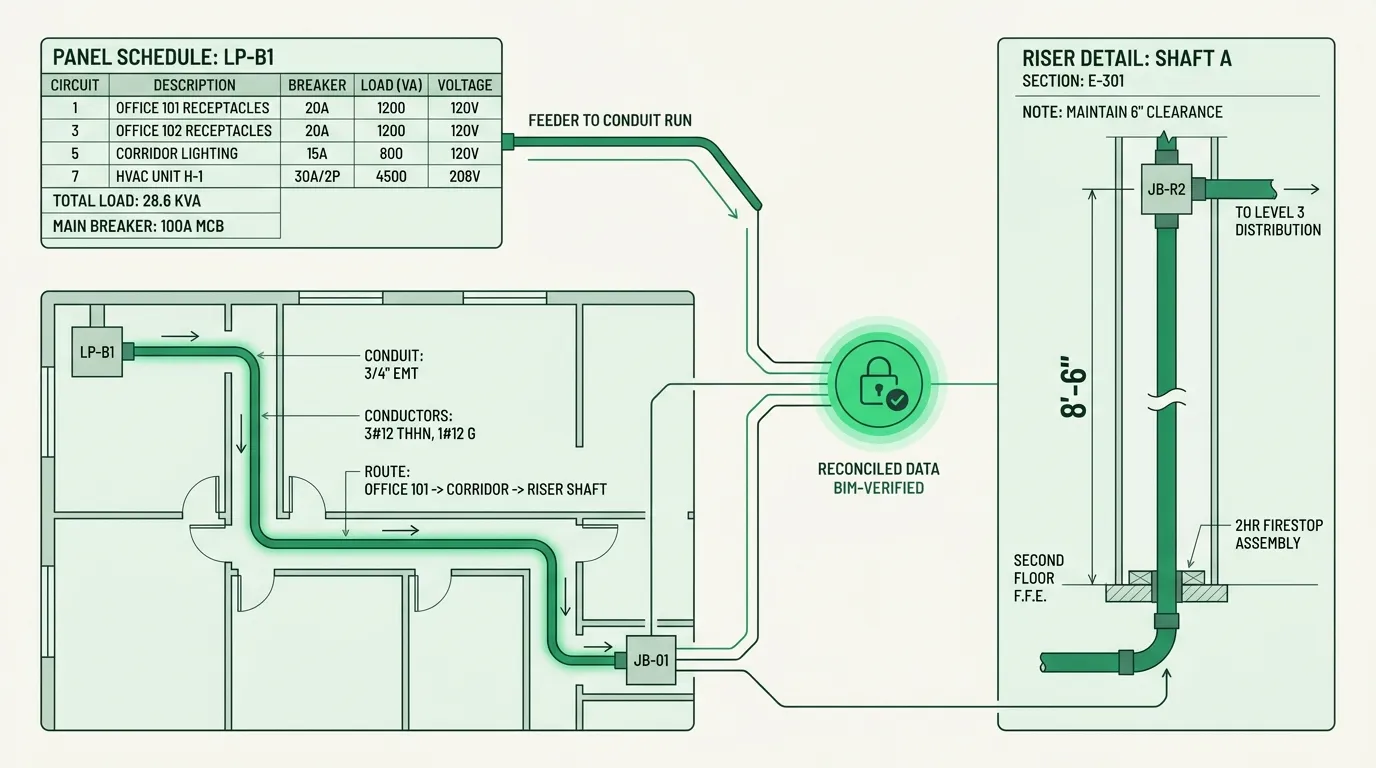
Pick any conduit run on a large electrical set and try to answer a simple question: where does it start, where does it end, and how big is it? You will find the answer in at least three places. The panel schedule names the circuit and its home run. The floor plan draws the route. The riser or the detail sheet dimensions the rise and the conductor fill. Three descriptions of one physical object, and on a real set, they rarely agree.
This is not a drafting failure. It is the structure of the document itself. A drawing set is not one description of a building; it is many overlapping descriptions, authored at different times, by different hands, at different scales, each correct in isolation and none guaranteed to match the others. The engineer’s job, the part no software has ever truly done for them, is to hold all three in their head at once and notice when they diverge.
We think that reconciliation is exactly the kind of work a spatial model should do, and exactly the kind of work that reveals why construction is not a document problem. It is a graph problem.
When one run has three sources of truth
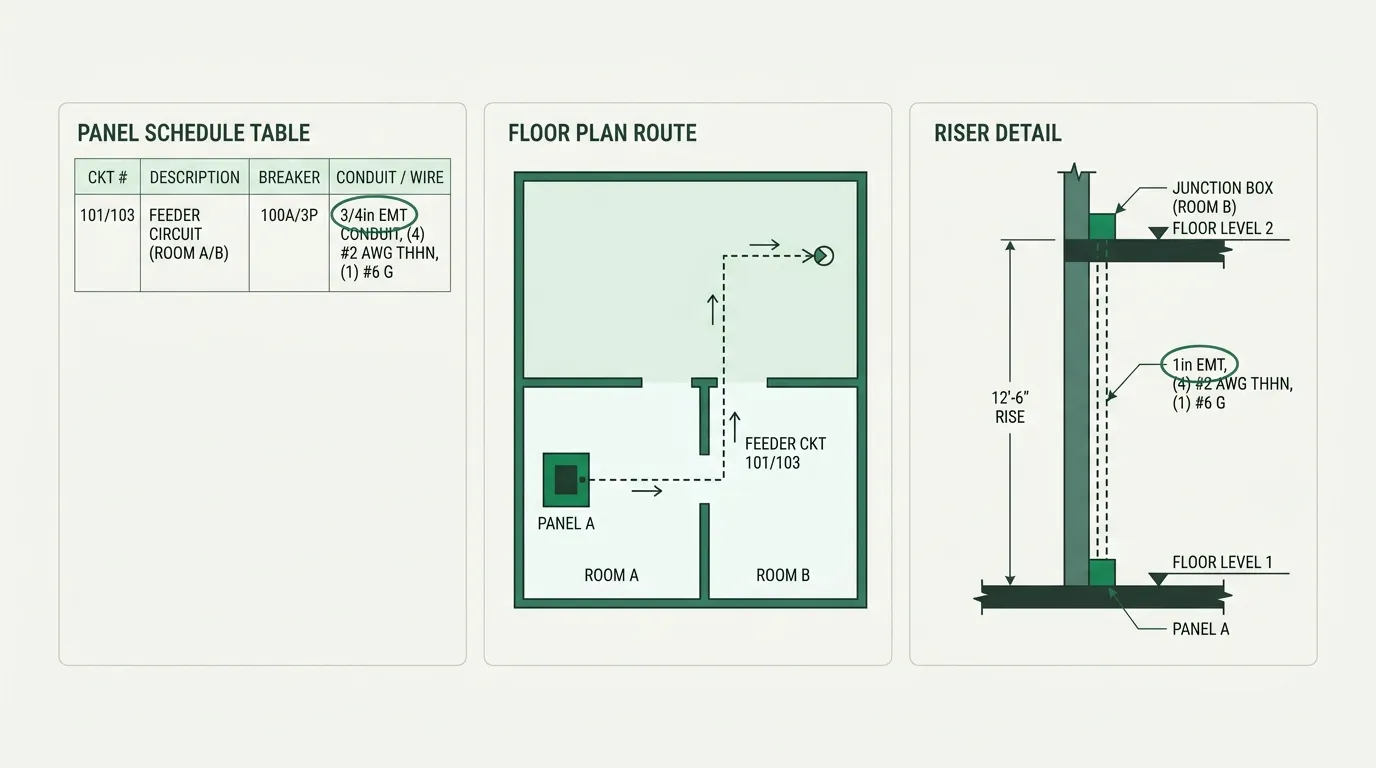
Consider a single feeder. The panel schedule lists it as a 100-amp circuit with a specified conductor and conduit size. The floor plan shows it leaving the panel, turning twice, and terminating at a junction box two rooms away. The detail sheet, the one nobody reads until the RFI is already written, dimensions the vertical rise and, quietly, calls a different conduit size than the schedule did.
Now three things are true at once, and only two of them can survive to the field. The estimator who prices the schedule buys one quantity of conduit. The foreman who builds from the plan routes a length that doesn’t match. And the detail that would have caught it sat on a sheet that was never cross-checked against the other two, because cross-checking every run against every sheet by hand is a task that scales with the size of the set and the patience of the person doing it, and patience runs out first.
The disagreement is not exotic. It is the normal condition of a drawing set. The reason it survives to the field is that the three sources of truth live on three different pages, and nothing in the workflow forces them to be read together.
Why the human catches it on the third pass
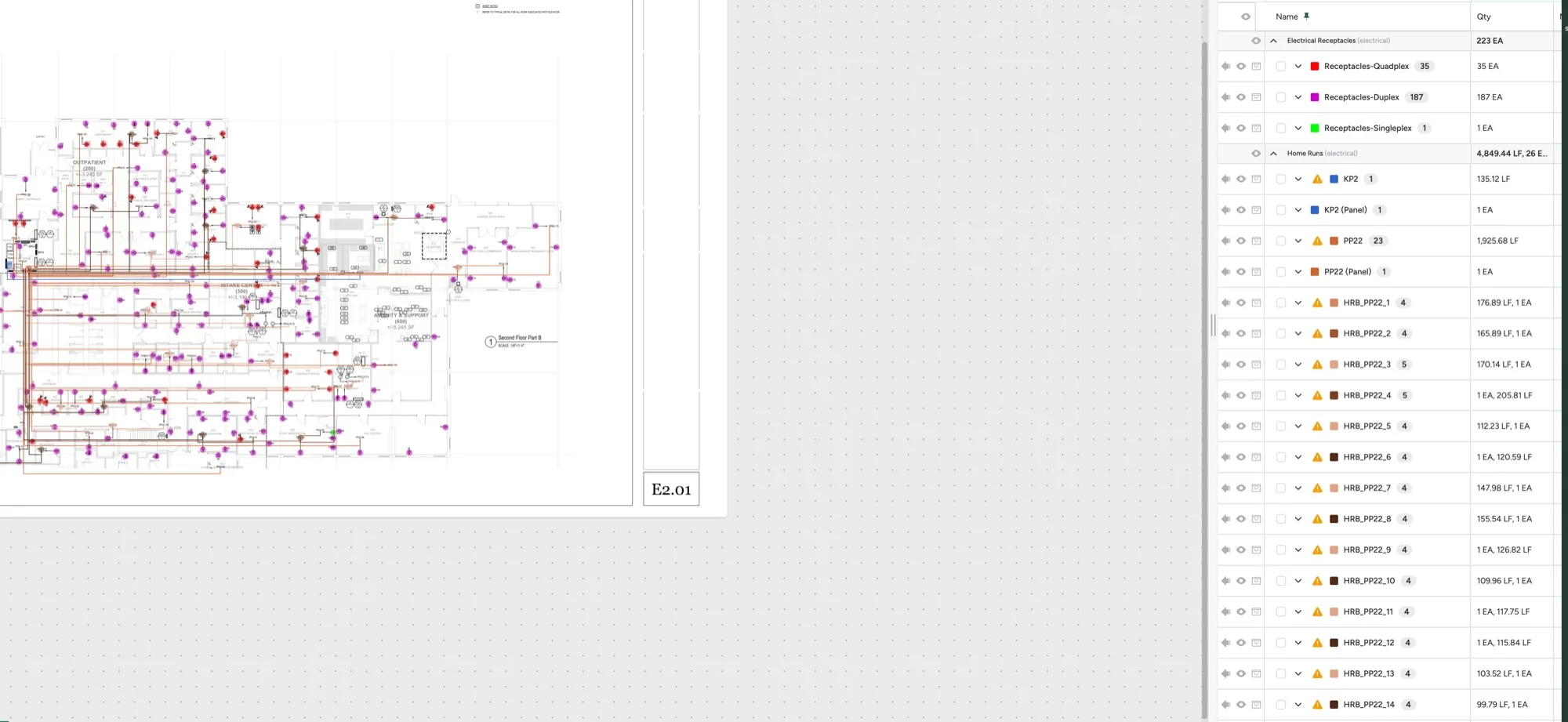
Experienced engineers do catch these conflicts. They catch them on the second pass, or the third, or in the coordination meeting where someone finally lays the schedule next to the plan and sees the mismatch. The craft is real, and it works, but it is slow, it is manual, and it is the first thing to get compressed when the deadline moves in.
That compression is where the cost lives. Design-related errors and omissions are the single largest driver of construction rework, and rework is not a rounding error: independent research puts the cost of rework and conflict resolution in U.S. construction at more than $177 billion annually (PlanGrid/FMI, 2018), with studies placing direct rework at 9% to 20% of a project’s total cost (Becht). A conduit-size mismatch that a third review pass would have caught, but didn’t, becomes a field conflict, and field conflicts are the most expensive place to discover anything.
The trade knows this, which is why the conduit run is so often the thing that gets rerouted when a clash appears late. It is the most flexible system on the job, so it absorbs the errors of every other trade. But being flexible in the field is not the same as being correct on the page. The run that gets bent around a beam at 6 a.m. was a run whose three descriptions never got reconciled at draft time.
Reading the set as one connected object
Here is the shift. A conduit run is not three drawings. It is one object that happens to be drawn three times. If a system reads the set the way an estimator’s mind does. Resolving the schedule entry, the plan route, and the detail dimension into a single node in a connected graph, then the three descriptions stop being three separate pages and become three attributes of one thing. And the moment they are attributes of one thing, a disagreement between them is not something you have to go hunting for. It is a contradiction the model can see the instant it reads the set.
This is what Boon’s spatial model does. It does not treat a plan sheet as a picture and a schedule as a table and a detail as another picture. It reads them as descriptions of the same physical systems and reconciles them into one model of what the drawings collectively claim the building is. Where the claims conflict. A conduit size that differs between schedule and detail, a route on the plan that can’t carry the fill the schedule specifies. The conflict is surfaced at draft time, on the first pass, not the third.
The reason no spreadsheet and no drafting tool does this is the same reason it’s hard: the spreadsheet understands rows, not space, and the drafting tool understands geometry on one sheet, not the relationships between sheets. Catching a three-sources-of-truth conflict requires a model that natively holds the cross-page graph. That is not a feature you bolt on. It is the architecture.
Why this is structurally Boon’s problem to own
Every downstream workflow an engineer cares about (takeoff, clash detection, coordination, RFI prevention) depends on the same underlying capability: reading a multi-sheet set as one connected object. A tool that only reads one sheet at a time can never reconcile a run that is described across three. A tool that reads the set as a graph gets the conduit-run problem, the panel-schedule problem, and the coordination problem for free, because they are all the same problem wearing different clothes.
That is why this is not a point solution. The conduit-run conflict is a proof case for a general claim: construction’s hardest problems are cross-reference problems, and cross-reference is exactly what a spatial foundation model is built to do. Every set Boon reads deepens the model’s understanding of how these systems are described, and how those descriptions tend to disagree, which makes the next set’s conflicts easier to catch.
The engineer will always own the judgment call: which of the three sources of truth is right. That is craft, and it should stay with the human. What should not stay with the human is the archaeology. The slow, manual, deadline-compressed work of finding the disagreement in the first place. That is the work the model should have already done by the time the engineer opens the file.
The cheapest conflict to resolve is the one you see before the set is issued. Three sources of truth should never survive to the field. With a model that reads the set as one object, they don’t have to.