The Boon agent working this exact use case, in product. Customer details anonymized.
Try this in Boon in about two minutes
You send: the full drawing and spec set, with one message: “Find every alternate and tell me what each one changes.”
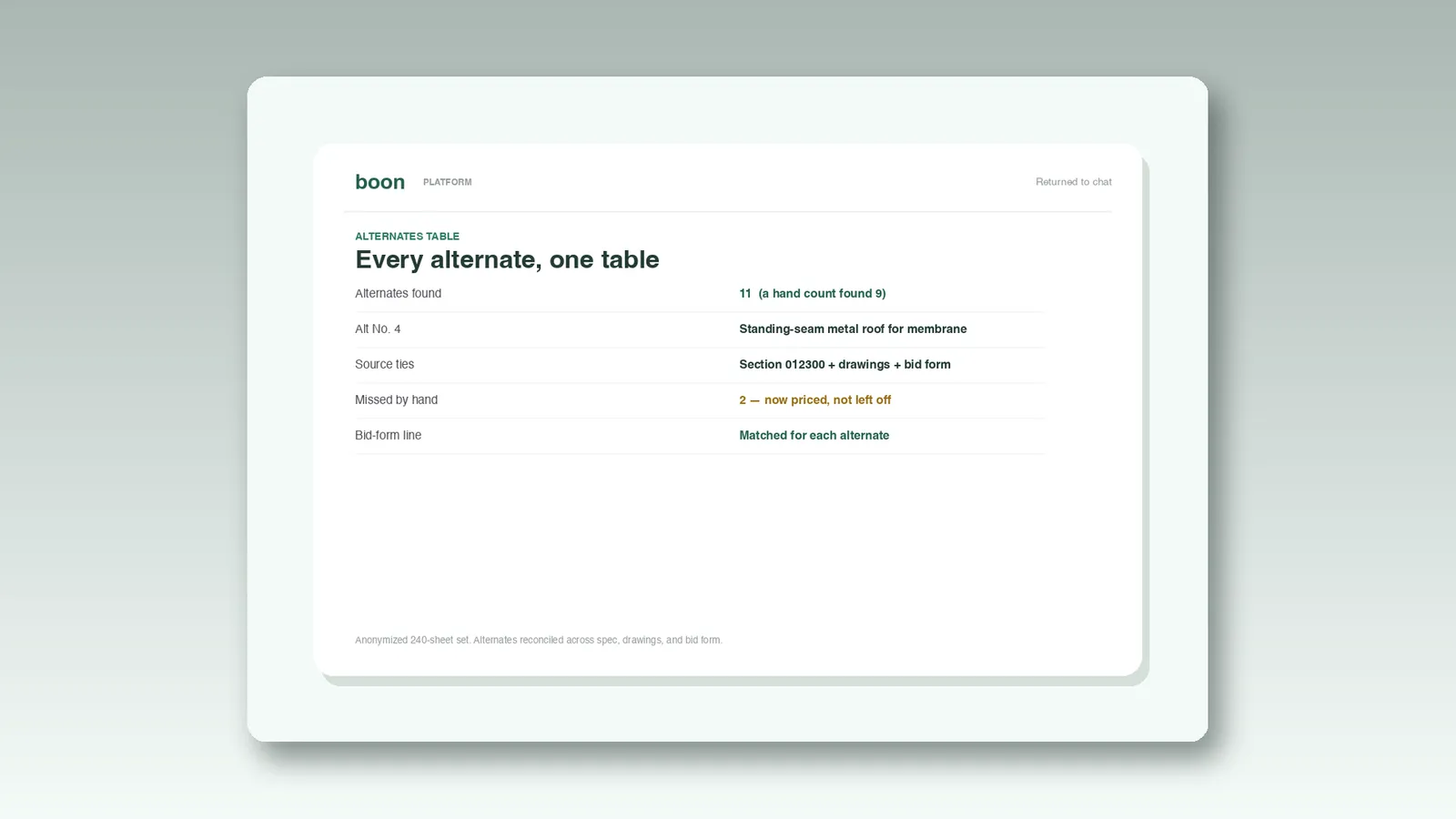
Boon returns: one table with every alternate tied across Section 012300, the drawings, and the bid form, so nothing gets missed on bid day (it found 11 where a hand count found 9).
Where: inside the Teams or Slack your team already uses, no new tool to learn.
Find every alternate free at getboon.ai/boon-agent
Alternates are where bids get won and lost, and they are scattered on purpose. The alternate itself is described in Section 012300 of the spec book. The scope it changes lives in the drawings, sometimes on a sheet the spec never points to. The line where you actually price it sits on the bid form. Three documents, three authors, and no single place that lists every alternate with what it does to the project. A precon lead has to assemble that list by hand, under a bid clock, on a 240-sheet set.
The danger is not pricing an alternate wrong. The danger is missing one entirely. An alternate that never makes it onto the estimator’s radar gets left off the bid form, and on bid day that is either a scope the owner asked for and you did not price, or a competitive lever you did not pull. Either way the miss does not surface until the bids are opened and someone else’s number reflects an alternate yours ignored.
A precon lead at a mid-market GC we work with asked our AI estimator to find every alternate in a 240-sheet set and tell them what each one changed on the project. Read Section 012300, walk the drawings for the callouts, check the bid form for the line items, and return one table that ties all three together.
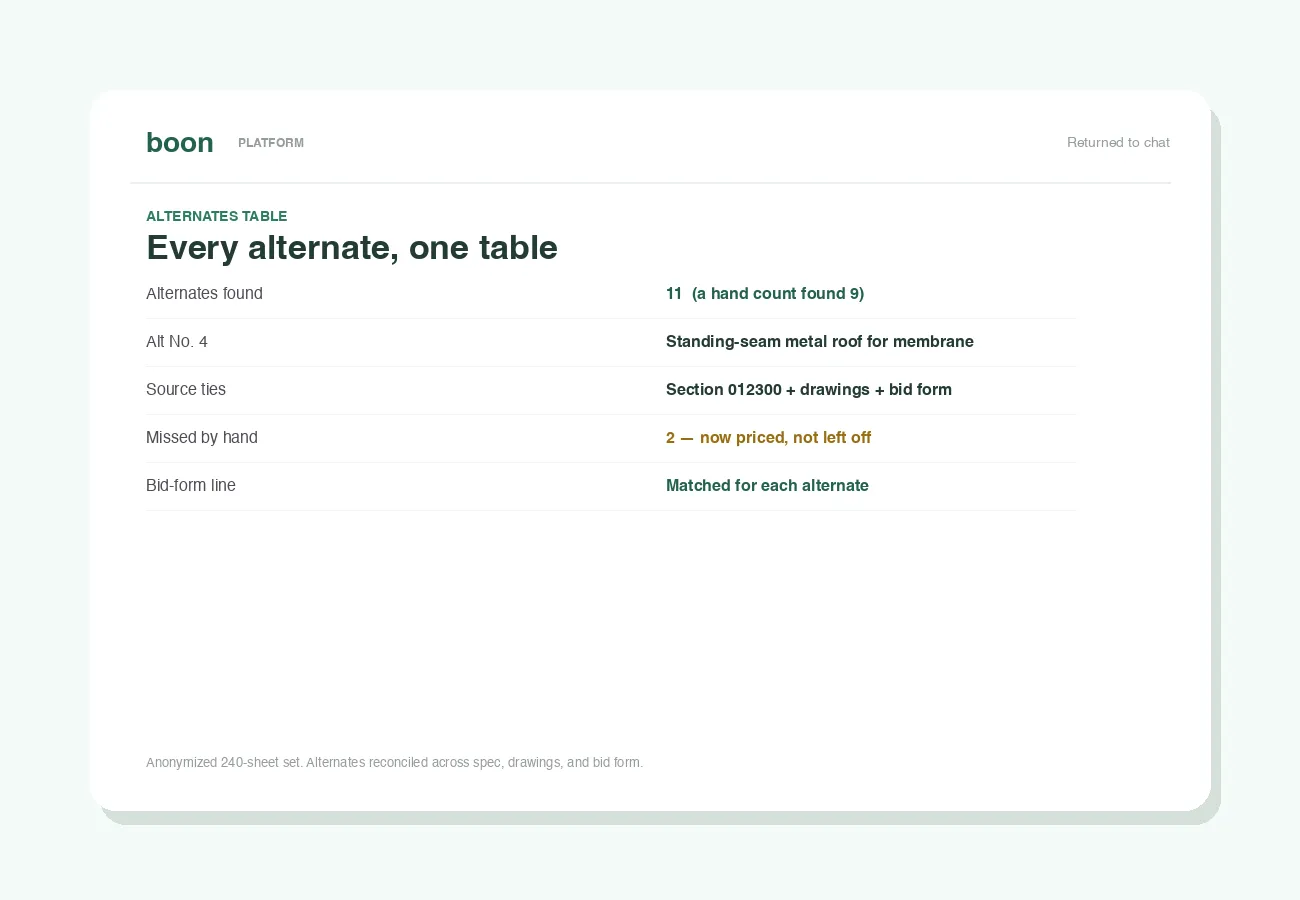
The returned deliverable, shown in product. Anonymized.
Why alternates get missed
An alternate is easy to miss precisely because it is defined across documents that no one reads side by side. Section 012300 says “Alternate No. 4: substitute standing-seam metal roof for the membrane roof specified in Section 07.” To know what that costs, the estimator has to find the roof scope in the drawings, figure out which sheets it touches, and confirm there is a matching line on the bid form to price it against. If any one of those three references is thin, the alternate slips.
Under bid pressure the precon lead builds this list by paging through the spec section, then hunting the drawings, then reconciling against the bid form, and the failure mode is not a wrong number. It is an alternate that was described in the spec but never got walked in the drawings, so it never made the list, so it never got priced. The set had eleven alternates. A hand assembly under a clock finds nine of them and feels done, because there is no master list to check against. The two that got missed are invisible until bid day.
That is the gap. Not that precon leads do not know alternates matter. They decide bids. The gap is that pulling every alternate across spec, drawings, and bid form by hand, on a 240-sheet set, is hours of cross-referencing that does not fit the bid clock, so it gets done fast, and fast is where the miss lives.
What the table showed
The agent read Section 012300 for the full list of alternates, walked the drawings for the callouts that told it what each alternate physically changed, checked the bid form for the corresponding line items, and returned a single table cross-referencing all three. Each row was one alternate: what the spec called for, which sheets it affected, and whether a matching bid-form line existed to price it.
The rows where the three sources did not line up were the ones that mattered. An alternate described in the spec with no callout in the drawings. An alternate on the bid form with no corresponding scope in Section 012300. Those mismatches were flagged instead of smoothed over, so the precon lead could chase the ambiguity before bid day instead of after.
From hunting alternates to pricing them
The precon lead’s job did not shrink. It sharpened. Instead of paging through three documents to assemble the list and hoping none slipped, the lead started from a complete table and spent the time on the part that needs judgment: how to price each alternate, where the competitive leverage sat, and which mismatches were real scope questions for the owner versus documentation gaps to clarify.
That is the shift. The mechanical assembly, finding every alternate across spec, drawings, and bid form, is the part the agent carries. The strategy, how to price the alternates and which ones to lean on competitively, is the part the precon lead keeps. The lead stops being an assembler of the list and becomes a strategist working from a complete one.
The number under the missed alternate
Pulling every alternate across spec, drawings, and bid form by hand runs 8 to 16 hours of precon-lead work per bid. With the agent producing the table, that becomes about an hour of review. I’m framing that as an internal industry estimate rather than a figure this GC reported.
But the time is not the number that matters here. A missed alternate on a large contract does not cost an hour. It costs the bid. An alternate the owner wanted that you did not price puts you out of contention on responsiveness, and an alternate you priced blind can swing the total by a range that decides who wins. The value of the table is the alternate that would have slipped on a hand build and instead showed up as a row, flagged, before the bid went out.
The teammate frame
No precon lead got into this job to page through a spec book cross-referencing bid-form line items against drawing callouts. They got into it to make the calls that decide which bids win, and pricing the alternates is one of the sharpest. The assembly of the list is the tax on getting to that decision, and it gets rushed under a clock, which is exactly when an alternate goes missing.
Our AI estimator carries the assembly, reading the spec, walking the drawings, and checking the bid form to return one complete table with the mismatches flagged, and hands the strategy back to the precon lead who prices the alternates and owns the bid. The lead stays in the loop, because on alternates the loop is where the bid gets won. What changes is that they are pricing from a verified list instead of one they assembled from three documents and hoped was complete.
If you want to see every alternate in your own set pulled into one table, our AI estimator works inside the Teams and Slack your team already uses. Start here: https://www.getboon.ai/boon-agent
Acknowledgements
Thanks to the Boon preconstruction and product teams for reviewing the workflow described here.