The Boon agent working this exact use case, in product. Customer details anonymized.
Try this in Boon in about two minutes
You send: the RFP, the owner-contractor agreement, and the spec exhibits, with one message: “Run a Go/No-Go on this pursuit against our checklist.”
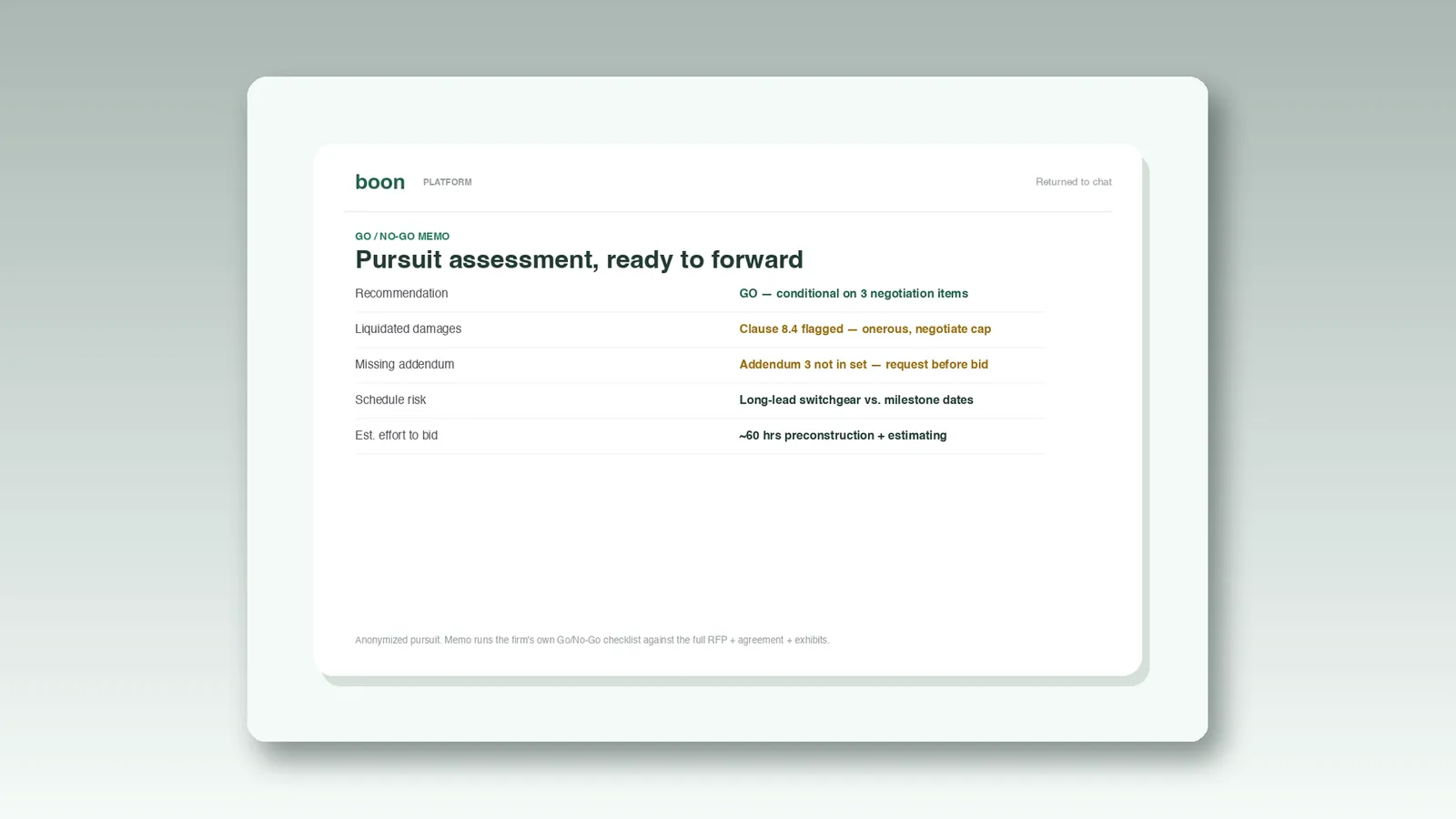
Boon returns: a forwardable memo that flags onerous clauses (LDs, indemnity), catches missing addenda, names schedule and scope risk, and gives a clear GO / NO-GO with the negotiation points to resolve first.
Where: inside the Teams or Slack your team already uses, no new tool to learn.
Run your first Go/No-Go free at getboon.ai/boon-agent
Every precon director has a version of this math in their head, even if they never write it down. A serious pursuit costs 80 to 200 hours of estimator and precon-leader time before the number goes out. On a full team, chasing the wrong pursuit does not just lose that bid. It burns the capacity you needed for the two good bids sitting behind it. The most expensive bid your firm submits this year is not the one you lost. It is the one you never should have chased in the first place.
The trouble is that you usually cannot tell which one that was until the estimator is already 60 hours deep and the onerous clause or the missing addendum or the impossible schedule finally surfaces. By then the money is spent.
Five times last month, across three of the GCs we work with, a precon leader asked our AI estimator to run a Go/No-Go on an incoming pursuit before committing an estimator to it. Read the RFP, the owner-contractor agreement, and the spec exhibits. Run the firm’s Go/No-Go checklist. Come back with a memo. Two of those five pursuits were dropped after the memo landed. Three moved forward with a specific negotiation list in hand.
The triage that never happens
Most firms have a Go/No-Go process on paper. A checklist, a committee, a form somebody is supposed to fill out. In practice, under a full pipeline, the triage gets skipped or done from a two-minute skim of the RFP cover page. The document set is too long and the front of the funnel is too busy for a precon leader to actually read the owner-contractor agreement and the spec exhibits on every incoming pursuit before deciding whether to commit a person to it.
So the decision gets made on gut and on the relationship and on whether the team has room this week, and the onerous liquidated-damages clause on page 40 of the agreement does not enter the decision, because nobody read page 40 until the estimator was already assigned. The triage that would have saved the 80 hours is exactly the triage there is no time to do.
That is the gap. Not that firms do not know a Go/No-Go matters. They know. The gap is that doing it properly means reading a lot of dense contract and spec language at the front of the funnel, on every pursuit, and there is never enough precon-leader time to do that at the top of the pipeline where it would actually change the decision.
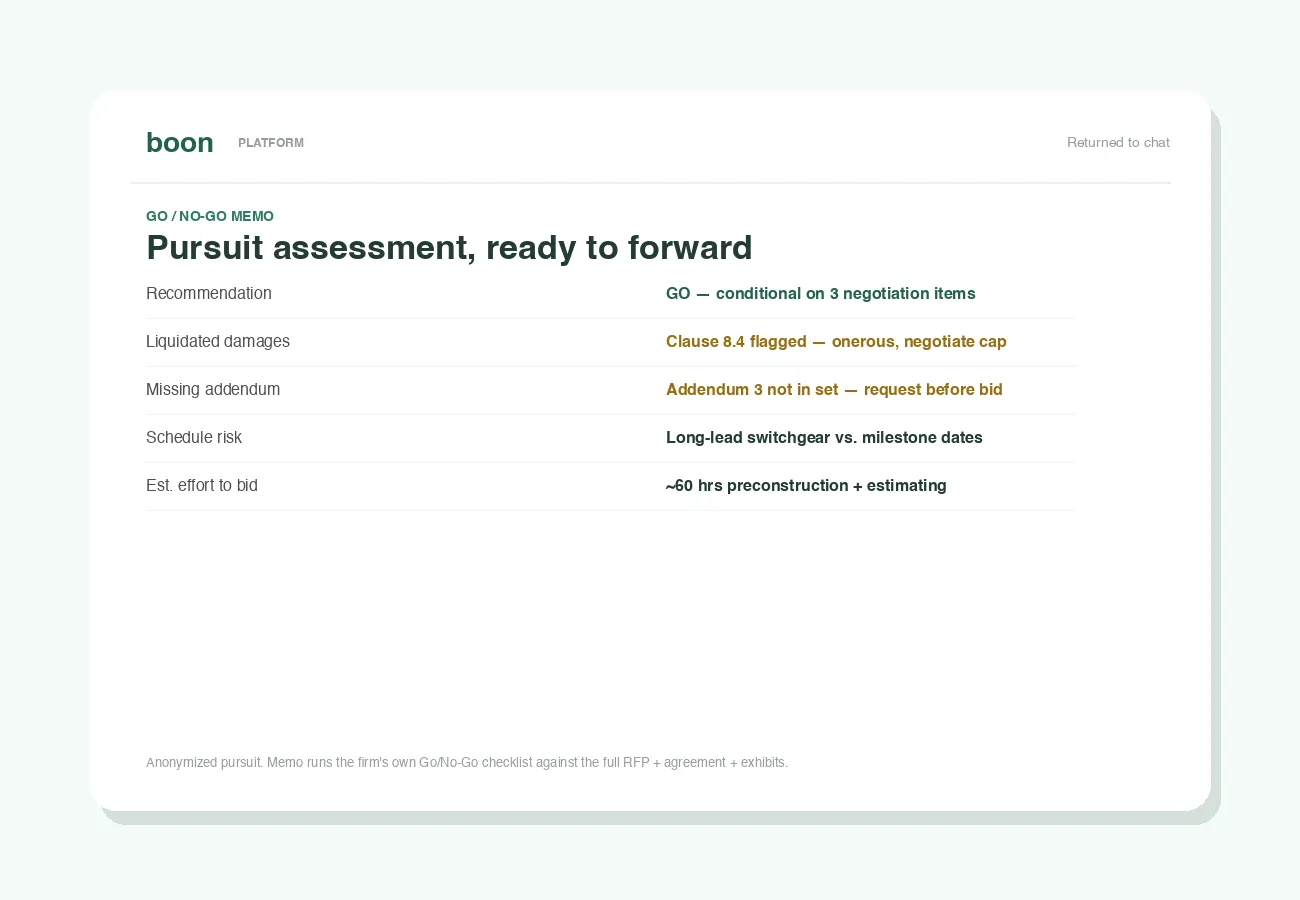
The returned deliverable, shown in product. Anonymized.
What the memos flagged
The memos came back having read the full set against the firm’s own checklist. They flagged onerous liquidated-damages clauses. They caught missing addenda. They surfaced unusual schedule risk and scope gaps that would have turned into fights later. The output was not a yes or a no. It was a memo a precon director could read in a few minutes and act on, with the risks laid out and the negotiation points named.
Two of the five pursuits got dropped on the strength of that memo. Not because the agent decided, but because a precon leader read a clear summary of what the pursuit actually required and made the call that it was not worth the team’s hours. The other three advanced with a specific list of things to negotiate before signing, which is a much stronger position than advancing blind.
The economics of the drop
A committed pursuit that should have been dropped burns 80 to 200 hours of estimator and precon-leader time per bid. Those are industry ranges for a serious pursuit, not a specific customer’s reported figure, and I am labeling them as such. The point holds regardless of the exact number: two accurate drops last month, across three firms, means a meaningful amount of misdirected bid effort that got redirected to pursuits worth chasing.
But the real return is not the hours saved on the pursuits you dropped. It is the pursuits you did not have to drop because the capacity was there. When the triage happens at the front of the funnel, the estimators spend their 80-hour pursuits on bids the firm actually wants to win, not on the one with the buried clause that was never winnable on acceptable terms. The Go/No-Go memo is not a cost-cutting tool. It is a capacity-allocation tool, and capacity allocation is the entire job of a preconstruction leader.
The teammate frame
A precon director does not want the machine to decide what to bid. That decision carries relationships, strategy, and risk tolerance that no checklist captures. What they want is to make that decision with the full set actually read, the clauses actually flagged, and the risks actually named, at the moment the decision gets made rather than 60 hours too late.
Our AI estimator does the reading, the RFP and the agreement and the exhibits, and runs it against the firm’s own checklist, and hands back a memo. The director makes the call. The judgment stays where it belongs. What changes is that the judgment is now informed at the front of the funnel instead of discovered halfway through a pursuit that was doomed from page 40.
If you want to see a Go/No-Go memo run against your own checklist and a real anonymized pursuit, our AI estimator works inside the Teams and Slack your team already uses. Start here: https://www.getboon.ai/boon-agent
Acknowledgements
Thanks to the Boon preconstruction and product teams for reviewing the workflow described here.