The Boon agent working this exact use case, in product. Customer details anonymized.
Try this in Boon in about two minutes
You send: the drawing set and fixture schedule, with one message: “Read the schedule as the key, walk the plans, give me the BOM.”
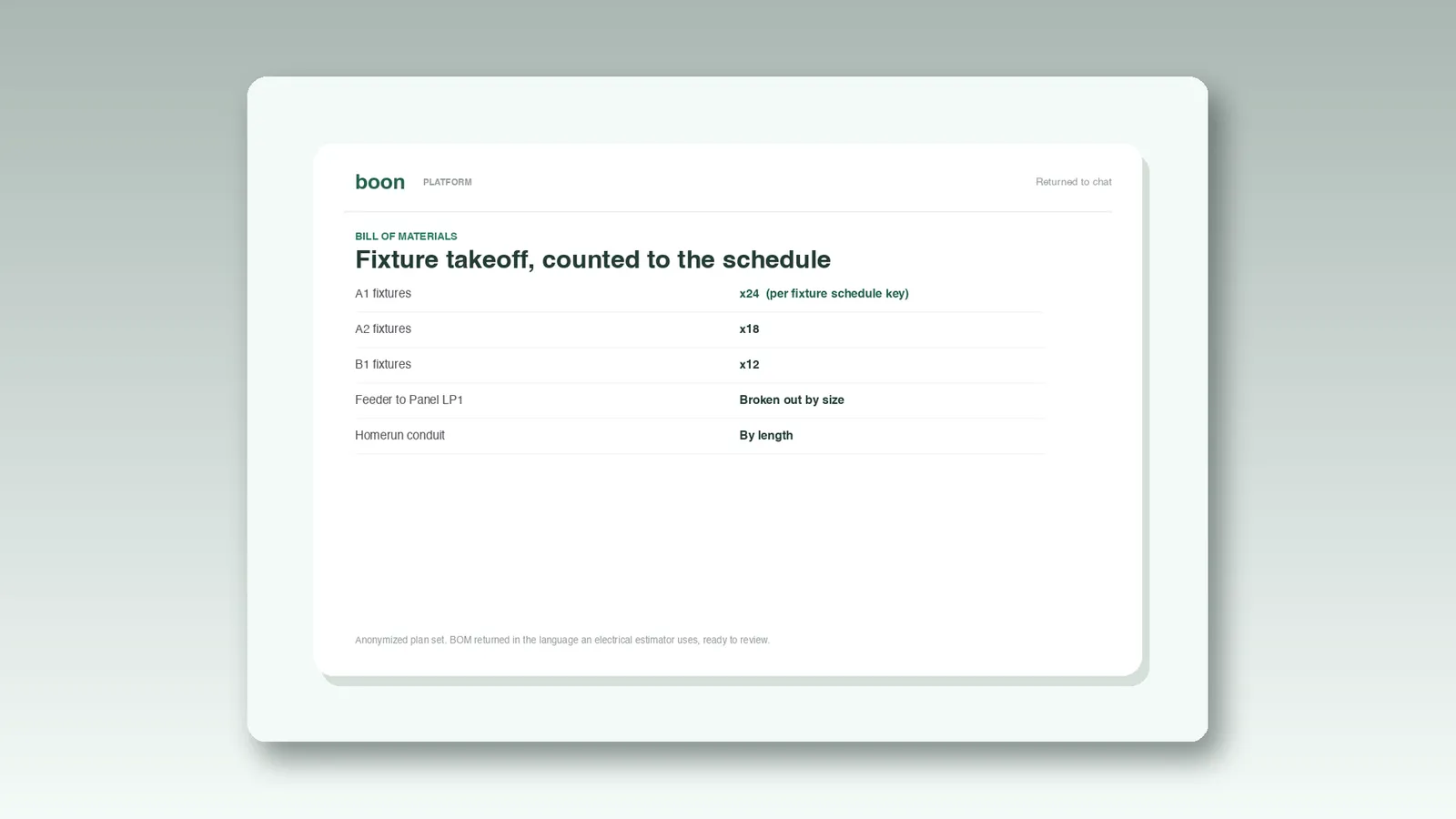
Boon returns: a bill of materials in estimator language, fixtures by type (A1 x24, A2 x18), feeders broken out by size, homeruns by length, ready to review and correct.
Where: inside the Teams or Slack your team already uses, no new tool to learn.
Run a legend-count takeoff free at getboon.ai/boon-agent
Any electrical estimator will tell you the takeoff does not start on the plans. It starts on the schedule. The fixture schedule is the key that tells you what A1 is, what A2 is, what B1 is, before you go count them across the drawings. Get the key right and the count is mechanical. Miss a type on the schedule, or misread how it maps to the plan symbols, and the whole takeoff is wrong in a way that does not show up until the job is running short.
That is the part of an MEP takeoff that is both slow and easy to get wrong: reading the schedule as the key, then walking the plans against it, then rolling it all into a bill of materials. It is hours of disciplined, repetitive counting where one misread symbol propagates through the entire number.
Six times last month, three different electrical and MEP subs asked our AI estimator to do exactly that. Read the fixture schedule as the key. Walk the plans. Hand back the BOM.
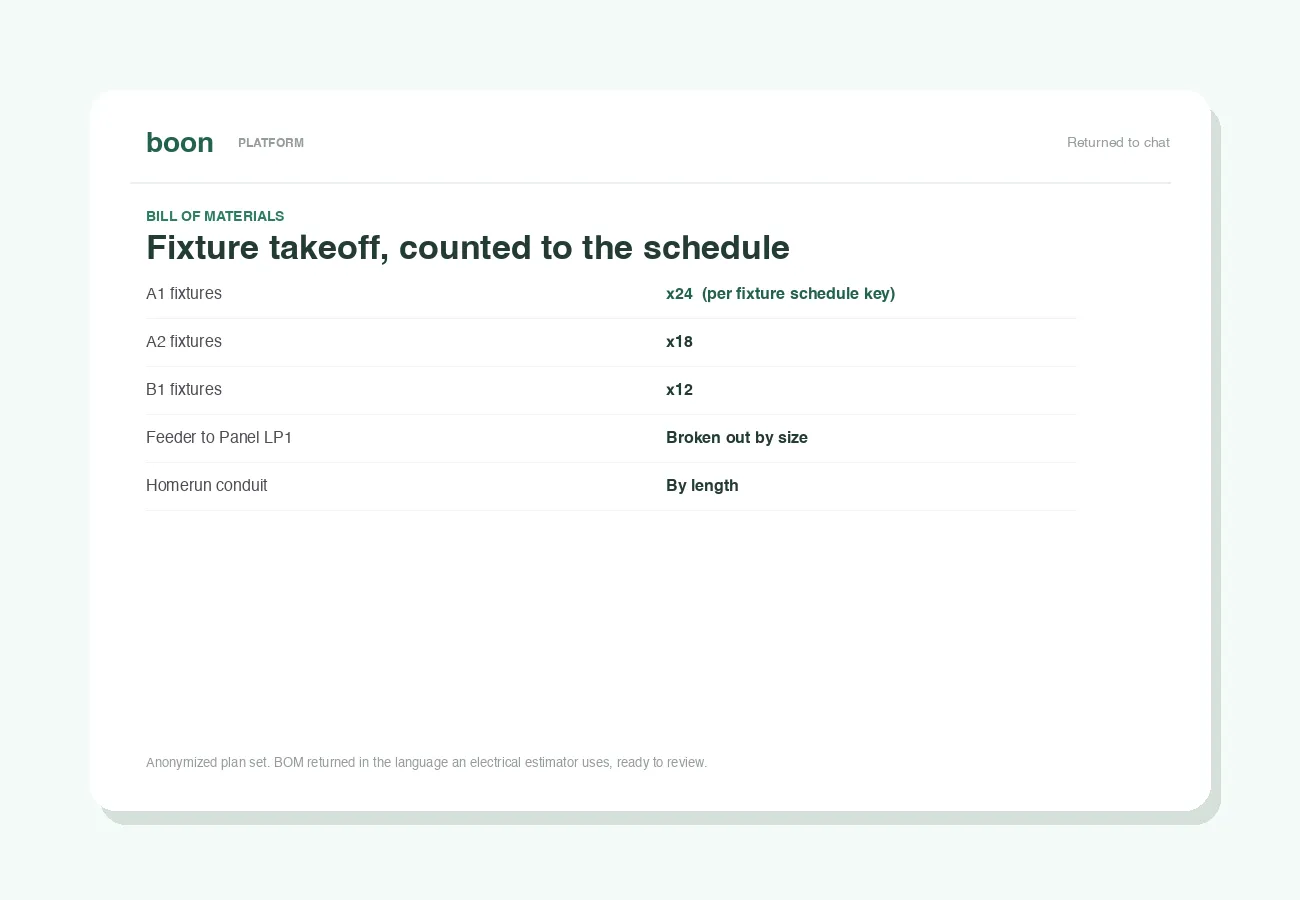
The returned deliverable, shown in product. Anonymized.
The output speaks estimator
What came back was not a generic table of shapes. It was a takeoff in the language an electrical estimator actually uses. A1 fixtures times 24. A2 times 18. B1 times 12. Feeder to Panel LP1 broken out by size. Homerun conduit by length. Receptacles by circuit.
That matters more than it sounds. A general-purpose tool can count symbols on a page, but it does not know that the fixture schedule is the key, and it does not know to break the feeder out by size or the homeruns by length, because those are trade conventions, not generic document facts. An estimator handed a count of anonymous symbols still has to do the real work of mapping them back to the schedule and the panel and the circuit. An estimator handed A1 times 24 and the feeder broken out by size has a draft they can review, correct, and use.
The estimator on these jobs did exactly that. They took the draft, checked it against their read of the set, corrected what needed correcting, and moved on to the next building. Which is the part that turned out to matter most.
The number under the number
A schedule-driven electrical takeoff on a mid-size building runs 12 to 24 hours by hand. Reading the schedule, walking every plan, counting every type, rolling up the conduit and the feeders and the devices. With the agent producing the draft, the estimator’s job becomes review, roughly two hours of checking and correcting rather than a full day-plus of counting from scratch.
That is real time returned, on the order of a senior estimator’s day per building, and I am framing that as an internal industry estimate rather than a figure any customer reported. But the time on one building is not the interesting number.
The interesting number is what happened after each of those six takeoffs. Every one of them turned into “now do the next building.” The estimator who used to spend a day and a half on one takeoff, and therefore could only get through so many bids a week, could now review a draft in a couple of hours and pick up the next set. For an MEP sub, that is the difference between the number of jobs the shop can bid with the same estimating team. Bid capacity, not headcount, is the constraint that decides how much work a sub can chase, and this moves that constraint.
Why a construction-specific agent, not a generic one
The reason the output spoke estimator is that the agent was built to read a construction set the way an electrical estimator reads it. It treats the fixture schedule as the key because that is how the trade works, not because someone asked it to in the prompt. It breaks the feeder out by size and the homeruns by length because that is what a BOM needs to be useful to a person who is going to buy the material.
A generic model produces a plausible-looking table the first time and a differently-shaped one the next time, and the estimator spends their saved time reformatting the tool’s output instead of reviewing the takeoff. Consistency in the trade’s own conventions is what makes the draft worth reviewing instead of redoing. That is why these six asks came from the same three subs repeatedly rather than as one-off experiments. It worked the way their estimators already think, so they used it again on the next building.
The teammate frame
No electrical estimator got into this trade to count symbols across 40 sheets. They got into it to build a number they can stand behind and to win work at a margin the shop can live on. The counting is the tax on getting to the judgment. Our AI estimator pays that tax, reading the schedule and walking the plans and producing the BOM, and hands the judgment back to the estimator who corrects it and owns it.
The estimator stays in the loop, because on an electrical takeoff the loop is where the money is. What changes is that they are reviewing a draft instead of building one from a blank sheet, and the next building is now something they have the hours to bid.
If you want to see a legend-count takeoff run on your own set, our AI estimator works inside the Teams and Slack your team already uses. Start here: https://www.getboon.ai/boon-agent
Acknowledgements
Thanks to the Boon preconstruction and product teams for reviewing the workflow described here.