The Boon agent working this exact use case, in product. Customer details anonymized.
Try this in Boon in about two minutes
You send: the room set with all revisions of the finish spec, with one message: “Give me a room-by-room finish scope tied to the governing spec revision.”
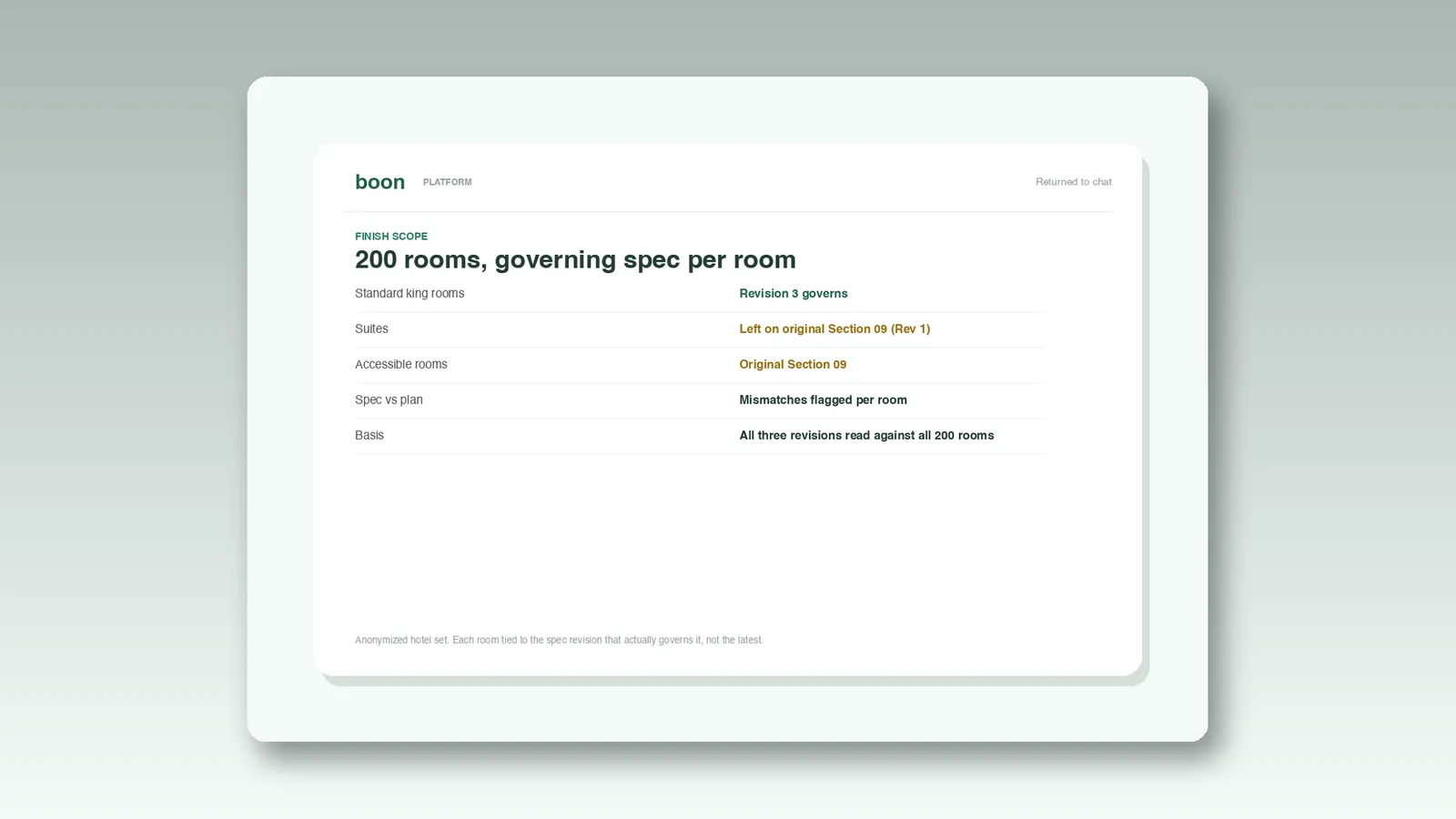
Boon returns: a room-by-room scope that ties each room to the revision that actually governs it (standard rooms on Rev 3, suites left on Rev 1), with every spec-vs-plan mismatch flagged.
Where: inside the Teams or Slack your team already uses, no new tool to learn.
Reconcile your next finish set free at getboon.ai/boon-agent
On a hotel job the finishes are the whole fight. Two hundred rooms, and the spec book has been revised three times because the owner keeps changing the carpet, then the wall covering, then the bathroom tile after the interior designer got a new sample. By the time the estimator sits down to price the finish scope, Section 09 exists in three versions, and no single one of them is right. Some rooms follow revision two, some rooms follow revision three, and the drawings reference whichever version was current when that sheet was issued.
The trap is not counting the rooms. The trap is knowing which spec revision governs which room. An estimator who prices all 200 rooms off the latest Section 09 has priced a hotel that does not exist, because the owner only revised the finishes on the standard king rooms and left the suites on the earlier spec. Miss that, and the number is wrong in a way that does not surface until submittals, when the mismatch becomes a fight about what was bid.
A senior estimator at a GC we work with sent our AI estimator a 200-room set with all three versions of Section 09 in the book and asked for one thing: a room-by-room finish scope tied back to the spec revision that actually governed each room. Not the latest spec. The governing one.
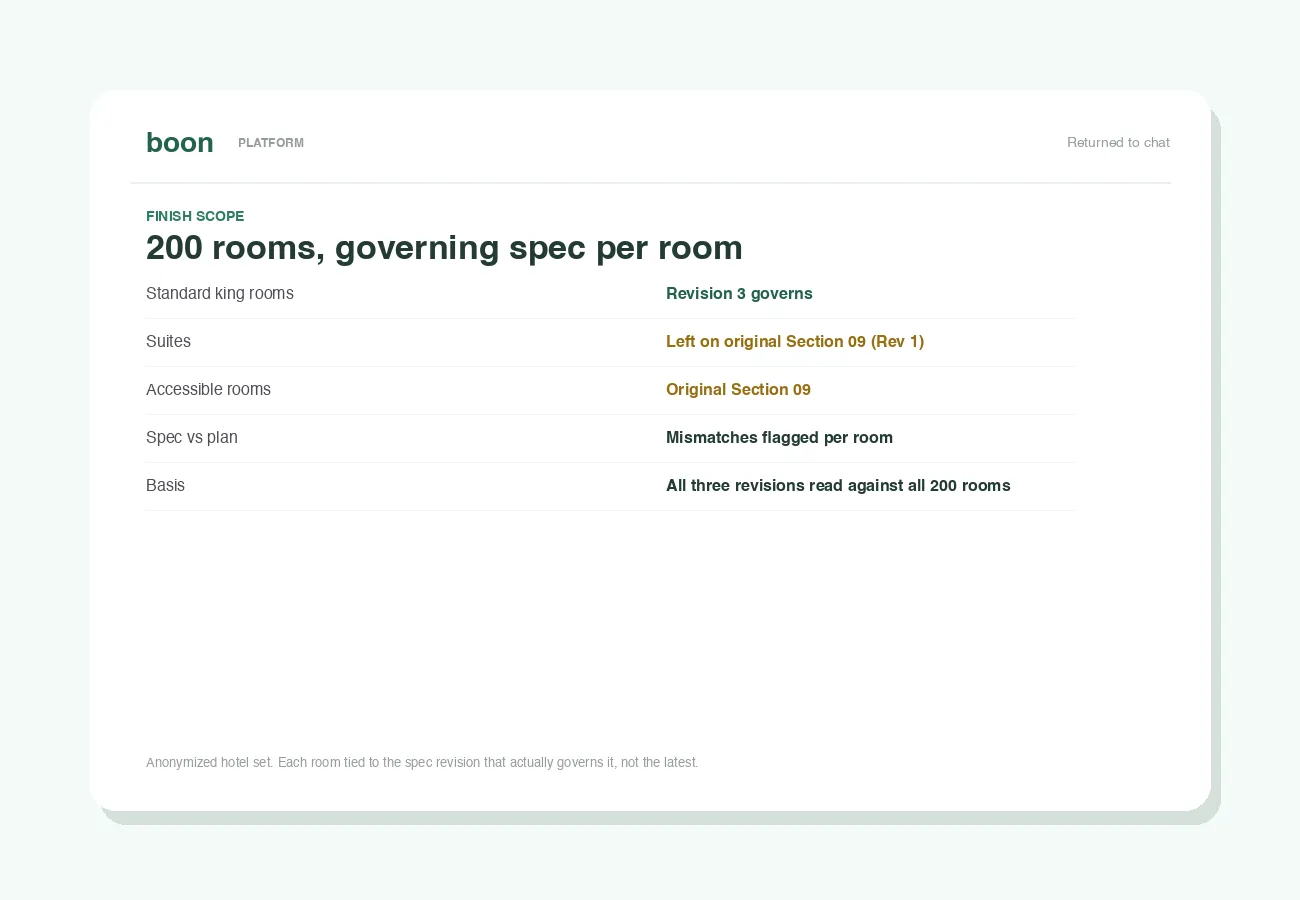
The returned deliverable, shown in product. Anonymized.
Why the revisions are the hard part
A finish walk on 200 rooms is tedious no matter what. But a finish walk across three spec revisions is a reconciliation problem, and reconciliation is where estimators lose hours and make mistakes. For each room the estimator has to figure out which revision of Section 09 was in force, cross-check that against the finish plan for that room type, and catch the places where the drawing was updated but the spec lagged, or the spec changed but the plan still shows the old callout.
Under bid pressure, what actually happens is the estimator prices off the latest spec and hopes the revisions were global. Sometimes they were. On this job they were not. The owner had revised finishes on the standard rooms twice and left the suites and the accessible rooms on the original Section 09, and the only way to know that was to read all three revisions against all 200 rooms.
That is the trap. Not that estimators do not know spec revisions matter. They know. The trap is that reconciling three revisions across 200 rooms by hand is a day and a half of work that does not fit inside a bid clock, so it gets shortcut, and the shortcut is where the mispriced suites hide.
What came back
The agent walked all 200 rooms and, for each one, cited the finish scope to the Section 09 revision that actually governed that room, not the latest one on the shelf. Where a room followed revision two, it said so. Where a room followed revision three, it said so. The places where the revisions disagreed, or where a drawing callout did not match the governing spec, landed on their own tab as exceptions for the estimator to resolve.
That exceptions tab was the part that mattered. It did not paper over the disagreements between the three revisions. It surfaced them, room by room, so the estimator could make the call on each one instead of discovering the conflict at submittal.
From walking the set to resolving the conflicts
The estimator’s job did not disappear. It moved. Instead of spending a day and a half reading three spec revisions against 200 rooms to build the scope from scratch, the estimator spent a few hours working the exceptions tab, deciding which revision governed the rooms flagged as ambiguous, and correcting the handful it read differently than they would have.
That is the shift worth naming. The mechanical reconciliation, matching each room to its governing revision, is the part the agent carries. The judgment, resolving the genuine ambiguities where the owner’s intent is not clear from the documents, is the part the estimator keeps. The estimator stops being a reader of three overlapping spec books and becomes a resolver of the conflicts between them.
The number under the reconciliation
A manual finish walk on 200 rooms with spec-revision reconciliation runs 60 to 120 hours of estimator and precon-lead time. Those are industry ranges for a hospitality finish scope of this size, not a figure this GC reported, and I’m labeling them as such. With the agent producing the draft and the exceptions tab, the estimator’s job becomes review, on the order of eight hours instead of a week-plus.
But the time returned is not the real return. The real return is the suite that got priced off the correct revision instead of the latest one. A finish-scope miss on a hotel does not stay small. It becomes a submittal fight, then a change order, then an argument about what was bid, on every room type that was priced wrong. Catching the revision mismatch at bid time is worth far more than the days of reconciliation it saved.
The teammate frame
No hospitality estimator got into this trade to figure out which of three spec revisions applied to the accessible rooms on the fourth floor. They got into it to price the job right and win it at a margin the firm can live on. The revision reconciliation is the tax on getting to a defensible finish number, and it gets shortcut under a bid clock, which is exactly when the shortcut costs the most.
Our AI estimator carries the reconciliation, matching every room to its governing spec revision and surfacing the conflicts on their own tab, and hands the judgment back to the estimator who resolves the ambiguities and owns the number. The estimator stays in the loop, because on a hotel finish scope the loop is where the margin is. What changes is that they are resolving flagged conflicts instead of building the whole reconciliation from three overlapping books.
If you want to see a finish scope reconciled across your own spec revisions, our AI estimator works inside the Teams and Slack your team already uses. Start here: https://www.getboon.ai/boon-agent
Acknowledgements
Thanks to the Boon preconstruction and product teams for reviewing the workflow described here.